The Microsoft-Nokia Deal: A Case Study in the Challenges of Cross-Cultural Mergers

In 2013, Microsoft made a bold move by acquiring Nokia’s phone business for $7.2 billion. 

During a press conference about the merger, Nokia’s CEO Stephen Elop ended his speech with the words, 

“We didn’t do anything wrong, but somehow, we lost.”

In saying this, he seemed to acknowledge that the company had failed to adapt to the evolving marketplace.

The deal was expected to bolster Microsoft’s presence in the mobile market, leveraging Nokia’s hardware prowess and Microsoft’s software expertise. 

However, unlike Geely’s acquisition of Volvo, the integration of the two companies soon revealed significant challenges, particularly in managing the cultural differences between employees from the Finnish and American firms.

Background of the Deal

The acquisition was strategic: Nokia had a strong global presence in the mobile phone market, and Microsoft needed to strengthen its position against competitors like Apple and Google. 

The merger aimed to create a seamless hardware-software ecosystem that would rival the market leaders. 

But the rub came when integrating Nokia’s employees into Microsoft’s corporate culture.

Cultural Clashes and Communication Barriers

The corporate cultures of the two companies were night and day. 

Nokia, a Finnish company, had a more egalitarian and consensus-driven approach to decision-making

Finnish employees valued autonomy, modesty, and a non-hierarchical work environment. 

In contrast, Microsoft’s culture was more top-down, with a focus on individual performance and aggressive competition.

These differences led to significant communication barriers

Finnish employees felt overwhelmed by Microsoft’s assertive communication style, which they perceived as abrasive and confrontational. 

On the other hand, Microsoft employees found Nokia’s approach too passive and slow, leading to frustration and misunderstandings.

Integration and Trust Issues

Building trust between the two groups was another major hurdle. 

Many Nokia employees were skeptical about Microsoft’s intentions and feared job losses. 

This anxiety was not unfounded, as Microsoft announced significant layoffs shortly after the acquisition, further straining relations and diminishing morale.

Efforts to unify the teams often fell short due to these underlying tensions. 

Microsoft attempted to impose its processes and practices on Nokia, which led to resistance and disengagement from Finnish employees who felt their expertise and methods were undervalued.

Strategic Misalignments

Beyond cultural integration, there were also strategic misalignments. 

Nokia had been focused on producing hardware, while Microsoft’s expertise lay in software. 

Bridging this gap required not just cultural integration but also a harmonization of business strategies.

Unfortunately, these efforts were hampered by the ongoing cultural friction, leading to delays and suboptimal product development.

A Failed Experiment: Lessons Learned

The Microsoft-Nokia acquisition serves as a cautionary tale about the complexities of cross-cultural integration. 

It underscores the importance of cultural due diligence in mergers and acquisitions.

It’s not enough to align business goals; companies must also consider the cultural compatibility of their workforces. 

Effective communication, mutual respect, and a willingness to adapt are crucial for successful integration.

To mitigate such issues, companies can implement cross-cultural training programs, establish clear communication channels, and promote a culture of inclusivity and collaboration. 

By valuing and integrating diverse perspectives, organizations can turn cultural differences into strengths rather than obstacles.

While the deal had strong strategic merits, the failure to effectively manage cultural differences ultimately undercut the intended synergies. 

Does Cross-Cultural Competency Improve Job Performance?

Organizations may hire expatriates in high-tech positions based on their technological aptitude rather than on their cross-cultural or personal merit.

On the other end, expatriates may accept a position without being cross-culturally competent or familiar with the country.

A study of expatriates in the high-tech industry reveals some interesting findings on the subject.

Let’s take a look.

What is Cross-Cultural Competency?

The study defines cross-cultural competence as follows:

“the ability of individuals to work effectively and live normally in different cultural contexts, and…to adopt adaptive thinking patterns and behaviors in the host country.”

Using collected questionnaire survey data, the study identifies expatriate challenges in their new role and proposes ways in which expatriates can adjust psychologically.

Challenges

Challenges to expatriates include:

When these challenges lead to excessive pressure, psychological and even physical symptoms can occur.

That isn’t to say that all pressure is bad, however. 

An appropriate application of pressure can drive employees to progress in their work smoothly and help the adaptation process.

How Adaptation Can Help

Those expatriate employees who adapt to their host country’s culture and customs participate more in the workplace and find more ways to alleviate stress.

Moreover, those employees with high cross-cultural competency also adjust to their host country more smoothly and have a higher job performance.

Setback Period

There is a setback period when expatriates first begin working in their new role.

Unforeseen situations coupled with cultural incompetency and potential incomplete assignments lead to wariness of expatriate employees.

The expatriate needs to navigate the setback period successfully in order to adapt to their cross-cultural environment and achieve in their job performance.

Cross-cultural skills will help this transition, as the expatriate will sooner accept the foreign culture, the environment, and their co-workers.

The Study’s Findings

To achieve cross-cultural competence, the expatriate must initially recognize the differences between old and new environments in order to spot potential conflicts between the two and find ways to overcome them in order to integrate.

Using the reported data, the study found that the stronger an expatriate employee’s level of cross-cultural competence, the better their performance in both the host country and in their job.

Job involvement is also improved by the employee’s ability to adjust to customs. 

This is likely due to the fact that those who can adjust to the host country generally release more work stress and enjoy greater life satisfaction.

Moreover, those able to adjust to work contexts better feel less frustrated and achieve more in their role.

An accumulation of negative pressures can lead to poor job performance, while positive pressures can drive expatriates to achieve individual and work success.

The bottom line is: cross-cultural competency can improve job performance by smoothing the transition and reducing stress.

Returning Home: What Impacts the Degree to Which You Feel Reverse Culture Shock?

You are returning home after spending five years living in Ukraine – a country to which you’ve adapted and adopted to a certain degree.

You’ve had to balance your home-grown values with your host country’s; you’ve altered your norms wherever you could in order to integrate properly.

For instance, you don’t smile in public as much anymore. It was drilled into your head that those who smile at strangers in Ukraine are believed to have a screw loose.

And now you’re returning home. Back to the familiar.

Home sweet home.

And you’re still not smiling.

Home is NOT So Sweet

Reverse culture shock is the upset that you feel upon returning to your home country.

When you step off that airplane, everybody is smiling. But your face is stuck in its deadpan of Ukrainian stoicism.

It’s like returning to your childhood bedroom after college – everything comes flooding back to you and, yet, feels distant and detached.

After all, it’s all familiar, from the language to the people to the foods and the streets.

There’s only one problem: everything is the same, but YOU are different.

You are returning from your second home: your host country – a place to which you spent a lot of time and energy adapting.

You learned the language, you learned the history, you learned the religion.

You knew and began to understand the culture.

So, now, upon trying to sleep in your old bed, you’re like Goldilocks.

It just doesn’t feel right.

It may be the case that some things have changed too – new pillows, a scratchy bedspread – and your once-familiar bedroom wasn’t what you were expecting.

You realize your home no longer feels like home.

This complex mix of feelings all contributes to reverse culture shock.

Degrees of Reverse Culture Shock

The U.S. Department of State details some aspects that impact the degree to which those who return from abroad feel reverse culture shock.

Taken from Craig Storti’s book, The Art of Coming Home, the following may affect your experience of this shock:

  • Voluntary and expected reentry – whether you voluntarily or involuntarily reenter and/or whether you expected to reenter or did not can impact the degree of shock. Involuntary and unexpected reentry results in greater shock.
  • Experience – if you’ve had previous reentry experience from a foreign country, the shock is generally milder.
  • Age – older people often have an easier time at reentering due to more experience with general life transitions.
  • Extent of differences between the two cultures – the more different your home culture is from your host culture, the more difficult reentry can be.
  • Length of time spent in host country – the longer your duration overseas, the harder the return may be, as you will have adapted to your host country to a greater extent.
  • Amount and degree of interaction with your host country culture and your home culture during your time abroad – the more time and intimacy with your host culture, the harder it will be to leave; likewise, the more time and the degree to which you’ve interacted with your home culture, the easier it will be to reenter.
  • Environment of reentry – supportive and familiar environments make reentry easier. Returning to conflict, instability, or uncertainty will increase the shock, as will the lack of a support system.

Consider these aspects to gauge how difficult it might be to return home. This will help you prepare for the impact.

Let It Happen, and Drink Strong Tea: Factors that Affect Cultural Integration

The process of integrating into a new culture has its ups and downs.

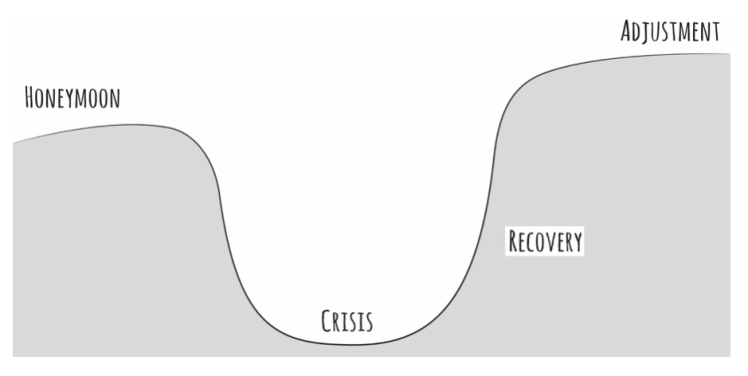
We talked last week about the U-curve – that theoretical interation period that comes in four clean stages: 1) Honeymoon, 2) Crisis, 3) Recovery, and 4) Adjustment.

While many do experience these four stages when moving to a new country, they often aren’t as clear-cut as the chart would suggest.

Instead, they might look more like this:

This is what Marie, an expat culture blogger, drew to represent her cross-cultural experience.

She wrote:

“Even when I was completely in love with my host country, there were tough times. It was a lot like raising children, in fact: I love my kids more than life itself, but there are plenty of days when I’m convinced I’ll never get the hang of this parenting thing. And then the sun comes out again, and life is good.”

Like Marie, you might feel a true love for your host country, but you’ll most certainly experience failures and setbacks.

But, don’t worry, the sun will come out again.

Factors That Impact Integration

There is no time table for cross-cultural integration.

The process may tie you up in knots, and it won’t happen on a predictable schedule. 

And that’s because many factors come into play that can be out of your control.

These factors include but are not limited to:

These are just a few factors that play into the process of cross-cultural integration.

Some are within your ability to control; others are not.

Adapt at Your Own Pace

Each person adapts at their own pace, and the process is unpredictable.

While you will definitely have moments of happiness and bliss in your new culture, you’ll also face challenges you’ve never faced before which may fill you with dread and uncertainty.

Speaking another language. Making foreign friends. Adapting to social norms.

You will see progress, but sometimes, you’ll feel stalled.

This will make you frustrated and even depressed.

There’s no avoiding the hurdles altogether; they’re there, and you will have to find the will to jump them.

So, when faced with them, take a breath of African fatalism:

Let it happen, and drink strong tea.

Remember that this process is normal, and in a couple of years, if all goes according to plan, you’ll feel right at home in your new home.

And those hurdles that seemed like abrupt speed bumps at the time will look like nothing more than rumble strips in your rearview.

Expats Abroad: What Category Do You Fall Into?

In your experiences as a foreigner abroad, you’ve probably noticed that not all expats are alike.

Some keep to themselves, some mingle with other expats on the weekends, some are entrenched in local culture.

In fact, you might see that expats fall into three general categories.

Can you identify your fellow foreigners abroad in these descriptions?

Diplomats

Diplomats country-hop, spending short stints in each country – enough time to do business and make friends, but solely with their own compatriots for the most part.

In fact, official diplomats are often this type, as most countries dissuade their diplomats from getting involved in local economics and politics.

Because of this, diplomats are moved to new countries every couple years, never truly setting down roots.

Another reason for a diplomat’s narrow circle is that their main job is to take care of their nationals in foreign countries.

Although you may not be an official diplomat, you may still fall into the diplomat category in your approach to integration if you tend not to fraternize much with the locals.

Internationals

Internationals flock together.

They’re those expats who don’t stray much from the expat community.

French, English, German (often those of Western cultures) – they are a tight-knit group, developing an international circle within whatever host country they might call home. 

If they have kids, their kids go to international private schools.

If they go to church, they attend service at their international church.

Although these mixed international expat communities are interesting and, often, welcoming, they’re not locals.

They can offer you valuable advice about the local community, practical details about settling in, and examples of cultural barriers you may face, but their views are often tainted, particularly if they’ve lived in this host culture for a long time.

With time, they’ve dealt with a myriad of cross-cultural conflicts that you might not necessarily confront, so any cautionary tales and cynicism about the culture should be taken with a grain of salt.

Don’t take anyone’s subjective experience as fact, as it often comes with their own personal baggage. 

Do not discredit their experience, but refrain from holding fast to opinions before building your own.

Expat cynicism is real, so do your best to start the painting of your own cross-cultural experience with a blank canvas.

Localizers

Localizers are the category that you’ll ideally try to fit into as an expat or foreign manager.

Localizers seek out local friendships.

They intend to integrate into the local culture and build a home away from home.

Their goals are to appreciate, understand, and respect differences in culture – so much so as to adopt some of its values, attitudes, and behaviors.

Those who fall into this category tend to learn the culture more quickly than do those in the other two categories.

This is because they get their hands dirty. They rely on their own experiences and their relationships with local people to truly see and understand the culture. 

Localizers take to heart what it really means to adapt and adopt as a person of the world.

Next week, we’ll talk about strategies to becoming a localizer.

Sharing Culture: Why Local Friends Are Important to Foreign Managers

You work for an international company that relocates you to Beijing, China.

Having never been to China and knowing little about the culture, you feel like a fish out of water.

Nothing is familiar to you; the lay of the land, the crowds, the language on street signs.

You think of home – your family/friends, your favorite haunts, your favorite foods – and you immediately feel homesick.

But you know your success in this foreign country depends on building your own home here, even if it’s temporary. 

It depends on your ability to integrate.

And to aid that integration, you begin your friend-finding mission.

Expat Community

The first people you meet are, of course, your colleagues, some of whom are expats from your own country.

You join them for trivia night at a bar that caters to foreigners, and they introduce you to the broader expat community.

This community makes you feel immediately comfortable. 

They laugh at your jokes, understand your references – they understand YOU.

The group is familiar. It’s home. 

It’s easy to choose comfort and familiarity over differences that may generate potential conflict.

With people of your own culture, you’re not navigating a cross-cultural minefield; you generally know where the mines are and you avoid them.

But if you want to truly integrate into a foreign culture, you cannot self-segregate, sticking to your own flock.

You must migrate into unknown territories.

Cross-cultural Friendships Over Comfort

This is not to say you shouldn’t make expat friends.

In fact, these friendships often evolve into lifelong friendships and are also helpful to your cultural integration.

But when you avoid making local friends altogether, you’re losing out on an important part of living in a foreign culture: sharing.

Sharing culture not only allows you to better understand your employees and direct reports, as you better understand the culture you’re managing in; it also shows them that you care.

Without respect and a genuine interest in the culture and its people, you won’t connect with your local colleagues and employees. 

They will note that you haven’t sought out any significant cultural experiences in your new home.

They will note that you don’t bother with the language, the customs, or anything else.

They will note that you stick to your own flock and don’t show interest in making friends or sharing culture with the locals.

As with anything, you’ll only get out of your experience abroad what you make of it.

You can choose to stay in your bubble and never expand your comfort zone.

Or you can choose to share in a new culture, meet new people, appreciate new ideas and traditions, and ultimately broaden your horizons.

Next week, we’ll talk about the three types of expatriates, and you can decide which category you want to fall into.

Learning a Culture: From Scholastic Learning to Experiential Learning

Over the past few weeks, we’ve spent a lot of time discussing how important learning the language, religion, and history of your host culture is.

This conscious, and often scholastic, learning process requires time, energy, and discipline in ways that may make you feel like you’re back at school.

It can oftentimes be a tough process, requiring many studious hours logged. After all, you’re investing in educating yourself about an entire culture.

But don’t worry, not all cultural learning will require you to dust off the books. Some of it – and some might say the most important part of it – is experiential.

Learning Through Sharing

You are not going to learn the power and emotion of Spanish flamenco watching it on YouTube.

You are not going to learn the colloquial idioms of Portuguese by memorizing by rote.

You are not going to learn how to make Italian pasta by hand without getting your hands dirty (or flour-y).

Learning culture is an experiential process and, without learning by sharing, you’ll be missing out on all the warmth of learning culture.

Cultures are not two-dimensional. They are living and breathing; they must be experienced in-the-round.

Immersion for Integration

“Instead of having 100 rubles, it’s better to have 100 friends.”

That’s what a Russian proverb says.

And foreign friends will be so much more valuable to you than rubles, as they will be able to show you their cultural behaviors, tell you their history, and teach you their traditions better than any book can.

Making friends is an investment in your cultural integration, as it allows immersion learning.

This type of learning involves sharing time and food and language with local friends.

Whether you’re an expatriate living in your host country or an international manager traveling abroad often, local friends will make learning fun rather than book work.

Not only will local friends make you culturally savvy, but they’re likely to expose you to local entertainment and opportunities that you wouldn’t have been privy to on your own.

And, even better, you’ll build life-long relationships in the process.

Sink or Swim: How to Stay Afloat When Thrown Off the Deep-end of a Foreign Culture

Whether you’re an expat adapting to a foreign country or an international manager in one’s own country working in a multicultural environment, you must ready yourself for integration.

To integrate means to “bring together and become part of a whole.”

As a foreign or international manager, it’s your duty to bring your team together – to make it a cohesive whole – and you can do this by taking action.

Sink or Swim

Just as you prepare yourself for negotiations, coming up with your objectives and the strategy you might use to achieve them, you must also prepare yourself for integration into a foreign culture.

As with every aspect of meticulously planned business – from putting together engaging presentations that appeal to clients to scheduling your time down to the minute – a cross-cultural business venture requires an extra layer of planning: preparing for the cultural differences and those potential monkey moments that accompany them.

Depending on your organization, you might not even receive cross-cultural skills training prior to departure.

This leaves you two options: take it upon yourself to prepare beforehand or just wing it when you arrive in your host country.

Either way, your host country colleagues and the friends you make will essentially become your “trainers,” while your entire host country – from its local streets, shops, and restaurants to your workplace itself – will be your training venue.

Daily interactions with locals, friends, and colleagues will become hands-on training.

You’ll be thrown in the deep-end and told to sink or swim.

Here’s how you swim.

Learn How to Prepare

In order to successfully swim when thrown off the deep-end, you must eliminate, as much as you possibly can, the culture shock.

This phase is called “Taking Action.”

Taking action involves a conscious effort to adapt smoothly and quickly, avoiding monkey moments in the process.

Being that you’ve already taken the first step of cross-cultural integration – Awareness – you’re already able to reduce cultural monkey moments by following the next steps: Accepting, Adapting, or Adopting.

Accepting, Adapting, and Adopting are generic steps that help you integrate into any culture. 

However, knowing the culture in which you’ll be living, you can take specific action to prepare yourself, for example, by learning the cultural values and norms prior to arrival.

In the next few weeks, this blog will discuss a general methodology to efficiently learn the scope of a new culture.

Adapting: The Second Step in Cross-Cultural Management

Over the last few weeks, we’ve laid out the first step of cross-cultural management: acceptance.

Accepting another’s culture, values, and norms as different than your own, while foregoing judgment, accepting ambiguity, tolerating actively, and explaining yourself is the best way to get your toes wet in a new culture.

But we have yet to talk about wading into the shallows of the culture in the form of adapting.

If you dig in your heels at acceptance, then your degree of cross-cultural integration is limited. 

Doing so will certainly help you blend into your host culture, particularly as a manager;  however, at some point, you will find that you must adapt to some aspects of the new culture, or you’ll be forever an outsider.

As the German manager did in his Swiss company, taking your integration a step further by altering your behavior will make the culture accept you.

This is called adapting.

Adapting

First of all, how is adapting different than adopting?

Adapting involves changing your behavior but not your values.

For instance, you are being hosted by a country that bows in greeting as opposed to shaking hands.

As a courtesy, you adapt to this behavior. You bow.

But no doubt, your values haven’t changed; shaking hands is still your preferred greeting based upon your values.

Working across cultures, you might choose to accept and adapt those behaviors whose values are valid and do not impose on your own.

After all, a change in values involves a significant life-altering transformation. More often than not, that takes time.

While such a transformation may come, depending upon how long you remain in your host country and how impacted you are by their culture, until that impact happens, small adaptions will show your hosts that you respect their culture and are making an attempt to integrate where you can.

Cost/Value

The bottom line when deciding what to adapt to and what to simply accept is drawn by the personal cost to you versus the value behavioral changes may add to your life in this new culture and your success as a manager.

Does adhering to the culture’s dress code come at a significant cost to you? Does the value of “fitting in” outweigh whatever cost that may be?

Those values and norms which are not in direct contradiction to your own culture’s should be easy enough to adapt and should be what you actively implement first.

Although the behavior may feel unfamiliar (greeting your French colleague by a kiss on both cheeks, for instance), after normal processing, such behaviors will feel more or less natural.

In fact, give it time, and you may not even notice you’ve adapted to another culture.

Next week, we’ll discuss the type of adaptions that you will notice and how to get over that discomfort. Stay tuned.

Respect Culture: How to Respond to Norms that Make You Uncomfortable

What does respect mean to you?

In the face of disagreement, in the face of, perhaps, discomfort or even anger, what does it mean to respect someone with whom you do not share values or norms?

An example:

You’re Japanese, and you’ve moved to Spain. The Spanish are a warm, open and friendly culture. A kiss on both cheeks is a common greeting, whether you’re a friend or a stranger being met for the first time.

This social norm is not only one you’re not used to; it’s one that makes you incredibly uncomfortable.

What do you do?

Discomfort

I actually know a Japanese woman who struggled with this exact scenario.

She was the wife of a diplomat who had recently transferred to Spain. I met her at a language school.

Not only did she grow up in a culture that is as far removed from Spain as it possibly can be, she was also born to an aristocratic family, so her upbringing was even more disciplined than most. From childhood, she had been taught that public spaces and situations were not the place for physical human contact.

Remember: the Japanese greeting is a bow. A handshake is even too intimate. So, imagine then transitioning into a country in which men and women engage in this public display of affectionate greeting.

A kiss on both cheeks seemed too much for her to bear.

Tolerate, Comply and/or Explain

According to LQ Williams of Owlcation:

“Tolerance is the recognition of the universal human rights and freedoms of others… and the recognition of the value of differences without judgement.”

Tolerance, in essence, is respecting diversity, the world over. Despite feeling uncomfortable with certain cultural norms, you can still demonstrate your tolerance and respect for the culture by complying with other cultural behaviors.

In my Japanese friend’s case, she was taking this step: she was actively trying to learn the language.

Lastly, if you find yourself between a rock and a hard place – that is, between an attempt to integrate into the culture and your discomfort with some of this culture’s social norms and values – then explaining yourself goes a long way.

As Core Languages notes: “Often, just trying to be culturally sensitive is appreciated. Even if you don’t execute well, you’ve taken the time to learn about another and invested in a relationship.”

Who knows – maybe somewhere down the road, you’ll become comfortable with those norms that were initially a roadblock for you, just like my Japanese friend did.

Instead of only accepting the norm, she chose to overcome her deep level of physical discomfort and adapt.

These are some of the battles you may face when living and working in a foreign country. It’s up to you where you draw the line.

But know that in some cases, if you draw the line too close to your own cultural comfort, you may be impeding yourself from successful cross cultural integration.