Attachment Styles & Culture: Are You Secure?

Attachment styles are psychological frameworks that describe how we form and maintain emotional bonds with others, particularly in close relationships

These styles are typically developed in early childhood through interactions with caregivers and can significantly influence how we relate to others throughout our lives. 

A 1986 study by Takahashi found that, when using Western attachment style classifications, double the number of Japanese infants were categorized as insecure-resistant when compared with American babies. 

This raises an important question: Are Japanese infants more prone to forming unhealthy attachments, or is the classification system skewed by ethnocentricity?

This issue highlights the need to understand cultural variations in attachment and the complexities involved in studying attachment across different cultures.

Attachment Varies by Culture

Attachment theory in psychology investigates whether attachment styles differ based on cultural practices or whether they are universal

According to Bowlby’s Monotropic Theory of Attachment, attachment is an inherent mechanism that ensures infants bond with their caregivers for survival

He argued that this attachment serves as a template, or “internal working model,” for all future relationships.

Bowlby’s theory suggests that the drive to develop a secure attachment is a biological, universal trait found in all human infants.

However, many scholars have criticized Bowlby for failing to consider cultural variations in child-rearing practices. 

These cultural differences can significantly influence attachment styles, suggesting that attachment may not be as biologically determined as Bowlby proposed. 

In cultures where different social norms around caregiving exist, attachment behaviors may reflect those norms rather than innate patterns. 

For instance, some cultures might encourage more physical closeness or independence, which could lead to different attachment behaviors.

Assessing Attachment

Mary Ainsworth’s “Strange Situation” is the primary method for assessing attachment styles in infants. 

In this procedure, an infant’s behavior is observed during a series of interactions, such as when a caregiver exits the room, when the infant is left with a stranger, and when the caregiver returns. 

Based on their responses, infants are classified into three categories: secure, insecure-avoidant, or insecure-resistant. 

While the Strange Situation has been extensively used in the U.S. and Europe, it was developed based on middle-class, Western family dynamics, which may not capture the nuances of attachment in non-Western cultures. 

For instance, behaviors classified as insecure-resistant in Japan, such as clinging to a parent, might simply reflect cultural norms of close physical proximity between mother and child.

Cross-Cultural Studies

To explore the validity of Bowlby’s claims, studies have been conducted to compare attachment styles across cultures. 

Cultural variations in attachment refer to differences in social norms around caregiving and how these influence attachment styles. 

These variations can challenge the idea that all infants form attachments in the same way. 

For example, research by Van Ijzendoorn and Kroonenberg compared attachment styles across eight countries, showing significant cross-cultural differences. 

While American infants predominantly exhibited secure attachments (as defined by Western standards), other cultures displayed different attachment patterns without negative consequences for children’s emotional development.

Cultural variations in attachment challenge the assumption that attachment styles are universal. 

We’ll explore this further next week.

Take a Pause: Cultural Variations in Conversation Between Germany and Japan

When it comes to communication, what isn’t said can be just as important as what is spoken. 

The subtle art of pausing during a conversation is a powerful tool that varies greatly across cultures.

Understanding differences in pause perception can provide valuable insights, especially when developing virtual agents designed to interact with humans in culturally diverse settings

A recent study comparing the use of pauses in speech between German and Japanese speakers sheds light on these differences, offering fascinating glimpses into how silence is wielded in communication across these two cultures.

The Role of Pauses in Communication

Pauses are more than mere breaks in speech; they are a form of non-verbal communication that can convey a range of meanings, from contemplation to hesitation, or even respect. 

In certain cultural contexts, pauses can signal deep thought, while in others, they may cause discomfort or impatience. 

This study sought to understand how pauses are used differently by German and Japanese speakers, with the ultimate goal of integrating these insights into the behavior of virtual agents to improve their cultural adaptability.

The Study: German vs. Japanese Use of Pauses

Researchers analyzed speech patterns using the CUBE-G video corpus, focusing on interactions between German and Japanese speakers. 

In a preliminary study, they observed pauses in eight video samples from each culture, each approximately five minutes long. 

They measured pauses lasting over one second and those over two seconds, comparing the frequency and duration of these pauses between the two cultures.

The results were striking: Japanese participants used significantly more pauses than their German counterparts, both in terms of frequency and duration.

Japanese speakers averaged 31 pauses longer than one second and 8.4 pauses over two seconds per video, while German speakers averaged 7.1 and 1.3 pauses, respectively. 

These findings align with the theory that Japanese culture, being a high-context culture, relies heavily on non-verbal cues like pauses to convey meaning. 

In contrast, Germany, a low-context culture, values explicit verbal communication, often viewing pauses as awkward or unnecessary.

Cultural Contexts: High vs. Low Context Communication

The concept of high-context and low-context cultures plays a crucial role in understanding these differences. 

In high-context cultures like Japan, much of the communication is implicit, relying on shared cultural knowledge, non-verbal cues, and the context in which the conversation occurs. 

Pauses in speech are often used to reflect on the conversation and allow the speaker to consider their response carefully.

In contrast, low-context cultures like Germany prioritize clear and direct communication. 

Here, pauses might be interpreted as a lack of clarity or confidence. 

As a result, German speakers tend to avoid lengthy pauses, striving for continuous, unambiguous conversation.

Implications for Virtual Agents

These cultural differences in the use of pauses have significant implications for the development of virtual agents designed to engage with humans. 

By understanding how different cultures perceive pauses, developers can create virtual agents that adapt their conversation styles to better align with cultural expectations, improving user experience and acceptance.

Future research might explore the specific contexts in which pauses occur, who breaks the silence, and how these pauses influence the flow of conversation.

Big Issues with Small Talk Across Cultures: Germany vs. Japan Watercooler Rules

Image credit: John Brooks

Sarah, a marketing executive from Berlin, is attending a business conference in Tokyo. 

As she enters the crowded conference hall, she spots Hiroshi, a senior executive from a leading Japanese corporation, standing alone by the refreshment table. 

Eager to make a good impression, Sarah approaches Hiroshi with a warm smile and a casual greeting.

“Guten Tag, Hiroshi! Wie geht es Ihnen?” Sarah asks (“Hello, Hiroshi! How are you doing?”), extending her hand for a shake.

Hiroshi, taken aback by Sarah’s directness and informal demeanor, hesitates before responding with a polite nod. 

“Es geht mir gut, danke,” he replies (“I’m fine, thanks”), his tone reserved and formal.

Sarah is completely bewildered by his demeanor. But unbeknownst to her, her attempt at small talk has inadvertently breached cultural norms

In Japanese business culture, casual inquiries about personal well-being are uncommon, especially when first meeting someone in a professional setting. 

Instead, initial interactions typically focus on exchanging business cards and discussing neutral topics related to the conference agenda.

As Sarah and Hiroshi navigate this cultural disconnect, they highlight the topic of a German study centered around chatbots. 

Chatbot Study

Researchers sought to explore how cultural differences influence small talk by using chatbots programmed to engage in culture-specific casual dialogue. 

They focused on comparing the small talk practices of Japanese and German participants, two cultures known for their distinct communication styles.

To conduct the study, researchers set up simulated conversations between pairs of German and Japanese individuals using these chatbots. 

They carefully observed and analyzed the interactions between the participants to identify cultural differences in small talk behavior

Based on their observations, they programmed the chatbots to reflect these cultural nuances in their dialogue.

After programming the virtual agents, the researchers asked German participants to observe pairs of German and Japanese virtual agents engaging in small talk and rate which conversations they found more appropriate or interesting. 

This allowed the researchers to gauge the participants’ perceptions of small talk behaviors across cultures.

The Results

The results of the study revealed several interesting findings. 

German observers tended to interpret the Japanese participants’ small talk style, which focused on commenting on the immediate environment and avoiding personal discussions, as “distant” and “superficial.” 

In contrast, they perceived the more familiar German tendency to discuss personal topics as indicative of greater interest in their conversation partner.

Additionally, the study highlighted cultural variations in the perceived value of small talk. 

While some cultures, like the Germans, may place importance on engaging in personal discussions as a way to express interest and build rapport, others, such as the Japanese, may prioritize maintaining a polite and respectful distance, particularly in initial interactions.

Overall, the study demonstrated how cultural misunderstandings and assumptions can arise in seemingly innocuous social situations like small talk. 

By using chatbots to simulate cross-cultural interactions, the researchers were able to shed light on the stark differences in communication styles and the importance of cultural sensitivity in social interactions.

Building Bonds Across Borders: The Crucial Role of Trust in Cross-Cultural Negotiations

Who do you trust? And why?

The answer may be partially rooted in your culture.

Through two eye-opening experiments in a study on cross-cultural differences in trust, researchers examined how people from different cultures build trust with strangers

They focused on Americans and Japanese, expecting their trust-building methods to differ. 

And they were right.

American vs. Japanese Trust

For Americans, trust was thought to come from shared group memberships, while for Japanese, it was about having direct or indirect connections with others.

The results confirmed these ideas. 

In both experiments – one involving questions and the other a money-sharing game – Americans trusted people from their in-group more. 

But for the Japanese, something interesting happened: when there was a chance of having an indirect connection with someone outside their group, their trust increased even more than for Americans.

These findings show how cultural backgrounds shape the way we trust others. 

For Americans, it’s about being part of the same group, while for Japanese, it’s more about having connections, even if they’re not direct. 

Understanding these differences is crucial for better communication and relationships across cultures.

And for negotiations.

Understanding the Significance of Trust

In cross-cultural negotiations, trust goes beyond mere reliance on promises or assurances; it reflects a deep-seated belief in the integrity, credibility, and goodwill of one’s counterparts. 

Trust fosters open communication, facilitates collaboration, and enhances the likelihood of reaching mutually satisfactory outcomes. 

Without trust, negotiations may stall, misunderstandings may arise, and relationships may falter.

Strategies for Building Trust Across Cultural Divides

Think about what you learned in the earlier study.

Before negotiations commence, you might consider researching how the culture views trust and attempting to adapt to that view

For instance, let’s say you’re a businessperson from the United States negotiating a deal with a company based in Japan. 

In American culture, trust might be primarily based on shared goals or business interests. 

However, in Japanese culture, trust is often built through personal connections and relationships.

To adapt to the Japanese cultural sense of trust, you might prioritize building rapport and establishing personal connections before diving into business discussions. 

This could involve taking the time to engage in small talk, showing genuine interest in your Japanese counterparts’ backgrounds and interests, and demonstrating respect for their cultural norms and customs.

By understanding and adapting to the Japanese view of trust, you can lay the foundation for a more productive and harmonious negotiation process, ultimately increasing the likelihood of reaching a mutually beneficial agreement.

We’ll discuss more strategies for building trust next week.

Cultural Mirrors: Behaviors and Self-Views Across Borders

What shapes us?

Self-construal theory (Markus and Kitayama, 1991) poses that our feelings, thoughts, and behaviors are shaped by the tapestry of cultural self-views. 

Two dimensions emerge: the independent and interdependent self-construals.

These construals are the basis for this cross-cultural comparison of behaviors of Japanese, Australian, and Canadian university students.

These three groups were asked to complete an independent and interdependent cultural self construal scale.

After a week, they rated their past behavior.

The findings reveal a compelling pattern.

Cultural Heritage

The interdependent behavior score exhibits a positive correlation with interdependent self-construal scores, while displaying a negative correlation with independent self-construal scores.

Japanese participants, true to their cultural heritage, report a greater inclination toward interdependent behaviors than their Canadian and European Australian counterparts. 

Yet, within the Canadian context, the plot thickens. 

Asian Canadians, with their unique fusion of cultural influences, exhibit a stronger tendency toward interdependence than their European Canadian peers. 

These revelations support Markus and Kitayama’s cultural self-construal hypothesis.

However, there’s a twist. 

The self-view measures, while expected to follow suit, defied the study’s hypothesis. 

European Canadians and European Australians, as anticipated, perceive themselves as more independent than their Japanese counterparts. 

Yet, surprisingly, Canadians lean toward interdependence more than their Japanese counterparts.

However, the study’s authors believe the divergence lies within the very structure of their questionnaires. 

Potential Flaw in the Study

The behavioral measure, rooted in tangible actions and future probabilities, stands as a reflection of actual performance. 

It requires no comparison against others, delivering a raw and authentic portrayal. 

Conversely, the self-construal measures ask participants to assess the extent to which they embody certain tendencies, lacking an objective reference point. 

To top it off, social comparison creeps in, complicating matters.

For instance, in a situation of conflict-avoidance: How can one respond without drawing upon the comparisons embedded within their own social fabric? 

A statement such as “I avoid having conflicts with members of my group” demands a comparison of one’s conflict-avoidance against others’. 

When the behaviors of others differ across cultures, biases infiltrate our cross-cultural means of self-rating scales. 

Such is the nature of the “reference group effect.”.

The Self

Still, the results pertaining to the self-construal scales may indeed reflect genuine perceptions of how the self is viewed in different cultures. 

Levine and colleagues discovered that Westerners showcased greater independence than their East Asian counterparts, though the level of interdependence did not follow the anticipated trajectory.

Japan in a national-level transition is a collision of individualism and collectivism, tradition and modernity. 

While the Japanese continue to behave in interdependent ways, their self-view rebels against the interdependence they embody. 

Does Emotional Support Positively Benefit Well-Being? That May Depend on Culture

When you hear “emotional support,” you might think of positive actions like understanding, encouragement, compassion, and comfort.

Emotional support is commonly seen as essential for forming and maintaining friendships, providing a sense of help, tangible support, and self-worth. 

Existing studies have highlighted the positive impact of emotional support on health and well-being, emphasizing its role in combating loneliness and improving overall health outcomes.

Interestingly, some researchers have found that the perception of emotional support does not always lead to positive effects on subjective well-being and can even have adverse effects. 

According to Fisher et al. (1982)

“Recipients of support often ‘experience negative consequences including feelings of failure, inferiority, and dependency’ and thus ‘in many instances “[they] bite the hands that feed them”’ (p. 27).”

This apparent contradiction prompted this study published by sage, exploring the cultural underpinnings of the benefits or absence of benefits associated with perceived emotional support.

Independence-Interdependence Theory

Drawing on the independence-interdependence theory of cultural self, the researchers argue that in cultures that value independence, the direct link between perceived emotional support and well-being may be compromised. 

This is because perceiving oneself as dependent on support can conflict with the importance placed on independence. 

On the other hand, in cultures that prioritize interdependence, perceived emotional support is expected to have clear and positive effects on well-being.

To test this hypothesis, the study examines subjective well-being and reported physical health among college students (Study 1) and nonstudent adults (Study 2). 

By considering different cultural contexts, the research aims to shed light on the role of culture in shaping the effectiveness of perceived emotional support in promoting well-being.

The Study

Study 1 found that among Euro-American college students, the positive effect of perceived emotional support on subjective well-being was weak and virtually nonexistent once self-esteem was taken into account. 

On the other hand, in testing Japanese and Filipinos in Asia, even after controlling for self-esteem, perceived emotional support positively predicted subjective well-being

Study 2 extended the research by examining Japanese and American adults in midlife. 

The results supported Study 1.

The evidence suggests that cultural orientations towards independence or interdependence influence the way individuals perceive and benefit from emotional support. 

Those cultures that are more interdependent are more likely to benefit from perceived emotional support in terms of well-being and physical health.

These findings have implications for understanding the role of cultural context in shaping social support processes and interventions to promote well-being.

Assertive vs. Avoidance Tactics: How Does Culture Determine Approach to Conflict Resolution?

How do you approach conflict resolution?

Are you tactically assertive or avoidant?

And is your approach determined by personality or culture?

Over the coming weeks, I’ll discuss scientific studies dealing with the six cultural constructs, the first of which is individualism versus collectivism.

This paper by cognitive and cross-cultural psychologist, C. Dominik Guess, takes a look at conflict resolution in individualist and collectivist cultures.

Japan Collectivism vs. US Individualism

One of the studies in Guess’ paper explores how cultural background shapes the way conflict is handled – specifically, American individualism versus Japanese collectivism.

A group of researchers, led by Ohbuchi, Fukushima, and Tedeschi, gathered American and Japanese students and unleashed the power of conflict recall. 

They asked participants to dig deep into their memories and recall a conflict they had experienced.

These participants were then asked to share their conflict experience – what they did, what they wanted to achieve, etc. 

Using rating scales, they were asked to measure various aspects of the conflict, like goals and tactics. 

In the battlefield of conflict, four major tactics emerged, each with its own arsenal of sub-tactics: conciliation, assertion, third-party intervention, and avoidance.

The Four Tactics

Let’s better understand the four tactics identified.

Conciliation this tactic involves finding common ground. It’s a way to indirectly communicate expectations and build bridges. 

Assertion this tactic is a bold and assertive move, where you fiercely demand what you want.

Third-party intervention this tactic involves calling in reinforcements in the form of seeking help or advice from an outsider. 

Avoidance this tactic is the ultimate passivity, dodging confrontation like a pro.

Considering these differing approaches to conflict resolution, you can imagine the cultural clash that may result.

The Results: Assertive vs. Avoidant

As you may have guessed, the American students, with their individualistic spirit, generally used assertive tactics in their conflicts. 

On the flip side, the Japanese students, being the collectivist champions they are, took a more subtle approach overall. 

They opted for avoidance tactics, sidestepping confrontation and prioritizing harmony in their relationships.

This may be because each group’s main goal in these conflicts also differed.

The Japanese participants prioritized their relationships, while the American participants’ goal was more often geared toward achieving a sense of justice.

While the results confirm what most would have hypothesized, considering what we already know about individualist and collectivist cultures, the research could be adapted so that the type of conflict being discussed is more uniform. 

An individual’s approach (the tactics and goals) may vary based on the conflict.

As the students were allowed to choose whichever conflict they wanted to assess, their responses may have differed based upon the type they chose.

Regardless, this study may tell us something key about how individualists and collectivists approach conflict: individualists with justice in mind, and collectivists with harmony.

Early Language Mapping: How Infants Learn Pronunciation

Why do Americans struggle with differentiating between the “shee” (“west”) and “chee” (“wife”) sounds in Mandarin?

Why do the Japanese struggle with the “l” and “r” sounds in “lake” and “rake”?

University of Washington speech professor Patricia Kuhl has the answer.

Map-Building

Having studied early language development for nearly three decades, Kuhl has a better understanding than most of how and when pronunciation and accents develop.

Before a baby even speaks her first word, a pattern of speaking has formed in the brain, based on her primary caregiver’s speech.

With American, Japanese, Swedish, and Russian infant participants, Kuhl found that vowel and consonant sounds of both native and foreign languages are clearly recognized by children between 6 to 8 months. 

That means an American infant can recognize and respond to the differences in “shee” and “chee,” while the Japanese infant will differentiate between “l” and “r” just as easily as an American.

Head-Turn Study

Kuhl used a “head-turn” study to identify whether infants could recognize these sounds.

While distracting an infant with a toy, the speaker would repeat a sound over and over – “la, la, la,” for instance.

The infant would continue watching the toy until she would hear a different sound mixed in – “la, la, ra”  – which would then light up the toy.

In anticipation of the reward, two-thirds of both Japanese and American 6- to 8-month-old infants would turn to look at the toy when the sound changed.

That ability was lost by the time the child reached one year.

Using the same sounds, a little over half of Japanese infants and nearly four-fifths of Americans would turn to look at the toy by the time the infants had reached a year.

The study concluded that this is when native sounds become the baby’s norm.

Magnet Effect

A Smithsonian article by Edwin Kiester, Jr., throws this map-building into further relief, with Kuhl describing the mapping of the baby’s language brain:

“The baby early begins to draw a kind of map of the sounds he hears. That map continues to develop and strengthen as the sounds are repeated. The sounds not heard, the synapses not used, are bypassed and pruned from the brain’s network. Eventually the sounds and accent of the language become automatic.”

A “magnet effect” further maps the native language, as prototypical sounds are absorbed and interpreted as native, while foreign sounds are discarded as “interference.” 

And what of infants born in bilingual households?

Those infant brains simply draw multiple maps, which is made easier if a specific language is spoken in the pitch, tone, and pronunciation of either caregiver.

This is why foreign languages are difficult to learn into adulthood: your language brain has long been mapped, and it’s a struggle to tune into sounds your brain wiring perceives as “interference.”

But this does not mean it’s impossible.

We’ll talk about the possibility next week.

Food Culture: What HOW You Eat Can Tell You About Culture

Do you eat your dinner at the dining table, or do you eat sitting crosslegged on the floor?

Do you share a communal dish of food, or does everyone have an individual plate?

What utensils do you use – a fork, spoon, and knife; chopsticks; your hands?

With whom do you eat? Family, friends, with only your own gender?

The answers to these questions are part of your food culture – and to a larger extent, your culture as a whole. 

On the surface, you see only the limbs of the baobab – the cultural norms – but the details of your food culture can tell you something deeper about the roots (i.e. your cultural values).

The Presentation: Food Plating

Another aspect of food culture is the amount of care put into food presentation.

One study delved into the differences between American, Italian, and Japanese food plating preferences.

Titled, “Looks Good Enough to Eat: How Food Plating Preferences Differ Across Cultures and Continents,” the study found that Japanese participants prefer more formally arranged plates, while Italians and Americans prefer more casually presented food.

The researchers concluded that this springs from the respective cultures’ individualist versus collectivist natures.

The Japanese are a collectivist culture, so formality and identical presentation may have roots in the Eastern collectivist tradition.

Italians and Americans are individualist Western cultures. Self-autonomy and informality, even in how one’s own plate is presented, may be rooted in this mindset.

The study also noted the fullness/emptiness of the plated food.

The Japanese and Americans’ plates were relatively empty, while the Italians preferred very full plates.

The researchers concluded that the preference for empty plates might be related to the Japanese and American ideal of open space.

How, When, Why, With Whom?

Food norms can tell you a lot about a culture, so when you’re trying to understand/learn a culture, consider these norms to understand the culture’s deeper values

Practice this with your favorite culture – or even your own.

Ask:

  • How often do you eat? How long do you take to eat? 

Many Mediterranean countries, for instance, spend hours dining each day, as sharing food is considered an important social event.

  • When do you eat?

The Spanish, for instance, eat dinner between 9 PM and midnight, and it’s a much lighter meal than lunch. This is historically linked to their afternoon siesta and being geographically located in the wrong time zone.

  • Why do you eat?

Some cultures tend to eat only for sustenance while others take more pleasure in eating.

  • With whom do you eat?

While eating is a family affair for most countries, for others this is not the case.

Answering these questions about food culture will help you understand that culture or learn something new. It will help you connect the dots between a culture’s norms and its values.

German vs. Japanese Nose: Scent Preferences = Food Preferences

Whether you like the smell of wintergreen or marzipan, cheese or fresh cut grass, lemon or borscht, your scent preferences are likely impacted by your culture.

Last week, we talked about how that which surrounds us often influences our favored scents.

It may be onions prompting attraction, cow manure implying success, or body odor indicating the spirit.

Whatever the case, our noses seem to know our culture.

First-World Cultures

Many of the scent preferences and concepts we discussed last week surrounded second- or third-world cultures, so we might expect the norms and preferences to differ more from those of first-world cultures than two first-world cultures would from each other.

But what happens when we compare the scent preferences of the first-world? Are they similar? Do first-world cultures like the same scents?

The short answer is no.

Of course, these are general claims; scent preferences differ depending on personal tastes.

But, generally…

Americans like the smell of wintergreen; the British don’t.

Germans like the smell of marzipan; the Japanese don’t.

The intrigue regarding these cultural differences in scent preferences led to a study that dove right into these comparisons. This is what it found.

Japan vs. Germany

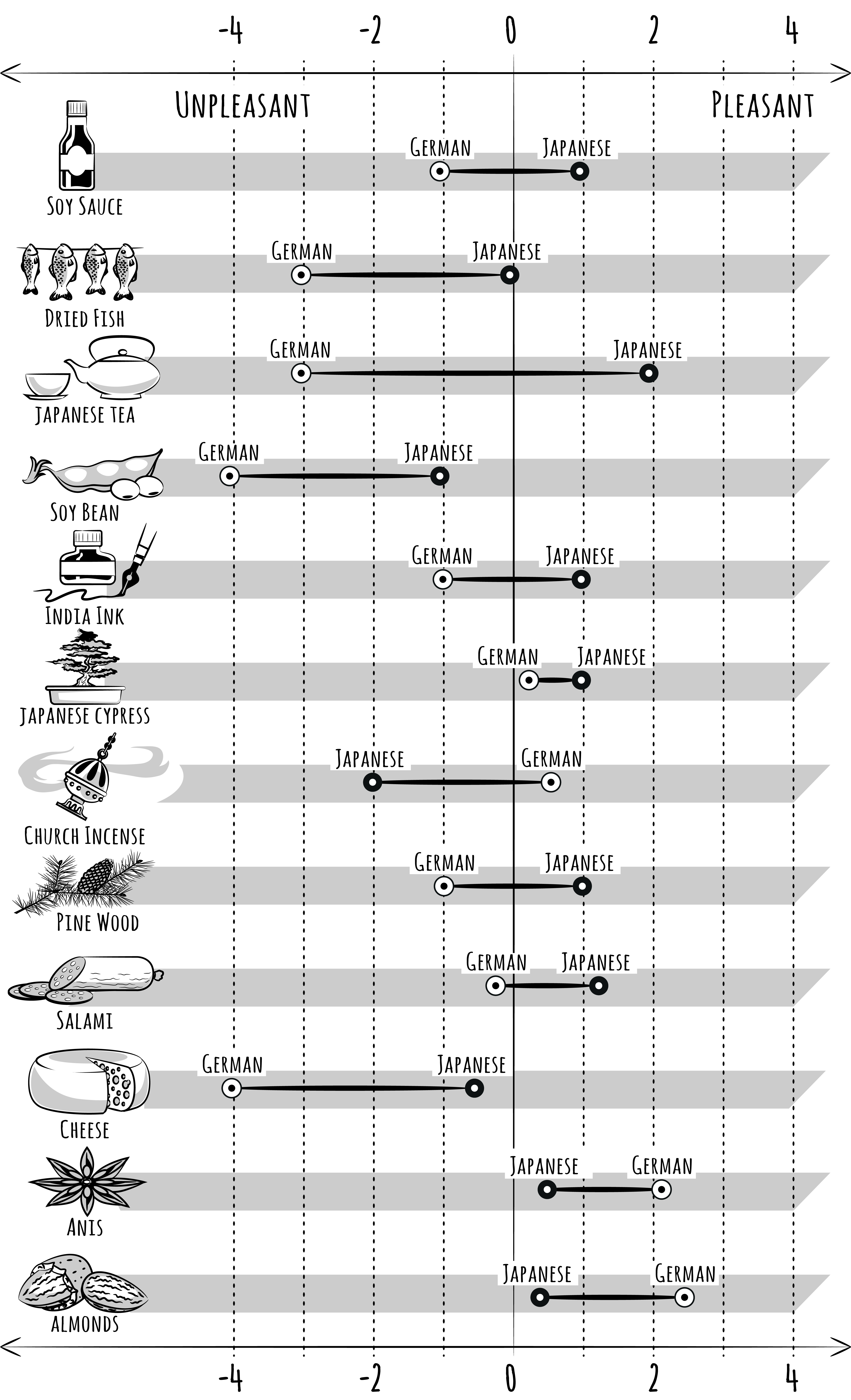
Japanese researcher, Saho Ayabe-Kanamura, explored Japan and Germany’s differences in scent preferences and perception of everyday odors.

germanjapanesechart.jpg

As you can see in the chart, the study found that participants preferred fragrances of food odors that they thought most edible. They tended to rate these edible odors higher.

This is not unusual. We are what we eat. And the food we consume is often a deeply acquired part of primary socialization.

Slimy Snails

One example of this: I had dinner with an American senior manager at a French restaurant.

We decided to dive into French dining culture headfirst, and we ordered escargot as an appetizer.

I asked my American colleague: “So how does it taste?”

He answered: “For you, these are escargot. For me, they will stay what they have always been: slimy snails.”

Americans will probably always taste slimy snails when chewing on escargot, and this is due to their primary socialization.

The same goes with scent. Once a preference is set, it’s not very adaptable.