Homesick for Your Host Country: How Reverse Culture Shock Manifests

You expect coming home to be euphoric.

And it is…for a minute.

But after that minute is over, in euphoria’s place is a feeling of unease, discomfort, and even sadness.

What you’re feeling is reverse culture shock, and it’s even stronger than the culture shock you experienced in your home country.

As described by the Founder of DFA Intercultural Global Solutions Dean Foster on expatica:

“[Reverse culture shock] is far more subtle, and therefore, more difficult to manage than outbound shock precisely because it is unexpected and unanticipated.”

Foster explains that the “patterns of behavior and thought” that an expat has developed to fit into his or her host country have now become part of them.

The change is gradual and not necessarily always conscious.

So, upon returning home, the expat is shocked to find the changes within themselves. 

Their home culture may have changed as well. It can seem a bit off, making it appear uncanny or surreal, like a funhouse mirror.

Readjusting to both the changes within oneself and within one’s home culture can feel like a double-whammy.

Another Thing: No One Cares…

What’s more, as an expat, you’re often excited and bursting to share your experience abroad, particularly if this was your first experience.

You are expecting a curious audience of family and friends awaiting your arrival.

You have great expectations.

But what you more often find is that no one cares.

Your family and friends have been living their own lives while you’ve been off living yours.

They are wrapped up in the day-to-day back home; not so much concerned with the many “monkey moments” you had in a world they’ve never visited.

You may get an odd question here or there out of courtesy – not much more than an open-ended “so, how was it?” or a “did you have a good time?” – but no one is sitting on the edge of their seat, waiting attentively for your tale of life abroad.

All of this might make you feel a number of things: annoyed with your family and friends, alienated from your home country, and homesick for your host country.

Your relationships may have changed back home too, having lost out on some experiences (weddings, births, or other family/friend events, for instance) while you were away.

What can you do to reduce the shock of all these changes and feelings?

Find Your People

One, you can find your people.

Other expats who are experiencing the same reverse culture shock as you often hold support groups either online or in person in major cities. You don’t even have to be from the same host country; you have a shared experience of returning from a foreign land and feeling these same effects.

Moreover, those with this shared experience are more likely to be that rapt audience you were searching for. Curiosity about the world is built-in, so you’ll be able to share your experiences and swap stories about life abroad without feeling like your audience is uninterested or disconnected.

As for homesickness, you might find ways to embrace your change in personality and continue in the lifestyle you’ve developed abroad at home. 

Cook up some of your favorite meals from your host country, continue with your language lessons, stay connected to your host country friends – keep in touch this other part of who you are.

You’ve enriched your life with this experience abroad, and even though you may not be encouraged to unload your memoir on everyone in your life, you should nurture it and let it continue to be a quiet new branch of your personal baobab.


Returning Home: What Impacts the Degree to Which You Feel Reverse Culture Shock?

You are returning home after spending five years living in Ukraine – a country to which you’ve adapted and adopted to a certain degree.

You’ve had to balance your home-grown values with your host country’s; you’ve altered your norms wherever you could in order to integrate properly.

For instance, you don’t smile in public as much anymore. It was drilled into your head that those who smile at strangers in Ukraine are believed to have a screw loose.

And now you’re returning home. Back to the familiar.

Home sweet home.

And you’re still not smiling.

Home is NOT So Sweet

Reverse culture shock is the upset that you feel upon returning to your home country.

When you step off that airplane, everybody is smiling. But your face is stuck in its deadpan of Ukrainian stoicism.

It’s like returning to your childhood bedroom after college – everything comes flooding back to you and, yet, feels distant and detached.

After all, it’s all familiar, from the language to the people to the foods and the streets.

There’s only one problem: everything is the same, but YOU are different.

You are returning from your second home: your host country – a place to which you spent a lot of time and energy adapting.

You learned the language, you learned the history, you learned the religion.

You knew and began to understand the culture.

So, now, upon trying to sleep in your old bed, you’re like Goldilocks.

It just doesn’t feel right.

It may be the case that some things have changed too – new pillows, a scratchy bedspread – and your once-familiar bedroom wasn’t what you were expecting.

You realize your home no longer feels like home.

This complex mix of feelings all contributes to reverse culture shock.

Degrees of Reverse Culture Shock

The U.S. Department of State details some aspects that impact the degree to which those who return from abroad feel reverse culture shock.

Taken from Craig Storti’s book, The Art of Coming Home, the following may affect your experience of this shock:

  • Voluntary and expected reentry – whether you voluntarily or involuntarily reenter and/or whether you expected to reenter or did not can impact the degree of shock. Involuntary and unexpected reentry results in greater shock.
  • Experience – if you’ve had previous reentry experience from a foreign country, the shock is generally milder.
  • Age – older people often have an easier time at reentering due to more experience with general life transitions.
  • Extent of differences between the two cultures – the more different your home culture is from your host culture, the more difficult reentry can be.
  • Length of time spent in host country – the longer your duration overseas, the harder the return may be, as you will have adapted to your host country to a greater extent.
  • Amount and degree of interaction with your host country culture and your home culture during your time abroad – the more time and intimacy with your host culture, the harder it will be to leave; likewise, the more time and the degree to which you’ve interacted with your home culture, the easier it will be to reenter.
  • Environment of reentry – supportive and familiar environments make reentry easier. Returning to conflict, instability, or uncertainty will increase the shock, as will the lack of a support system.

Consider these aspects to gauge how difficult it might be to return home. This will help you prepare for the impact.

Culture Shock: Confronting a Foreign Cultural Code

Imagine you’re flying into JFK in New York.

Recovering from jet lag, you disembark the plane, groggy and buzzing but still excited.

After all, you’re now in the Big Apple. The City that Never Sleeps.

You’re ready to explore and uncover every local gem and hidden hole-in-the-wall New York City has to offer.

You pull out your map, prepared to navigate New York’s famous subway system.

But instead, you find you’ve packed a map of the London Underground.

This is a bit what culture shock is like.

Culture Shock

Your map, in the above scenario, is your cultural code.

Although it’s easy to get around New York City when you know the way and have the directions at your fingertips, trying to use that map any other place is pretty pointless.

When first arriving in another country and culture, you’ll be confronted with this hard truth: you have stored internally the entirely wrong map.

This results in culture shock.

While you may only at first recognize the negative effects, culture shock is positive in some ways.

For one, you now KNOW you have the wrong map.

This knowledge will allow you to internally and externally develop a more accurate map for reality.

After experiencing culture shock, you will be able to anticipate the need to adjust. And the more you adjust, the less of a shock it will be for you when you realize there’s a street you never knew about or a bridge you must cross.

You’ll eventually learn the cultural code to the point that the shock wears off. 

But…

Reverse Culture Shock

Imagine you’re flying into London Heathrow after having lived in New York for two years. It’s the first time you’ve returned home.

Recovering from jet lag, you disembark the plane, groggy and buzzing but still excited.

After all, you’re now home sweet home again in the City of Fog.

But you realize, suddenly, everything seems foggier.

You’re ready to return to all the familiar places, and although you remember them on sight, you cannot seem to get into the rhythm.

Your internal map is still set to New York time. Your feet keep searching for the streets of downtown Manhattan.

You find that though your memory is trying to reload your map of London, it’s still got New York on the mind.

This is called reverse culture shock.

It’s even more off-putting than culture shock, because you DO know your own cultural code; you’re just finding it difficult to remember or relearn it.

This type of culture shock can hit you hardest.

We’ll talk more about why reverse culture shock can be so powerful next week.

Let It Happen, and Drink Strong Tea: Factors that Affect Cultural Integration

The process of integrating into a new culture has its ups and downs.

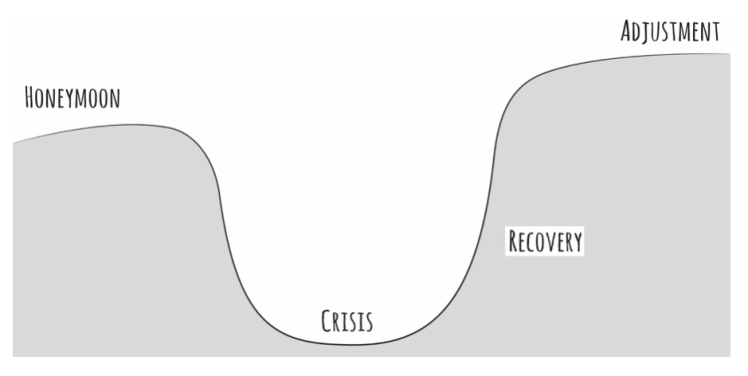
We talked last week about the U-curve – that theoretical interation period that comes in four clean stages: 1) Honeymoon, 2) Crisis, 3) Recovery, and 4) Adjustment.

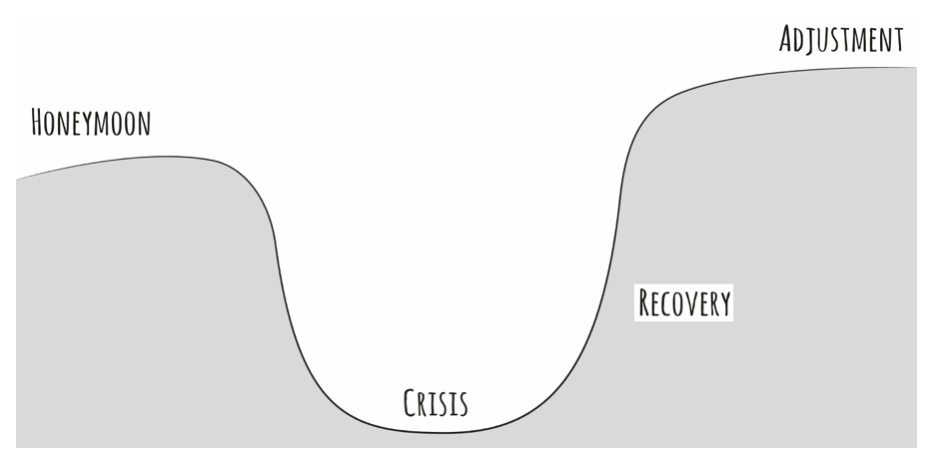
While many do experience these four stages when moving to a new country, they often aren’t as clear-cut as the chart would suggest.

Instead, they might look more like this:

This is what Marie, an expat culture blogger, drew to represent her cross-cultural experience.

She wrote:

“Even when I was completely in love with my host country, there were tough times. It was a lot like raising children, in fact: I love my kids more than life itself, but there are plenty of days when I’m convinced I’ll never get the hang of this parenting thing. And then the sun comes out again, and life is good.”

Like Marie, you might feel a true love for your host country, but you’ll most certainly experience failures and setbacks.

But, don’t worry, the sun will come out again.

Factors That Impact Integration

There is no time table for cross-cultural integration.

The process may tie you up in knots, and it won’t happen on a predictable schedule. 

And that’s because many factors come into play that can be out of your control.

These factors include but are not limited to:

These are just a few factors that play into the process of cross-cultural integration.

Some are within your ability to control; others are not.

Adapt at Your Own Pace

Each person adapts at their own pace, and the process is unpredictable.

While you will definitely have moments of happiness and bliss in your new culture, you’ll also face challenges you’ve never faced before which may fill you with dread and uncertainty.

Speaking another language. Making foreign friends. Adapting to social norms.

You will see progress, but sometimes, you’ll feel stalled.

This will make you frustrated and even depressed.

There’s no avoiding the hurdles altogether; they’re there, and you will have to find the will to jump them.

So, when faced with them, take a breath of African fatalism:

Let it happen, and drink strong tea.

Remember that this process is normal, and in a couple of years, if all goes according to plan, you’ll feel right at home in your new home.

And those hurdles that seemed like abrupt speed bumps at the time will look like nothing more than rumble strips in your rearview.

Adapting to a Culture: The U-Curve Adjustment Theory

Week 1.

You land in your host country. You’re in love.

The energy, the climate, the newness.

It’s all so fresh and bright.

You are thrilled to be here, and you can’t imagine ever NOT being thrilled.

This is the honeymoon period.

Week 2.

You’ve been trying to get your WiFi set up for over a week now.

The service guy hasn’t dropped in yet, even though you’ve called several times.

How are you supposed to work? How are you supposed to talk with your family back home?

You’ve never been more frustrated.

You’re missing home, where things are straightforward and service is immediate.

No waiting around, no wondering what to do. No communicating in broken Spanish.

No confusion.

You’re also feeling lonely, missing your friends and family, and wishing you were back in their comfortable presence.

This is the crisis period.

Week 9.

You’ve been living in your host country for three months.

Your WiFi has long been set up, and you’ve managed to put that crisis in your rearview.

You’ve faced several more in the past few months but, bit by bit, you’re figuring things out.

You’re making friends, eating the local foods, finding great places to go. Some that even remind you of home.

You still fell twinges of homesickness, but you haven’t researched one-way tickets back in weeks.

This is the recovery period.

Week 27.5.

You’ve been in your host country for two years. 

You’re well adjusted, and it almost feels like your second home.

You’ve established yourself, have your group of friends, new routines. You’re learning the language, you know your way around.

You’re adapting.

And you’re beginning to admire this new culture.

Things that used to irritate you about it are becoming easier to manage and even endearing.

This is the adjustment period.

Lysgaard’s U-Curve

Norwegian sociologist Sverre Lysgaard’s U-curve is a widely used model for cultural adapting and adjustment. 

Lvsgaard hypothesized in 1955 that the inverted bell-curve is a common expat experience. 

He writes:

“Adjustment as a process over time seems to follow a U-shaped curve: adjustment is felt to be easy and successful to begin with; then follows a ‘crisis’ in which one feels less well adjusted, somewhat lonely and unhappy; finally one begins to feel better adjusted again, becoming more integrated into the foreign community.”

These highs and lows might sound familiar to expats and international managers alike.

When adjusting to a culture, you’re bound to face days where you’ve had enough and feel that you’re at the end of your rope.

You may even hide inside and refuse to venture out of your safe space to interact with the locals.

Why? Because going outside will provoke you; it will remind you of all the things that are different about your host country: everything takes longer, people drive insane, you’re sick of the food, the language barriers…

You’ll contrast your host country with your “more civilized” home country, where everything seems right and makes sense.

You’ll resent the illogical nature of this new culture and feel angry about it.

Does this sound familiar?

The Consecutive Cycle

Although many do experience the highs and lows of an adjustment period, subsequent studies found that only 10 percent of those surveyed actually cycle consecutively across these four stages.

For the other 90 percent of expats, things are more confusing.

The feelings may ebb and flow. They might not follow in this order – or you may skip out on some stages altogether.

Or perhaps you won’t experience any of this at all.

Some expats have no honeymoon period whatsoever. They are disappointed and unhappy from the very first day they set foot off the plane.

And for some, that feeling may never change.

But keep in mind, research has shown that the first few months of expatriation are the most stressful.

If you can get over the hump, your honeymoon period just might come later.

Next week, we’ll talk about what to do if your U-curve is actually a knot.

Making Friends: Following the Cultural Rules of Relationship-Building

Is it easy to make friends in your culture?

In the category of “making friends” in the 2020 Expat Insider survey, conducted annually by InterNations, Switzerland ranks at the bottom end of the list at 53. 

Only Japan, Norway, Sweden, Kuwait, and Denmark offer tougher friend-making odds. 

The Local describes making friendships in these countries quite aptly:

“The way to their hearts can sometimes feel as long, dark and cold as the Nordic winters.”

And considering the Swiss concept of friendship and aversion to small talk with strangers, it’s easy to see why this would be the case.

An outsider might find it difficult to gain the trust and loyalty of lifelong friendship from the Swiss…particularly, as an expat, who is more likely to leave the country at some point.

So, how do you build friendships in countries where it’s notoriously hard and where your expat status makes it more likely that your time is fleeting?

Take Your Cue from Locals

Differing concepts of friendship can be a struggle, but some cross-cultural understanding will help ease the transition.

An American in Switzerland should be considerate of differences in communicational comfort.

Because the most important thing to keep in mind in countries that have a more restrictive definition of friendship is to hold back, as your own cultural approach will come across as overbearing.

Refrain from small talk with strangers in grocery stories. When with colleagues, speak in generalities and don’t get too personal too quickly.

And on the other side of the pond, a Swiss expat in America should brace oneself for discomfort when it comes to communication and friendship.

You might choose either to be open to adapting to the norm of small talk and practice sharing your personal life, bit by bit, or you might accept being viewed as closed and reserved by your American colleagues.

If your goal is to make friends and integrate, the first choice will obviously gain you more ground in a culture that’s more sociable than your own.

And remember: when you’re a foreigner, making friends is more than just socializing; a local friend can greatly aid you in understanding and navigating the culture.

Speaking in Generalities

As with everything, these generalities are not inclusive of every American and every Swiss.

You’ll find some Americans to be private and reserved and some Swiss to be more open to friendship.

You must always take stereotypes with a grain of salt and know that each and every person is an individual case.

Regardless, an awareness of your host culture’s general approach to human-to-human contact will help you avoid overstepping the common social boundaries that the culture deems agreeable.

Americans vs. the Swiss: Defining Friendship

An American sits down beside a Swiss on an airplane. 

After some initial friendly banter (one-sided from the American), he asks, “Where are you off to?”

The Swiss, slightly uncomfortable, is reluctant to respond, but the American doesn’t take the cue.

Without prompt, he proceeds to share his entire trip with the Swiss. He was visiting his son who lives abroad in France. They went on a bike journey across the Baltics together. He’s now heading home to Minnesota, where he’s retired. He and his wife have three other kids, all of whom are newly out of the nest. Their absence has been particularly hard on him, and he’s been trying to find new hobbies – like biking – to fill that empty void where activities with his children once stood.

“Enough about me…” he wraps up. “What about you? What do you do?”

The Swiss squirms in his seat. This man is a stranger, and it’s none of his business. Even worse, the Swiss has nowhere to turn. The nonstop flight is eight hours. Would it be rude to put his headphones in?

This is a marked difference between American and Swiss culture.

Small talk is a common, acceptable, and even appreciated social norm in America.

In Switzerland, not so much.

Sharing Personal Info

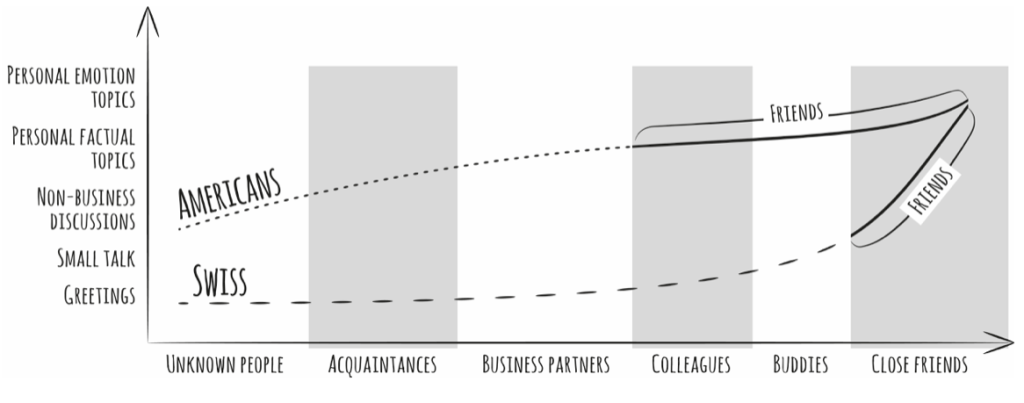
This chart illustrates just how uncomfortable the above American just made his Swiss cohort.

The Swiss only share small talk with buddies or friends – and sometimes with colleagues.

In fact, the American went well past small talk, sharing non business related topics, personal factual information, and even personal emotional themes, all of which are only shared between close friends in Switzerland.

To breach this wall with a stranger can feel egregious to the Swiss.

As we talked about last week, respecting others’ privacy is highly valued in Swiss culture.

Their “bubble” is much larger than that of their American counterpart.

Comfort Zone of Communication

The comfort zone of communication is considerably tighter in Switzerland and the scope of people with whom they communicate narrower.

Americans talk about anything and everything with their friends and are, more often than not, comfortable sharing more with a broader range of people as well, whether they be acquaintances or even strangers on a plane.

Swiss view friendship as intimate and permanent. Being a friend means being there, through thick and thin; it’s a life-long commitment not to be taken lightly.

Essentially, the Swiss have no “degrees” of friendship; they have a single solid unalterable definition.

Americans, on the other hand, have a wider range of friendships. They might have people they consider close friends who always have their back, others they consider fun and easygoing buddies who come and go from their lives, and still others with whom they’d be happy to grab a beer and discuss politics but not necessarily share their deepest darkest secrets.

While Americans might view “close” friendships similarly to the way the Swiss view friendship in general, they are also more often open to lighthearted, casual friendships with most anyone.

To some, they might be considered “fair-weather friends,” while to others with whom they are more intimate, they are considered loyal.

But they are willing to share degrees of themselves and their lives with even strangers, all the same.

So, how does one make friends in a culture with such a different concept of friendship?

We’ll bridge that gap next week.

Small Talk & Swiss Culture

A Swiss anchorman was traveling by train from Zurich to Chur.

A passenger sitting in the seat in front of him spoke not a word the whole train ride.

As the train pulled into the terminal station, the passenger stood, turned to the anchorman, and reached out his hand for a shake, saying, “Mr. Müller, it has been a pleasure to travel with you.” 

This is characteristic of the Swiss in general.

Respecting others’ privacy is a highly valued norm. The Swiss do not talk with strangers – even famous television anchormen – as they see this as an invasion of others’ privacy.

In this case, the passenger might have mustered up the courage to greet the anchorman, but that’s where the intrusion begins and ends.

Personal Details Are Private

The Swiss are traditionally secretive.

Whereas other cultures might chitchat while waiting in a queue, the Swiss don’t bother engaging in small talk.

In fact, if you initiate small talk with a stranger in Switzerland, you may be met with a dirty look.

Personal details are just that: personal.

Private or personal matters aren’t brought to work, be they emotions or facts.

Such matters needn’t even be deep to be avoided. The Swiss are unlikely to share where they’re from, what car they drive, or any sort of mundane detail about their lives.

An article about Swiss culture by Valentine Sergon on Expatica explains:

“As a whole, Swiss people tend to be polite, reserved, direct, and a little guarded at first. In work environments, social etiquette in Switzerland is to remain formal until explicitly told otherwise.”

Personal details and themes are only shared between friends.

Strangers and acquaintances receive only greetings and reserved niceties. It’s only until you break into the “inner circle” that you might earn a lifelong friendship from the Swiss.

But a lifelong friendship it will be, as once they put their trust in you, the Swiss are known to be loyal.

Struggle to Small Talk

An Australian expat wrote the following about Swedish people, but it could apply just as well to the Swiss:

“I can tell that they really want to learn, but they were never taught how to do small talk. When people find out I’m Australian, they try to make small talk with me, but they really struggle. They speak good English; it’s just that they don’t know what to say.”

Swiss culture is very much the same. Small talk is so foreign to the Swiss that, even if they wanted to try, they have a hard time with it.

Now that you know a bit about Swiss culture, you might wonder how it stacks up to American culture.

With such norms, how might a Swiss person survive in a world of America, a culture that typically embraces small talk?

Or how might an American fair in Switzerland?

We’ll tell you how next week.

Know the Rules: Understanding the Local Concept of Friendship

“True friends are the ones with whom you shared a sandbox.”

This is a Swiss saying, and it summarizes how the Swiss feel about friendships in general.

Friends are the people they grow up with. This is the general Swiss view.

They view foreigners’ concepts of friendship (particularly, Americans) as superficial.

They may also view certain areas of discussion with friends or social groups as taboo.

Because of these values and norms surrounding friendship, Switzerland might be one of the toughest places in the world to make friends as a foreigner.

In fact, many expats give up and stick to themselves.

But before throwing in the towel when it comes to cross-cultural friendships, learn the rules.

You might find it’s easier to make friends when you know what the local concept of friendship is to begin with.

Local Concept of Friendship

The definition of true friendship differs across cultures, as does what is considered acceptable in social settings. 

Simply put, to make friends according to local standards, you must know what friendship means to that culture.

The rules of forming a friendship in another culture are three-pronged.

They involve knowing the:

  1. Approach to Human Interaction
  2. Socially Acceptable Discussion Topics
  3. Pace by which Relationships are Expected to Progress

Let’s take a look at each of these in turn.

Approach 

One culture’s approach to human interaction – i.e., tone and delivery – may be very different than that of another culture.

The way in which we speak to each other – whether politely or jokingly – might be considered too uptight in one culture or too abrasive and disrespectful in another.

Knowing the tone and approach to communication that is culturally expected at different stages of a budding friendship can help you in forming cross-cultural friendships.

Discussion Topics

What can you talk about? What is off-limits?

While you might come from an open culture, some cultures are much more generally private than others.

They might see sharing private thoughts and feelings as oversharing, particularly if the relationship is new.

While talking about the weather might sound boring, being too intrusive or intimate in another culture upon first approach is a surefire way to be friendless.

Pacing

As with any developing relationship, there are typical steps to increasing intimacy in friendship and communication, no matter which culture.

Beginning with the basic level of personal communication, greetings are socially acceptable (and expected) to form common bonds during the initial stages of communication.

Next, you might engage in small talk about the workplace (if this is a situation in which you work together) and then non-work-related small talk.

If the relationship progresses, factual personal information might come next: sharing where you live, what you like to do in your down-time, etc.

As you move into true “friendship” territory, more intimate communication will be shared. Whether that’s a sharing of feelings, fears, dreams, the meaning of life, etc.

While most friendships develop along this curve, the pacing across cultures often differs.

For instance, you might move through all four stages within one plane ride. Or it could take you a year to reach this point.

If both participants are from the same culture, their pacing often aligns. They feel completely fine and comfortable becoming “fast friends” on a redeye.

If the participant is from a different culture, they might be uncomfortable with the pacing.

They might feel their boundaries are being intruded upon too quickly, and this invasion of privacy will be turn them off to friendship.

All cultures have different expectations of how and when to progress and intensify communication toward friendship. We’ll talk more about these rules next week.

Small Appeals to Common Interests: Creating Opportunities for Cross-cultural Friendship

Why are local friendships important when working abroad as a foreign manager?

We’ve been talking about the many reasons over the past few weeks, and it all boils down to this:

Friendship = Experience with, Exposure to, and Engagement with the Culture

Experience, Exposure, Engagement

Without experience with and exposure to the host culture, you cannot be a great leader to employees of that culture.

Without interest in the lives of your employees, they’ll show no interest in following you.

Without curiosity and enthusiasm for that which is most important to them – their culture –, you won’t inspire enthusiasm in teamwork.

The best leaders have a way of making their employees feel on their level. That you are “one of them,” so to speak.

This is why local friendships, both inside and outside of the office, can aid that sense of being “one of them.”

Because it’s only outside the four walls of the office where you will be fully exposed to the culture of your host country.

And with this exposure and experience, not only will you be able to adapt to and adopt the culture easier, but you’ll better avoid cross-cultural “monkey moments.”

Small Appeals to Friendship

It may be that your circumstances allow for little opportunity to make friends.

Whether you’ve been dropped into a foreign country with little notice or you’re an international manager on-the-move, time might not be on your side, making socializing with locals more difficult.

Moreover, as an international manager, you might be more isolated from local culture, due to your children going to international schools, your work-life being spent wooing clients on the golf course, your family life taking precedence, etc.

So rather than spending your time on an all-consuming mission to make friends, you’ll make better headway with small appeals to common interests.

Built-in Common Interests

If you’re religious, local congregations are a great way to integrate into the local culture with a common interest already woven in.

Congressional communities often embrace their congregants and provide various gatherings and festivals in which to come together.

Sports are another way.

My wardrobe includes sportswear with fencing insignias from U.S. and Spanish clubs. Wearing them provokes conversation or offers a segue into one about shared sports.

Knowledge of your host country’s national sports inspires camaraderie.

Many tend to be enthusiastic about their favorite sports teams, so showing curiosity in this shared interest provides an opening into a warm conversation.

Maybe sports aren’t your thing.

Cultural events are a fun venture to get to know different community cultures in your host country.

A regional food festival in Italy?

Delicious.

An international film festival in the U.S.?

A perfect way to spend the day.

Create opportunities for yourself. No matter your circumstances, you can find small ways to initiate friendships or common bonds with locals. 

Not only will you be exposed to the culture of the host country as a whole, but you’ll experience the micro cultures of regional communities.

It’s your responsibility as the monkey to take that initiative.