Family, Sex & Love: A Look at Humankind’s Social Fabric

From linguistics to archaeology, anthropology is the study of humankind, past and present, and the origin of all cross cultural studies.

Family, sexuality, and love are topics of much interest to anthropologists.

Each of these themes is at the core of humanity.

We’ll cover them in detail over the upcoming weeks.

Why These Topics Matter to Cross-Cultural Management

If you’re coming to this blog for corporate success across cultures, you might think that family and sexual mores don’t apply here.

However, I’d argue that they do for two reasons:

  1. A culture’s social fabric is woven by family structures. By better understanding family-related values and norms, you’ll integrate much more smoothly into a society than if you have no clue about the important roles that family members play.
  2. Sexual mores often evoke the strongest emotional reactions, as these norms are amongst the earliest socialized norms in a culture and are often enforced by religious and social taboos. Awareness of unfamiliar social mores will help you avoid crossing boundaries and keep you clear and well away from those dratted taboos.

In effect, any information about a culture’s values and norms will fortify understanding and help you view a culture through their own lens. Only when you can see from the culture’s perspective can you truly identify with their mentality and integrate cross-culturally.

Family, Sex & Love in Culture

Of these three topics, family structures is one of the more thoroughly researched of all anthropological studies.

The study, Family: Variations and Changes Across Cultures, explains why:

“In order to study psychological phenomena cross-culturally, it is necessary to understand the different types of family in cultures throughout the world and also how family types are related to cultural features of societies.”

Family structures are the blueprint for societal structures. This is why some knowledge of family values and norms will gain you significant headway when managing across cultures.

Sex is also on the mind of many an anthropologist. Although, according to The Cross-Cultural Study of Human Sexuality, “Anthropology has long had a love-hate relationship [with it].”

This is largely due to the own sexual mores of those anthropologists in question. Across many cultures, the topic is seen as taboo or controversial, so sexuality remains a “rarely studied” topic of human experience.

Moreover, love and romance is mixed in with family and sexuality and has been since the dawn of time.

According to Love Across Cultures:

“Although love needs to be framed within a cultural context, many scholars believe that romantic love is transcultural. Elaine Hatfield and Richard L. Rapson (1996) viewed passionate love as common to virtually all cultures, and indeed, romantic love has been found in most countries of the world.”

Over the next few weeks, we’ll dissect research on all three topics in more detail, taking a look at remote and predominant cultures, alike, to discover both shared and divergent values and norms in these themes.

German vs. Japanese Nose: Scent Preferences = Food Preferences

Whether you like the smell of wintergreen or marzipan, cheese or fresh cut grass, lemon or borscht, your scent preferences are likely impacted by your culture.

Last week, we talked about how that which surrounds us often influences our favored scents.

It may be onions prompting attraction, cow manure implying success, or body odor indicating the spirit.

Whatever the case, our noses seem to know our culture.

First-World Cultures

Many of the scent preferences and concepts we discussed last week surrounded second- or third-world cultures, so we might expect the norms and preferences to differ more from those of first-world cultures than two first-world cultures would from each other.

But what happens when we compare the scent preferences of the first-world? Are they similar? Do first-world cultures like the same scents?

The short answer is no.

Of course, these are general claims; scent preferences differ depending on personal tastes.

But, generally…

Americans like the smell of wintergreen; the British don’t.

Germans like the smell of marzipan; the Japanese don’t.

The intrigue regarding these cultural differences in scent preferences led to a study that dove right into these comparisons. This is what it found.

Japan vs. Germany

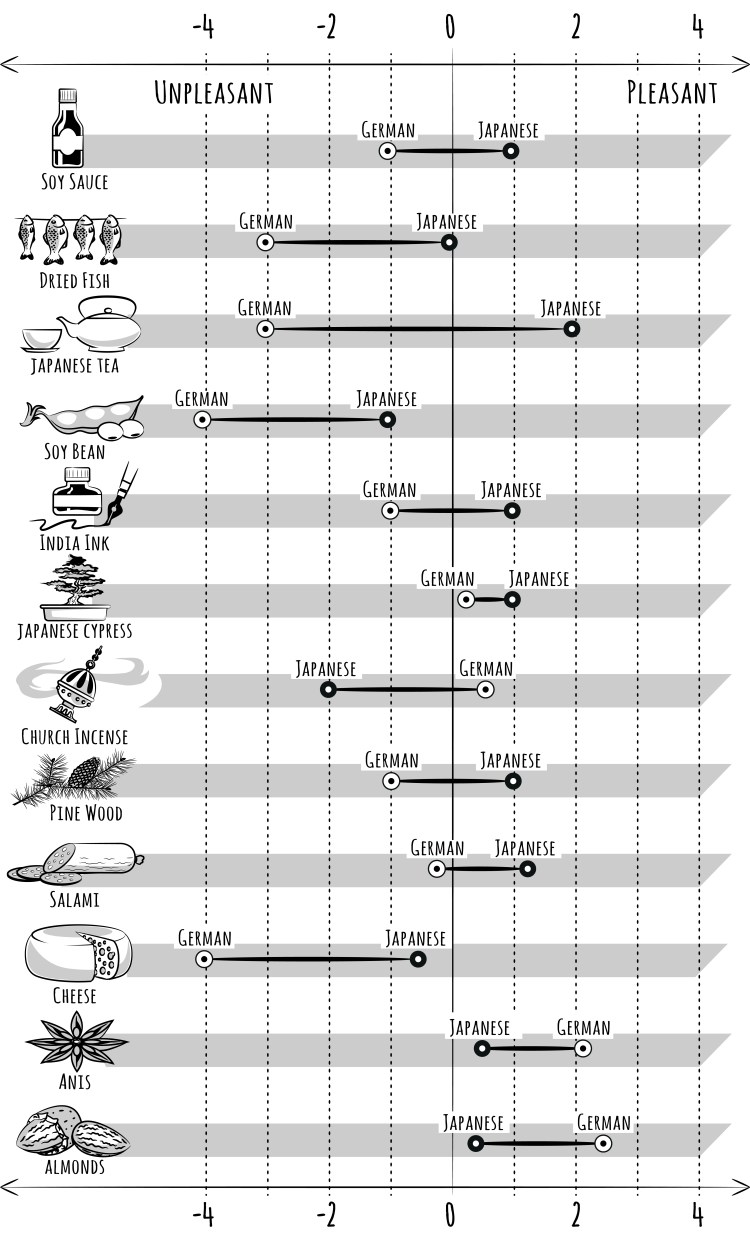
Japanese researcher, Saho Ayabe-Kanamura, explored Japan and Germany’s differences in scent preferences and perception of everyday odors.

germanjapanesechart.jpg

As you can see in the chart, the study found that participants preferred fragrances of food odors that they thought most edible. They tended to rate these edible odors higher.

This is not unusual. We are what we eat. And the food we consume is often a deeply acquired part of primary socialization.

Slimy Snails

One example of this: I had dinner with an American senior manager at a French restaurant.

We decided to dive into French dining culture headfirst, and we ordered escargot as an appetizer.

I asked my American colleague: “So how does it taste?”

He answered: “For you, these are escargot. For me, they will stay what they have always been: slimy snails.”

Americans will probably always taste slimy snails when chewing on escargot, and this is due to their primary socialization.

The same goes with scent. Once a preference is set, it’s not very adaptable.

Body Odor & Dead People: How Culture & Scent Preferences Mix

What would you do if you were on the metro, and you caught a strong whiff of body odor? You’d probably hold your breath, right?

Over the past few weeks, we’ve learned that cultures view scent in different ways.

The West tends to view it as of a lower order, in relation to the other four senses.

Other cultures – like the Onge and Indian groups – hold scent in high esteem. Algerians even reference the nose as their “honor.”

But not only do we view scent in a different way; we also may smell it differently.

Body Odor & Dead People

In some cultures, physical scent takes on a spiritual form.

For instance, a person’s scent is associated with personal identity for the Bororo of Brazil and the Serer Ndut of Senegal.

The Bororo see body odor as a person’s life force.

And the Ndut take this a step further. They believe in a physical and a spiritual scent-defined force.

The physical force is, of course, associated with body odor. The spiritual force may indicate when a deceased person or ancestor has been reincarnated in the body of a child with a similar scent.

On the other hand, Western cultures generally consider body odor unfavorable and even embarrassing. They do anything they can to cover it up.

Deodorants, body sprays, cologne, aftershave.

Natural body odor in the West is not a good thing.

But a Westerner in Africa might be considered strange for trying to cover up their god-given scent. In fact, I’ve been told by Africans that white people smell like death…which we can safely assume is not a compliment.

The Scents Around Us

The cultural preferences of scent may be partially influenced by the scents surrounding us, the scents we’ve taken in during primary socialization.

Consider a local market in Africa.

The fragrances are strong, exotic, unfamiliar. A Westerner might breathe in these aromas and find them unpleasant, while locals would probably disagree.

Much of what we find attractive in a scent depends on what’s valued in our culture.

In Ethiopia, the Dassanetch people, who raise cattle, find the smell of cattle preferable. The scent is tied to fertility and social status, so men often cover their bodies in cow manure and wash their hands in cow urine.

In Mali, the Dogon people find the fragrant scent of onion alluring. Both men and women use fried onion as a perfume, rubbing it on their bodies to attract partners.

All of these examples just goes to show that our own environment often influences our preferences, shapes how we see the world, and ultimately defines our sense of smell.

Next week, we’ll discuss research on the differences in German and Japanese scent preferences.

Love, Honor, and Smell: How Scent is Viewed in Other Cultures

When you think of the five senses, how would you rank them, superior to inferior?

You might instinctively say that sight is the superior sense. Next, you’d probably go with hearing or touch, followed by taste or smell.

This ranking makes objective sense to you somehow, but it’s likely that social and cultural prejudice of certain senses comes into play.

Language & the Lower Order

Last week we talked about how scientists once perceived smell as of a “lower order” than all other senses. This was because, at the time, rationality was in vogue, and scent was linked with emotion.

This scientific attitude toward our senses led to less research into scent. Even our language followed suit.

Think about it.

  • When someone is impressive, we might call them a visionary.
  • When someone is athletic, we might call them dexterous.
  • When someone is a curator, we might say they have good taste.
  • When someone is musically talented, you might say they have a good ear.

But you never compliment someone’s nose or smelling abilities, and the terms for nose in our vocabulary are often derogatory (schnoz, snout, snooty, snotty, etc.).

There is no positive equivalency for the sense of smell as there are for our other four senses.

Cross-Cultural Views on Scent

The thing is, other world cultures do appreciate the power of scent. Some even hold it in the highest regard, above all others.

One example is the Onge of the Andaman Islands. This tribe defines everything primarily by smell.

For instance, seasons are named after a particular scent, largely depending on what types of flowers or fruits blossom. Their calendar is literally run by the nose.

They also personally identify according to scent. If talking about oneself, one touches the tip of his nose, which means “me” or “my odor.”

The scent-centered culture appears expresses their focus on the nose in their language.

Consider the Onge greeting:

“Konyune onorange-tanka?”

This is the English equivalent of “How are you?” But it literally means, “How is your nose?”

Greeting & Scent

The Onge are not the only ones to hold scent in such esteem.

In Algeria, the nose – called “nif” – is synonymous with honor.

In India, greeting someone by smelling them on the head is equivalent to a hug or a kiss in the West.

Moreover, one ancient text in India reads:

“I will smell thee on the head, that is the greatest sign of tender love.”

So, it appears that, in some cultures, the link between scent and emotion makes the sense of smell even more powerful than all others.

Next week, we’ll continue this talk about culture and scent preferences.

The Nose Knows: Scent Emotion & Memory

You’re strolling down a path, when you brush past a lilac bush. You take a deep breath in, and suddenly memories of your grandmother flood in.

blog69-2

“Nana…” you think. “Why am I suddenly recalling my gran?”

Then you recall the big lilac bushes in her backyard.

We’ve heard it all before: scent triggers memory. But just how does it work?

Scent -> Emotion

Last week, we talked about the power of our sense of smell. And perhaps this power is one of the reasons why scent triggers emotion and memory recall.

Consider ads for body fragrance, perfume, or scented products. Marketing specialists know that scent triggers certain emotions and, thus, attracts consumers to particular fragrances. And so, they bank on that.

The scent of nostalgia at Christmas -> buy a pine-scented candle.

The scent of joy in the summer -> a citric body spray will do the trick.

The scent of love/romance -> try something dusky and mysterious, like sandalwood.

Some fragrances serve as aphrodisiacs, others trigger positivity, and some even trigger productivity.

This association between fragrances and emotion is what may provoke recollections and vivid memories.

How Does It Work?

Here’s how:

  • The nose has olfactory receptors that are linked to the limbic system, which is the seat of emotion in the brain.
  • These smell sensations travel to the cortex, which is the seat of cognitive recognition.
  • Recognition only sparks after the depths of our brains have been ignited, so after feeling a certain emotion from a scent, it usually takes a moment for cognition and memory to catch up.

Why Don’t We Value Smell?

So, if our sense of smell is so powerful, why don’t we value it as much as, say, sight or touch or hearing.

During the 18th and 19th century, scientists and philosophers revalued the senses. The period’s elite believed sight to be the most important sense, the most civilized. The superior sense, if you will.

Sight was based on reason, while smell was considered of a lower order. According to Katie Fox’s The Smell Report, published by the Social Issues Research Center, smell was considered:

“a primitive, brutish ability associated with savagery and even madness.”

The culture of the time drew the link between smell and emotion and believed that this connection threatened the rational detachment that was in vogue.

This strange view of smell has impacted culture’s relation to it, especially when it comes to language. We’ll talk more about that next week.

Smell This: A Study in Scent

Sniff, sniff – there’s something in the air.

Is it fresh cut grass, the aroma of borscht cooking? Is it the stench of durian?

When compared with our other four senses, our sense of smell goes rather unnoticed.

Sight, sound, taste, touch – they all get plenty of play.

But smell…

Unless there’s a strong repulsion or attraction to an odor, this sense wafts under the radar.

And, yet, it’s one of our most powerful senses.

A Rose By Any Other Name…

Rockefeller University’s Andreas Keller conducted research on smell perception that demonstrated just how sensitive our sense of smell can be.

There’s a diverse complexity in scent that is unrivaled by sight and sound. The scent composition of a rose, alone, contains around 275 elements.

And humans can differentiate between trillions of these scents, according to Keller.

Keller’s study, published in Science Magazine in 2014, tested the capacity of humans to determine differences in various odor mixtures that had different shared components.

Their conclusion that humans can discriminate between upwards of a trillion odors far surpassed previous scientific literature, which determined 10,000 odors was our limit.

Comparably, we can only see somewhere between 2.3 to 7.5 million colors, and we can only hear 340,000 sounds.

As quoted in Keller’s abstract:

“[This research] demonstrates that the human olfactory system, with its hundreds of different olfactory receptors, far outperforms the other senses in the number of physically different stimuli it can discriminate.”

When it comes to the schnoz, the ear and eye can’t compare.

Evolution of Scent

Darwin knows the reason we can discriminate minute differences between odors: evolution.

What’s evolution got to do with it?

It turns out that smell is a handy tool for survival.

For instance, when we take week-old leftovers out of the fridge and give them a sniff, we can tell whether or not they’ve gone bad. If we crack that egg over the frying pan, and there’s a rancid odor, we know not to eat it.

So, if it’s a matter of life or death, the nose knows.

Another key factor in the study was that, when discerning scent, women regularly out-performed men. This may be because, throughout history, they most often prepared meals and had to know when food was rotten.

Animal Olfactory: How Do Humans Compare

After taking all this in, the human sense of smell may seem like a super power, but it falls way behind that of dogs and other animals.

Really, in the food chain of smell, we’d be on the bottom rung.

Think about it: this is the reason we use drug dogs at airports. Have you ever seen a customs officer sniff out a balloon of cocaine?

Regardless, our sense of smell is still incredibly sharp, and we’ll talk next week about how that sharpness impacts memory.

Contact vs. No Contact Cultures: A Guide to Touching

If you’re a man, how would you greet another man? Probably just a shake of the hand, right?

How would you greet a woman? If you’re from the West, probably the same.

You’d offer your hand without a second thought. But, considering the different body contact norms across cultures, you shouldn’t assume sameness when it comes to greetings.

Sometimes, cross-cultural matters of gender are quite sensitive and, depending on the culture, even same-gender greetings may require some specific behaviors.

If you don’t want to do something taboo in your new culture, as a monkey, watch and learn. Or, better yet, prepare yourself beforehand by reading up on gender norms in this “guide to touching.”

Touching Across Genders

In certain cultures, particularly in traditional ones, touching when greeting is only acceptable when of the same gender.

Generally, same-gender contact (male-to-male and female-to female) is acceptable in many cultures. But what about male-to-female contact?

Physical contact between men and women in African countries and in Muslim majority countries is often seen as taboo.

Moreover, in traditional societies, PDA is unacceptable, and you’ll rarely see a man and a woman holding hands in public or greeting each other with physical contact.

In some regions, the latter is acceptable if the man and woman are family.

Left Hand/Right Hand

You should also consider which hand you greet someone with.

If you are left handed, and normally reach out to shake with your dominant hand, hold up a minute.

When in Africa or Muslim majority countries, many will consider this left-handed shake disrespectful, because the left hand is considered the “dirty” hand.

Because clean water for hand-washing isn’t always readily available in some regions, tasks in these cultures are separated between the left and right, with the left hand being responsible for dirty tasks…even cleaning oneself after using the toilet.

Not only that, but in Islam, a preference is always given to the right hand.

DohaNews states why:

“This follows in the tradition of the Prophet Muhammad, who favored his right hand for such actions [eating meals and greeting people].”

When Muslims perform wadu – purifying themselves ritually before prayer – they follow a sequence while washing, always prioritizing the right side.

Imam Talib Shareef told PBS:

“That cleanliness is a process. It starts with your intentions. In basic terms it’s, ‘I intend to make the ablution in preparation to stand in obedience before my Lord.’”

Being as the right hand is given such preference, touching or greeting someone with the left hand would be considered very rude, regardless of whether or not the right hand is busy at the time.

Knowledge of these differences in cross-gender contact and right hand/left hand norms can make the difference between success across cultures or a terrible first impression.

Culture & “The Bubble”: Closing the Gap of Personal Space

A tennis ball.

A volleyball.

A beach ball.

An ocean.

Whatever size our bubble is, we each walk around inside our own yardstick of personal space.

Last week, we talked about how culture and the climate, along with the level of intimacy in relationships, can all affect the degree of our bubble.

This week, we’ll talk about how to close that gap – or at least become more comfortable with it – when living in a foreign culture.

The American Bubble

Americans value personal space. 

International student guides to the US even highlight this preference:

“If you try to get too close to an American during your conversation, he or she will feel that you are ‘in their face’ and will try to back away. Try to be aware of this, so if the person to whom you are speaking backs away a little, don’t try to close the gap.”

More advice given to international students to the US includes:

  • Shake hands upon meeting
  • Avoid all other physical contact while speaking with casual acquaintances (no arm over the shoulder, arm touching, hand holding, etc.)

Americans clearly have a preference for physical distance and no body contact…at least when it comes to strangers and casual acquaintances.

So, how do American managers deal with more touchy-feely cultures abroad?

Insert Desk Here

Latin America is a physically close culture, as was illustrated in the study discussed in last week’s post.

Imagine an American manager entering into this tennis ball-sized bubble culture.

When speaking with an employee, said employee stands too close for comfort, forcing the manager to step backwards to regain his bubble. But in doing so, the employee steps closer again, because he is uncomfortable with the wide gap.

While savvy American managers who work in Latin America want to adapt cross-culturally, those who can’t bear the physical closeness often use a small trick to avoid it with their colleagues and employees.

Instead of taking a step back, they close the gap with an object – like a table or desk – thereby creating the gap for them. This way, the employee is at a comfortable distance, while not feeling uncomfortable, himself, with the object-made gap.

Sometimes, closing the gap is not easy (see: the Japanese woman who forced herself to adapt to the Spanish greeting of kisses); other times, it’s as easy as a desk.

Culture & “The Bubble”: How Norms Affect Personal Space

How big is your personal bubble?

Does the distance differ between a stranger, an acquaintance, a friend?

Over the last few weeks, we’ve been talking about kissing across cultures and the intimacy of cultural greetings. This all relates to cultural norms and, particularly, personal distance.

Safe Space

People of every culture like to keep a safe space from others, whether they’re talking, walking, or taking public transport. This invisible boundary, while sometimes particular to an individual, also has roots in the cultural baobab.

When someone trespasses this space, particularly if they’re a stranger or specifically unwanted within the bubble, the person whose space has been invaded will instinctively move away in order to regain their boundary of comfort.

Why do we have this sense of personal space? Do we fear bad breath or B.O.?

Well, that may be an issue…but, more importantly, the close proximity lends itself to a sense of intimacy that may be incongruent to the relationship between two people.

When our space is invaded, a ping of fear is triggered in the amygdala of the brain. Though mostly subconscious, this emotional reaction is established during primary socialization around the age of 3 or 4, which is when personal space starts to develop and is later fully formed in adolescence.

While matters of personal space may be somewhat suppressed when in a particular setting (on an elevator or a packed metro, for instance), the feeling of discomfort is still there. And, as mentioned, it often differs according to an individual’s relationship with the other person.

You’re Getting Warmer…

So, what makes a culture “colder” or “warmer” than another in relation to this bubble?

Funnily enough, often the temperature. 

A study published in the Journal of Cross-Cultural Psychology examined cultures and personal space, gathering information from around 9,000 people in 42 countries. Researchers were particularly interested in whether or not climate impacted a culture’s norms regarding personal space.

An earlier study had concluded that there were “contact” cultures ( Latin American, Arabian, and southern European) and “non-contact” cultures (North American, northern European, and areas of Asia).

Individuals were asked at what distance they were comfortable standing next to a close friend, an acquaintance, and a stranger. The study found that it was often the case that the warmer the climate, the thinner the bubble.

Argentina had the narrowest personal gap, being at as comfortable a distance with a stranger as a Canadian was with a close friend. On the other hand, Romanians had the widest bubble when it came to strangers (>1.3 meters) but one of the smallest for close friends (40 cm).

While this doesn’t illustrate a clear cut theory on warm vs. cold climates producing warm vs. cold cultures, in general, the higher a country’s temperature the narrower “the bubble” between strangers.

Next week, we’ll talk about ways of “closing the gap” of personal space across cultures.

Margaret Mead: A Study in Scarlet

A kiss isn’t just a kiss.

Last week, we spoke about different kissing traditions in different cultures.

This week, we’ll continue this discussion through Margaret Mead’s in depth research on the subject.

Margaret Mead

Margaret Mead was an American cultural anthropologist who dug deep into South Pacific sexual mores into the ’60s and ’70s.

She wrote a book on the subject called Coming of Age in Samoa. At the time, society and cultural traditions there allowed more sexual freedom than those in Western culture.

Mead argued that this freedom created an easier transition from childhood to adulthood and believed in encouraging broader sexual mores. Her theories were promoted by advocates of the sexual revolution in the ‘60s.

But although this was what brought Margaret Mead’s work to the forefront, this wasn’t her first course of research into sexual mores.

Courting Habits: American vs. Britain

The second world war brought American GIs to the United Kingdom and with this contact came cross-cultural courting.

Margaret Mead studied the conflicting courting habits of the two cultures.

Her findings:

  • American men believed British women were “too easy”
  • British women believed American men were “too fast and direct”

So, both cultures felt pressured by the other’s courting habits.

How and why did these seemingly contradictory conclusions occur?

30 Steps of Courting

Mead categorized the courting habits of both cultures from first contact to sexual intercourse. In doing so, she broke down each process – that of American courting and British courting – into around 30 steps. That’s how long it took for a relationship to progress from casual to intimate on both sides of the Atlantic.

What she found, however, was that though the process clocked in the same number of steps, there was a significant difference in progression.

The French Kiss

The real hitch all boiled down to French kissing.

For the Americans, French kissing was introduced into the mix in around the fifth step, as it was viewed as rather casual. On the other hand, the Brits viewed frenching as intimate, so it didn’t enter into the progression until step 25.

Therefore, if a British woman gave into her American counterpart and accepted his cultural courting mores at step five, she would then accept that the level of intimacy had jumped to the 25th step in her own cultural mores, thereby moving ahead much further than the American was prepared for.

This simple miscalculation created conflict that left Americans and Brits thinking negatively about each other and feeling pressured in their courting and mating habits. All because the other’s cultural values and norms differed from one’s own.

Next week, we’ll further discuss the differences in intimacy and personal distance. Stay tuned.