Early Language Mapping: How Infants Learn Pronunciation

Why do Americans struggle with differentiating between the “shee” (“west”) and “chee” (“wife”) sounds in Mandarin?

Why do the Japanese struggle with the “l” and “r” sounds in “lake” and “rake”?

University of Washington speech professor Patricia Kuhl has the answer.

Map-Building

Having studied early language development for nearly three decades, Kuhl has a better understanding than most of how and when pronunciation and accents develop.

Before a baby even speaks her first word, a pattern of speaking has formed in the brain, based on her primary caregiver’s speech.

With American, Japanese, Swedish, and Russian infant participants, Kuhl found that vowel and consonant sounds of both native and foreign languages are clearly recognized by children between 6 to 8 months. 

That means an American infant can recognize and respond to the differences in “shee” and “chee,” while the Japanese infant will differentiate between “l” and “r” just as easily as an American.

Head-Turn Study

Kuhl used a “head-turn” study to identify whether infants could recognize these sounds.

While distracting an infant with a toy, the speaker would repeat a sound over and over – “la, la, la,” for instance.

The infant would continue watching the toy until she would hear a different sound mixed in – “la, la, ra”  – which would then light up the toy.

In anticipation of the reward, two-thirds of both Japanese and American 6- to 8-month-old infants would turn to look at the toy when the sound changed.

That ability was lost by the time the child reached one year.

Using the same sounds, a little over half of Japanese infants and nearly four-fifths of Americans would turn to look at the toy by the time the infants had reached a year.

The study concluded that this is when native sounds become the baby’s norm.

Magnet Effect

A Smithsonian article by Edwin Kiester, Jr., throws this map-building into further relief, with Kuhl describing the mapping of the baby’s language brain:

“The baby early begins to draw a kind of map of the sounds he hears. That map continues to develop and strengthen as the sounds are repeated. The sounds not heard, the synapses not used, are bypassed and pruned from the brain’s network. Eventually the sounds and accent of the language become automatic.”

A “magnet effect” further maps the native language, as prototypical sounds are absorbed and interpreted as native, while foreign sounds are discarded as “interference.” 

And what of infants born in bilingual households?

Those infant brains simply draw multiple maps, which is made easier if a specific language is spoken in the pitch, tone, and pronunciation of either caregiver.

This is why foreign languages are difficult to learn into adulthood: your language brain has long been mapped, and it’s a struggle to tune into sounds your brain wiring perceives as “interference.”

But this does not mean it’s impossible.

We’ll talk about the possibility next week.

Affected Accents: From RP to Mid-Atlantic, Does an Accent Indicate Your Social Class?

If you want to climb the social ladder, you’d better develop the accent for it.

All kidding aside, accents often suggest a certain social class and give the – wink – to those in yours.

Thing Gatsby’s affected British accent in The Great Gatsby.

In Great Britain itself, accents have long been a way to differentiate between the aristocracy and those of the working-class population.

Inference in Accents

George Bernard Shaw wrote in his book, Pygmalion

“It is impossible for an Englishman to open his mouth without making some other Englishman hate or despise him.”

Through accent and dialect, a listener can infer several things:

  • Where the person is from
  • What his social standing is
  • His general background

And when you can infer things about a person, prejudices or stereotypes associated with those inferences might move you to pass judgment based solely on the way someone speaks.

Received Pronunciation & Mid-Atlantic Accents

Regional accents in Great Britain were quite static up until the late 20th century, because many English people were working class and couldn’t afford to travel.

Their isolation forged broad regional accents and dialects, like Cockney and Brummie.

However, those who belonged to the upper echelons of society – the aristocracy and noble classes – had the opportunity to move freely…to a point.

They were mainly mixing with only those of their own social class.

This created a distinct neutral accent called Received Pronunciation (RP), which is largely spoken by Westminster politicians.

The U.S. – or, more specifically, the Golden Age of Hollywood – comparatively produced the Mid-Atlantic accent.

Katharine Hepburn and Cary Grant are well-known speakers of it: an affected accent that nobody actually speaks, named for the middle of the Atlantic Ocean, where nobody actually lives.

Similarly, RP became an affected social accent used at prestigious schools and universities in the 19th century, so much so that it is said to be the native accent for about 3 percent of the UK’s current population.

Like the Mid-Atlantic accent, the “r” sound is dropped, conveying a sense of refinement and wealth.

Order becomes “awdah.”

Work becomes “wuhk.”

RP also splits off into various distinct accents based on certain social categories.

Mainstream RP is commonly used by BBC journalists, for instance.

Conservative RP is used by the aristocracy and older generations.

Contemporary RP is used by younger generations and is similar to Estuary English (spoken in southeast England’s Home Counties region).

Because the upper social classes largely socialize with only each other, their accents were allowed to grow in isolation from regional accents and dialects. 

Brummie vs. Cockney: Differences in Dynamic Dialects

If you speak English, you might think Brits sound “posher” than Americans.

Many Americans think so.

There’s a certain air of authority and sophistication in what one might term the “British accent.”

But funnily enough, the umbrella term we use for the “British accent” is basically the Queen’s English.

There are dozens of regional British accents and dialects within the language, all very different from one another.

Last week, we talked about the rhyming slang of the working-class Cockney dialect.

This week, let’s explore its West Midland cousin: Brummie.

Birmingham Brummie

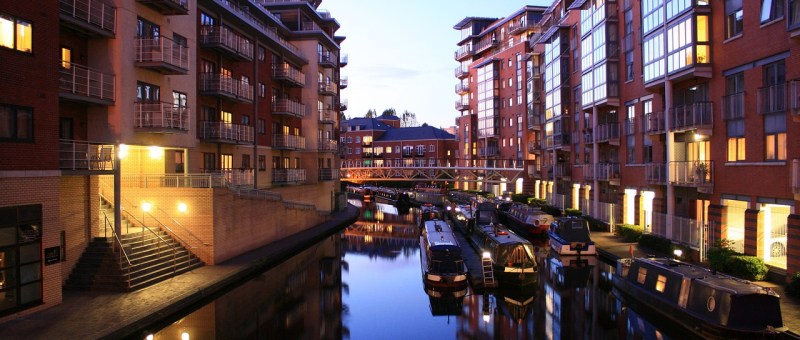
The term, Brummie, comes from the city of Brummagem, which was founded in the UK in 600 AD.

Although the city later became known as Birmingham, the name is commonly shortened to Brum, and locals are known as Brummies.

What’s It Sound Like

If you hear the Brummie accent in Birmingham, you might think, “Oy kwoyt loik it.”

But you might be alone in that.

If you’re trying to conjure up the Brummie accent without audio, possibly the most famous Brummie is Ozzy Osbourne.

Brummies are often portrayed in media as being daft or slow.

While there was a similar stigma for East Enders, there is a certain appeal to the Cockney accent amongst the Brits.

For many, the Brummie dialect does not carry with it that same charm.

James Kenny of Owlcation writes, 

“Of all the accents and dialects spoken around the British Isles, none attract as much scorn as the Brummie accent…Quite why this is, I’m not quite sure, but then again I am a Brummie myself, and therefore to my ears Brummie sounds wonderful.”

How Does Brummie Differ From Cockney & Scouse

While Cockney is known for its rhyming slang, Brummie is better known for its accent in the form of ending sentences in a downbeat.

This is in direct opposition to the Scouse accent of Liverpool, where the intonation rises in pitch.

Another unique aspect of Brummie is its monotonous tone and nonexistent aural variation. 

In comparison, Cockney is more upbeat in tone.

Brummie Slang

Just like any dialect, Brummie also has its own slang.

Some examples:

  • To say yes, you might utter “ar”
  • When complaining, you are “aggin’”
  • If you’re clumsy, you might be “cack-handed”
  • When you’re trying to flee the coppers, you’d be “legging it”
  • If you’re wearing a flat cap of the early 20th century Birmingham gang, you’re wearing a “peaky blinder” (yes, like the show)

These are just some of many terms that make up the Brummie “code.”

Next week, we’ll talk more about stereotypes related to dialects and accents.

Cockney Code: The Rough-and-Fast Rules of a Dialect

From “taking the mickey” to “making Barney Rubble,” the key to understanding dialects is to crack the code.

Some are more difficult to crack than others.

We’ve talked about how dialects formed across the UK, mostly due to its long history and isolation.

So, let’s take a look at how one might decode these complex dialects.

Cockney Rhyming Slang

One of the most commonly known English dialects, Cockney, is spoken by working-class Londoners, most often from the city’s East End – specifically within hearing distance of the church bells of St. Mary-le-Bow in Cheapside.

The dialect of Cockney is born of rhyming slang, a tradition believed to have originated in a criminal code used to fool the police or to keep customers out of the loop in the mid-19th century.

How does this rhyming slang work?

Random nouns are replaced with the odd words of common expressions. The expressions use words that rhyme with the original noun.

Some examples:

  • “Use your head” becomes “use your loaf” (“head” rhymes with “bread,” as in “loaf of bread”)
  • “I’m going upstairs” becomes “I’m going up the apples” (“stairs” rhymes with “pears,” as in “apples and pears”)
  • “Here’s your wife” becomes “Here’s your trouble” (“wife” rhymes with “strife,” as in “trouble and strife”)
  • “Give me some money” becomes “give me some bread” (“money” rhymes with “honey,” as in “bread and honey”)

Outliers in the Code

There is no end to the quirks of the Cockney dialect.

Some phrases don’t omit the rhyming word; instead, the entire phrase is used. For instance, in the case: 

  • “Would you believe it?” becomes “Would you Adam and Eve it?” (“believe” rhymes with “Eve”)

Other rhyming slang can also use obscure expressions, making the code even more difficult to crack. For instance, in the case:

  • “Having an egg” becomes “having a borrow and beg” (an expression that was renewed during WWII food rationing)

“New Cockney” even incorporates pop culture figures into the language, in the case:

  • “Christian Slater” standing in for “later” or “Sweeney Todd” is slang for a London police force unit known as “the Flying Squad.”

As you can see, unless you know the “code,” you’ll find yourself hard put to communicate in Cockney.

And British dialects in the English language split off even further.

Next week, we’ll look at how the dialect differentiates from Brummie and Geordie.

The “Code”: How Dialects Form in Language

Do you and your friends or family have a secret code?

A “language” that you speak: inside jokes, turns of phrase, or other unique features.

These idiosyncrasies bond us and distinguish our in-group from “others.”

Dialect and accent work similarly. They occur naturally when any localized group comes together, forming its own code.

Sometimes the code evolves into a whole new language.

The Proto-Germanic language is just one example.

You can see the linguistic branches grow from the Proto-Germanic trunk which, itself, is rooted in Indo-European language.

Dutch, Swedish, and English are all branches springing from this one Common Germanic mother tongue.

As the regions grew isolated, their language evolved over centuries into different Germanic languages, just as those of the Dravidian languages in Southeast Asia or the Ibero-Romance group of languages (Spanish, French, Italian, Romanian, Portuguese), which sprung from Vulgar Latin.

This is why the structural features – and oftentimes the vocabulary – of Proto-Germanic languages are similar.

Last week, we talked a little about how accents form in isolation.

Let’s explore this further by looking at the variances in English accents and dialects that exist across the UK today.

The Many Dialects of the United Kingdom

The United Kingdom is a treasure trove of language.

From its single base language of English, dozens of accents and dialects have sprung up.

Tom F. of Education First writes:

“There are almost 40 different dialects in the UK that sound totally different from each other, and in many cases use different spellings and word structure. In fact, there’s pretty much one accent per county.”

This is due to both the UK’s long history with the language, reaching back through 1400 years of English, as well as to its isolation as an island.

Further, rural inhabitants were largely immobile across many generations, making their villages even more isolated from outsiders.

Accent vs. Dialect

Before we go further, let’s differentiate between accents and dialect.

An accent is the way in which words are pronounced, while dialect is the specific vocabulary used in a region.

When examining accents and dialect under the microscope, the UK, in particular, is an interesting specimen.

In a country the size of Oregon, dozens of unique accents and dialects exist, including Cockney, Brummie, Geordie, Scouse, West Country, Yorkshire…you get the picture.

Although each is speaking a version of English, some accents and dialects are difficult for even other Brits to understand.

They are coded.

Next week, we’ll try to unlock some of these codes.

British English, American English, Antarctic English: How Do Accents Develop?

A group of British researchers spent months alone on the isolated continent of Antarctica.

There, an acoustic analysis was made of their speech characteristics as individuals.

In a matter of months, changes were observed.

The acoustical study created a computational model based partially on a common accent in Antarctica to predict the phonetic changes they expected to hear from this group’s prolonged isolation.

Recorded productions of the participating individuals were then taken and compared to the model.

In some ways, the model predicted the phonetic changes in the individuals’ accents.

Published in The Journal of the Acoustical Society of America, the results suggest that the initial stages of phonetic changes in accent occur incrementally when individuals in isolation interact.

Let’s delve deeper into this example of how accents and phonetics develop across the same language.

Shared Spoken Idiosyncrasies

Defining a spoken accent as “shared spoken idiosyncrasies across a community of speakers,” the study touches upon theories regarding potential evolutionary reasoning behind the development of accents.

Some evolutionists theorize that, due to its difficulty in imitation by outsiders, the function of an accent can allow the in-group to identify imposters, while simultaneously breeding cooperation, coordination, and camaraderie amongst individuals with the same accent.

Children are more apt at developing accents than adults, because the phonetic specifications are highly dependent on precise timing and vocal organ coordination, which is more easily acquired at a younger age.

How Accents Form

In this study, communication density was identified as the primary catalyst for accent formation.

This means that who you talk to and how often you talk to them can influence the early stages of accent formation.

The Antarctic researchers’ unique position of isolation created an environment resembling a microcosm of a former colonial settlement.

There was little-to-no communication with outside groups and yet regular communication with each other.

Being inside this bubble amplified the results.

BrainStuff’s Laurie L. Dove notes that the two primary factors influencing accent are isolation and human nature.

Dove writes,

“Human nature, vague as it sounds, simply refers to our innate love of being in groups. When a human is part of a crowd, they identify membership by wearing certain styles of clothing or eating specific foods. That group of people also may speak a certain way — so distinctly so that an accent becomes part of the group’s identity.”

What else impacts accent formation?

Next week, we’ll talk about social class, migration, and invasion.

How Does Culture Influence the Way We Use Our Brains? Find Out Here.

We’ve all heard of “right-brain” and “left-brain” thinkers.

Left-brain thinkers are thought to be more logical and mathematical, while right-brain thinkers tend to lean emotional and artistic.

But are there any links between the way our brains function and our cultures?

We’ve talked a lot about gene-culture coevolution over these past few weeks.

In short, the theory suggests that genetics and culture are interconnected.

This brain imaging study about visual perceptual tasks seems to substantiate that theory.

Individualist vs. Collective 

Psychological research has shown that individualist and collective values are demonstrated in an individual’s view of objects in relation to their context.

Americans, valuing individuality, tend to view the two as independent from each other.

East Asian cultures, which value the collective, view objects as contextually interdependent.

These differences have been shown to impact perception and memory by behavioral scientists.

The Study: How Our Brains Work

A study by the Massachusetts Institute of Technology took a look at whether these cultural tendencies can be measured in brain activity patterns.

Using functional magnetic resonance imaging (fMRI) scans from a group of 20 participants – 10 from East Asia, 10 from the U.S. – McGovern Institute for Brain Research Professor John Gabrieli and his team examined participants’ mental operations.

Participants were asked to compare a sequence of images, and their mental operations were mapped via blood flow changes in the brain.

The images were lines within squares.

Participants were asked to compare each image with the previous image, making judgments based on relative judgments of interdependent objects or absolute judgments of individual objects without context.

For instance, some questions asked whether the lines were proportional to the squares, regardless of size (interdependent); others asked whether the lines were the same length as each other, regardless of the squares (independent of context).

The Results: Confirmed

While the simplicity of the task resulted in no differences in accuracy between the groups, brain activation patterns did differ.

Relative judgments, which have been shown to be harder for Americans, stimulated the brain regions dedicated to mental tasks that demand attention. 

These regions were less active for absolute judgments.

As you might guess, the results for the East Asian group were the opposite, with brain activity becoming more active for absolute judgments and less for relative.

The paper’s lead author, Trey Hedden, said of the study:

“We were surprised at the magnitude of the difference between the two cultural groups, and also at how widespread the engagement of the brain’s attention system became when making judgments outside the cultural comfort zone.”

Even more interesting, questionnaires had been distributed prior to the exam to see how closely each individual identified with their culture, using questions regarding values and norms.

Those individuals who identified more intimately with their culture’s values showed a stronger reactive pattern of brain activity relative to their culture.

This study suggests that our culture – and how closely we individually identify with our culture – can influence the way our minds work.

Pretty heady.

Slava Ukraini: Glory to Ukraine and Its Culture

Considering current events, I wanted to take a moment to celebrate Ukraine, its culture, and its people.

The country, currently under siege by its much larger neighbor, has been independent since the break up of the Soviet Union in 1991.

Ukrainians are fiercely proud of their culture and independence.

From the ancient monasteries of Kyiv to the bright, cheery sunflower fields that are represented in their national flag, Ukraine is a country with a rich and unique history – one that most folks likely don’t know much about.

This dedicated post will provide a short summary of pieces – or sunflower petals – of Ukrainian culture.

Language

Language has been a talking point in Ukraine for years and for good reason.

Oblasts in the East speak Russian, those in the West speak Ukrainian.

And those in some central oblasts speak a combination of both, called Surzhyk.

The language divide is due to the East’s proximity to Russia and the country’s historical ties with its neighbor.

While both languages use Cyrillic, the Ukrainian alphabet has the letters – “Ґ ґ,” “Є є,” “Ї ї,” and “І і” – while the Russian alphabet does not; and the Russian alphabet has the letters – “ы,” “Ё ё,” and “ъ” – while the Ukrainian alphabet does not. 

The languages are similar in grammar and vocalization, but the Ukrainian language is actually more closely related to its northern neighbor, Poland, when it comes to vocabulary.

Many who live in Ukraine are of Russian descent, with 17.3 percent of the population identifying as ethnically Russian in 2001.

Thus, since Crimea was annexed in 2014 and the eastern oblasts of Donetsk and Luhansk became occupied territories, language has become a hot-button issue in Ukrainian politics.

Traditions and Customs

Some of the country’s brightest traditions and customs come in the form of celebration.

Image credit: Jolanta Dyr from Pixabay

As mentioned, the colors of the Ukrainian flag represent the vast sunflower fields and the brilliant blue skies that paint the countryside – a true sight to behold.

Public domain

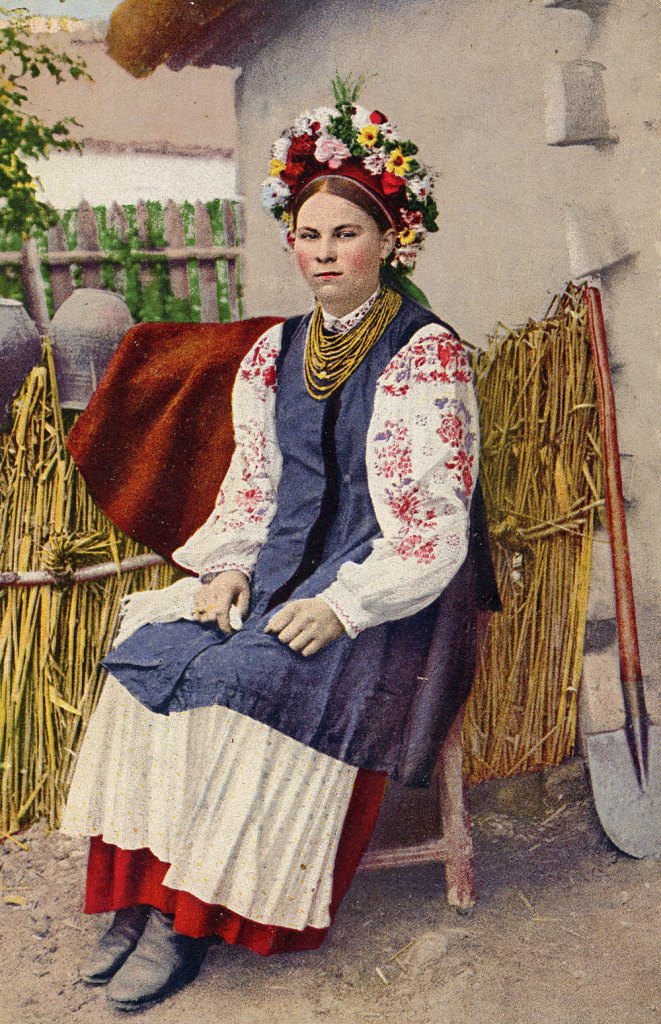
Traditional dress includes the vyshyvanka, an embroidered shirt. 

Often featuring black, white, and red thread, the embroidery design is specific to Ukrainian folk costumes.

Image by Yevhen Paramonov from Pixabay

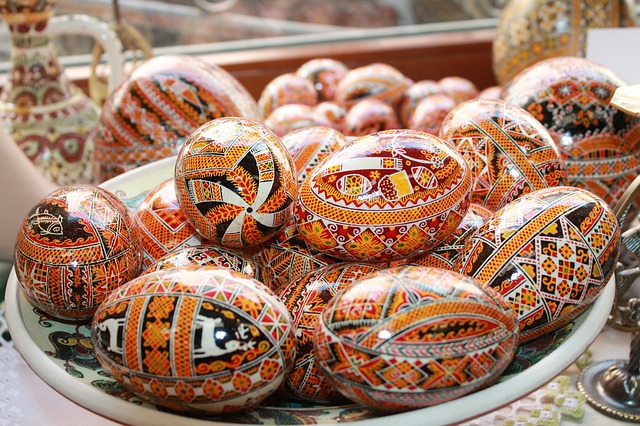
The famous Ukrainian decorated egg, the pysanka (derived from the word for “to write” or “to inscribe”), is made around Easter. 

Every pattern, detail, and coloring of the painted eggs means something.

And, according to legend, if the painting of the pysanka ceases, so does the world’s existence, as evil will overrun the world.

Slava Ukraini: Glory to Ukraine

“Ukraine is not yet dead, nor its glory and freedom”

“Ukraine is not yet dead, nor its glory and freedom,
Luck will still smile on us brother-Ukrainians.
Our enemies will die, as the dew does in the sunshine,
and we, too, brothers, we’ll live happily in our land.

We’ll not spare either our souls or bodies to get freedom
and we’ll prove that we brothers are of Kozak kin.”

These are the lyrics to the Ukrainian national anthem, translated.

The phrase you may be hearing frequently, “Slava Ukraini,” means “Glory to Ukraine.”

As this country continues to fight for its life, I hope every one of us watching can celebrate the great character and pride of its people.

Are Facial Expressions Perceived Differently Across Cultures? Find Out Here.

Languages have shaped our genetics in terms of physiological differences in speech.

The roof of the mouth, for instance, differs across cultures.

But language isn’t the only part of communication.

Facial expressions and mannerisms are a big part of communication, and the interpretation of these types of expression differs across cultures.

The facial musculature of humans is highly developed, far more so than in any other primate species.

As such, the lips and eyes reveal a lot about human emotion.

According to Herbert Gintis’ “Gene-culture coevolution and the nature of human sociality”:

“Humans have evolved a highly specialized and very costly complex of physiological characteristics that both presuppose and facilitate sophisticated aural and visual communication, whereas communication in other primates, lacking as they are in cumulative culture, goes little beyond simple calling and gesturing capacities.”

While other primate species’ may go “little beyond,” how far does ours go?

Emotional Expression

Prior studies have suggested that the evolutionary nature of facial expressions does not differ across cultures, but at least one study has found that expressions of happiness, anger, and sadness are perceived differently between the East and the West.

According to the study’s abstract:

“Briefly stated, the universality hypothesis claims that all humans communicate six basic internal emotional states (happy, surprise, fear, disgust, anger, and sad) using the same facial movements by virtue of their biological and evolutionary origins [Susskind JM, et al. (2008) Nat Neurosci 11:843–850].”

Published by the American Psychological Association in the Journal of Experimental Psychology: General, the research, led by Rachael E. Jack, PhD, of the University of Glasgow, opposes this theory.

The Study

Looking at the way in which Western Caucasians and East Asians view various expressions according to their facial features, two groups – one of Caucasians and one of Chinese participants – were selected.

The study’s participants viewed emotion-neutral faces that were altered at random using technology. They were asked to classify the faces as happy, sad, angry, disgusted, fearful, or surprised.

Researchers were then able to identify the facial features that the groups of participants associated with the emotions.

From the responses, researchers deduced that Western Caucasians focused more on the mouth and eyebrows when identifying facial expressions, while Chinese participants focused primarily on the eyes.

These differences can lead to complexities in communication across cultures, resulting in misinterpretation or missed signals of emotional expression. 

The findings support the concept of gene-culture coevolution and how culture is increasingly driving human behavior more than genetics.

We’ll talk more about cultural mannerisms and body language next week.

From Mandarin to Italian, How Language Shapes Genetics

Can you differentiate Mandarin from French or Italian?

Of course, you can. 

The sounds of each of these languages are very different, from hard or soft consonants to long or short vowels.

Due to the dynamic sounds of each mother tongue, you can see the adaptation of different vocal tracts across cultures.

These adaptations have developed across generations according to the languages spoken in countries around the world.

We discussed gene-culture coevolution last week in relation to the human species and speech.

Now, let’s talk about how speech and language have evolved our genetics across cultures.

Physiological Traits Adapt to Language

Speech-related physiological adaptations vary across the human species according to the language spoken.

Some languages, like German or Arabic, require deep guttural sounds due to the harsh consonants.

Others, like Spanish, require speakers to roll their r’s.

One of the ways in which this presents in our physiology was reported by Discover Magazine.

Researchers found that the roof of the mouth differs across cultures, according to how vowel sounds are pronounced. 

Furthermore, these anatomical variations evolve upon each generation, creating an evolution in the language itself and the sounds of speech.

The study’s author, Linguistics Expert Dan Dediu, says, 

“Even small variations in the shape of our vocal tract may affect the way we speak, and this may even be amplified — across generations — to the level of differences between dialects and languages.”

The Study

How did researchers discern this change?

The study looked at over 100 people from several ethnolinguistic groups in Europe, North America, China, and across India.

MRI scans were taken of the hard palate of each participant.

Using the scans and machine learning, computer models formed a picture into the future of the hard palate and the sounds it might produce. 

Five commonly used vowel sounds – the “uh” in sofa,” the “ah” in “hot,” the “oo” in “boot,” the “a” in “bat,” and the long “e” in “feet” – were plugged into the computer model. 

A second generation, mimicking the sounds from the first, showed the amplified pronunciation of each sound – as did 50 generational models after it.

Though the change in the shape of the hard palate over time only impacted pronunciation slightly each generation, the change in the vowel sounds after 50 generations was much more pronounced.

The researchers write that,

“besides culture and environment, quantitative biological variation can be amplified, also influencing language.”

This research begs the question: what will our languages sound like in 50 generations…and how did they sound 50 generations ago?