Eye Contact & Culture: A Guide to Understanding Non-Verbal Communication

Eye contact is a fundamental aspect of human communication, serving as a powerful non-verbal cue conveying various emotions and intentions

However, the interpretation and significance of eye contact can vary dramatically across cultures, often leading to misunderstandings in cross-cultural interactions

Understanding these differences is crucial for effective communication in global business.

Western Cultures: Direct Eye Contact = Confidence

In many Western cultures, particularly in the United States and Europe, direct eye contact is often seen as a sign of confidence, sincerity, and attentiveness. 

People who make steady eye contact during conversations are typically perceived as trustworthy and engaged.

In business settings, maintaining eye contact is crucial during negotiations and presentations, as it demonstrates interest and credibility.

But this doesn’t end at business: direct eye contact is also valued in social interactions

It is considered polite and respectful, indicating that you are actively listening and interested in the other person’s words. 

However, balance is necessary, as excessive staring can be perceived as confrontational or aggressive.

East Asian Cultures: Indirect Eye Contact = Respect

In contrast, many East Asian cultures, including Japan, China, and Korea, view direct eye contact differently.

Here, indirect eye contact is often a sign of respect and deference, particularly towards elders or those in positions of authority

Avoiding prolonged eye contact is seen as a way to show humility and politeness.

For instance, in Japan, a child might lower their gaze when speaking to a teacher or elder as a mark of respect. 

Similarly, employees may avoid direct eye contact with their superiors during meetings to demonstrate deference. 

Misinterpreting this cultural norm can lead Westerners to mistakenly perceive East Asians as being evasive or untrustworthy, when they are simply adhering to cultural standards of respect.

Studies Confirm These Differences

Research has shown that faces making eye contact are quickly detected and preferentially processed, a phenomenon known as the eye contact effect. 

This sensitivity to eye contact is believed to be innate and universal among humans

However, cultural norms influence eye contact behaviors, with Japanese individuals typically making less eye contact than those from Western European or North American cultures.

This study explored how cultural differences affect eye contact behaviors by examining autonomic responses (heart rate), looking time, and evaluative ratings of eye contact with a person displaying a neutral expression.

Participants from Western European (Finnish) and East Asian (Japanese) cultures were compared. 

The findings revealed that eye contact elicited stronger heart rate deceleration (indicative of attentional orienting), shorter looking times, and higher arousal ratings in both cultures compared to averted gaze.

However, cultural differences were evident in how participants interpreted faces making eye contact. 

Japanese participants rated faces as angrier, less approachable, and more unpleasant compared to Finnish participants. 

These results suggest that cultural norms and display rules influence how eye contact is perceived, rather than culture directly affecting physiological responses to eye contact.

We’ll talk more about culture’s influence on eye contact norms next week.

“Western Culture” as a Stereotype: Defining “The West”

Over the last few weeks, we’ve talked about stereotypes: how they can be harmful and ways in which you can use them wisely to aid cross-cultural understanding.

In fact, we use stereotypes a lot in this blog.

One of these stereotypes is the broad term, “Western culture,” which is associated with core values, norms, and beliefs.

But what, exactly, is it?

What is “Western Culture”?

What do you think of when you hear the term, “Western culture”?

You probably think of Europe, the United States, Australia, Canada – the latter three of which are highly influenced by Europe, due to their historical roots.

All of these countries mentioned (and others that fall under the umbrella of “Western culture”) hold a common set of values and norms.

However, as we’ve also highlighted in this blog, values and norms vary widely across the countries that fall under this umbrella.

In the U.K., queues are law; in Italy, it’s every man for himself.

German companies run like well-oiled machines; French companies are like royal courts.

Despite these cultural differences on a country-by-country basis, Western cultures share strong commonalities, due to their historical heritage under the Ancient Greek and Roman Empires, as well as the influence of Judeo-Christian religions.

Moreover, 18th-century Enlightenment in Europe brought forth a rationalist and secular-oriented ideology focused on social and scientific progress.

This drove such democratic values as the separation of church and state, human rights, capitalism, modern technology, and political pluralism.

Western Culture is a Stereotype 

Up until now, we never defined “Western culture” in this blog.

Yet, somehow, we all understood what it means.

This is due to the fact that “Western culture” is as much a stereotype as anything else. 

The behaviors of someone from “the West” are fixed in our mind, contrasted with how those from an Eastern culture might act or the ideology and values they might live by.

So, while we know there are differences between the values and behaviors of Australians, Europeans, Americans, etc. – and even further, between countries, regions, subcultures, and even individuals in each culture – we still recognize the broad commonalities that exist across all of “the West.” 

Use Your Discretion

If I board a plane and am seated between a Swiss person and an American, I would be more inclined to talk to the American.

This is not because I am opposed to the Swiss (I am Swiss); it’s because I want to be courteous.

Americans generally like small talk with strangers in public settings; Swiss generally don’t.

However, some Swiss might actually be prone to small talk, while some Americans will put their earbuds in immediately.

The point is, when it comes to stereotypes, applying them wisely means to use your discretion when approaching each individual.

Test the waters, apply your observational skills, and proceed accordingly.

Stereotypes blanket entire populaces, but they don’t take into account the individuality of people.

So, rather than presuming each person is attached to the stereotypical values, norms, and behaviors of their cultures, tuning in to the individual nature of a person’s preferences, priorities, and behaviors will allow you to avoid misusing stereotypes.

The Six Styles of Leadership Across Cultures, PART II

“The challenge of leadership is to be strong, but not rude; be kind, but not weak; be bold, but not a bully; be thoughtful, but not lazy; be humble, but not timid; be proud, but not arrogant; have humor, but without folly.” – Jim Rohn

Sounds like a lot. But the worst part is that, when you lead across cultures, there’s even more nuance to leadership than Jim Rohn described.

Last week, we talked about the study done by GLOBE, which identified various types of leadership styles.

Universal preference went to the charismatic/value-based leader.

After all, a personable leader who can inspire and motivate his employees is someone anyone can get behind.

However, when it comes to the other styles of leadership, cultural preferences varied.

Good vs. Bad

Unsurprisingly, leadership preferences differed based on the values of the culture.

One example: ambition.

Some cultures see ambition as a good thing, while others see it as bad.

This was reflected in the study on Maslow’s Hierarchy of Needs and in the breakdown of leadership preferences.

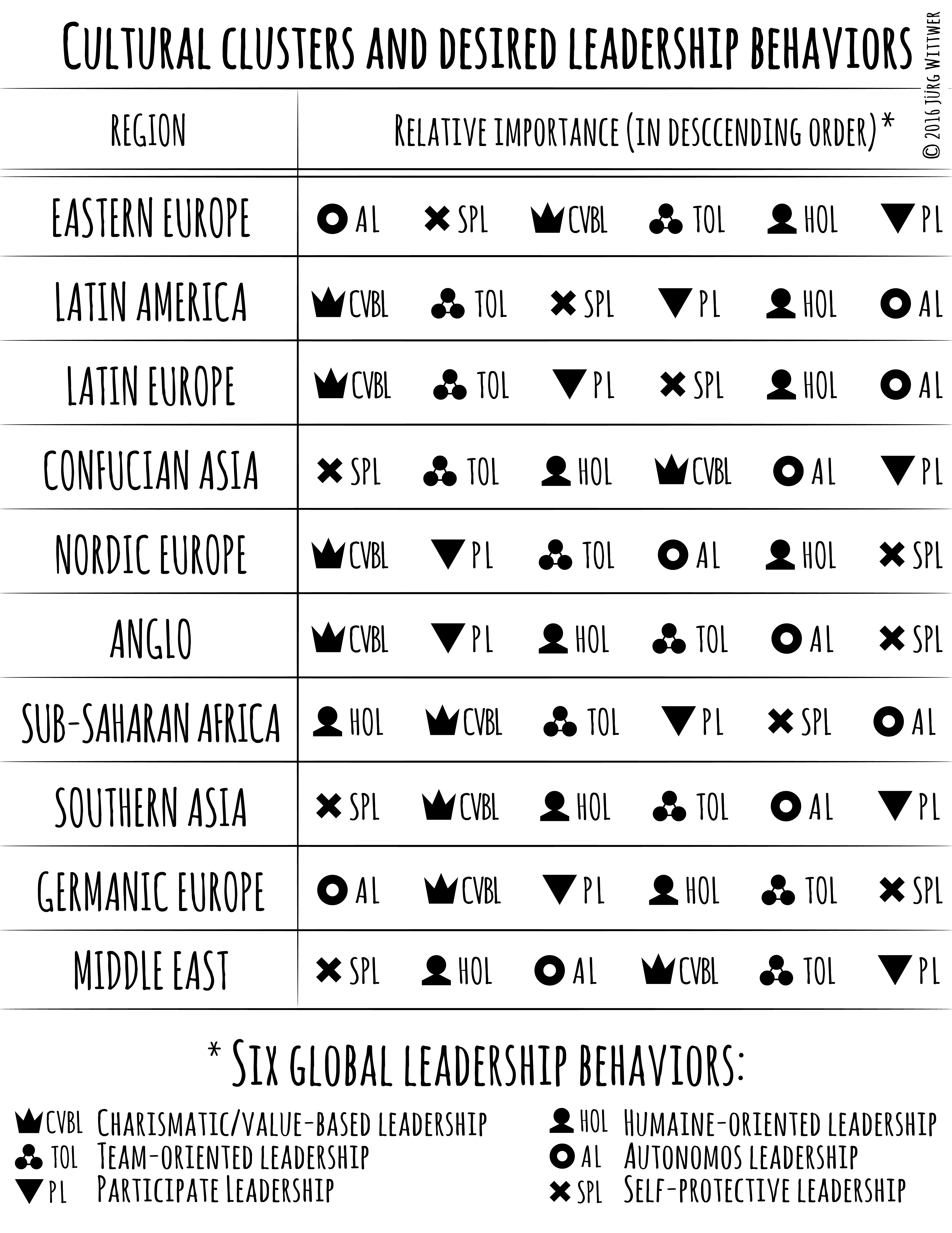
additional_charts_CMYK-06

While the charismatic/value-based leader was tops in the US, the UK, and Australia (Anglo-Saxon countries), the same leadership style was least preferred in the Middle East and South Asia, both of which sought self-protective leadership.

Human-oriented leadership was not favored in Nordic Europe but was favored in South Asia, while Latin America preferred team-orientated leadership.

Eastern Europe liked an autonomous leader, which rings true when you look at their history of favoring strong leaders.

The Roads Diverge

The greatest divergence in leadership preferences was between the Middle East and Western cultures.

Charismatic/value-based or team-oriented leaderships were favored least in the Middle East, in comparison to other regions.

Instead, the Middle East views self-protective leadership as less problematic.

Localized research also showed that Middle Eastern cultures preferred leadership attributes to include: humility, faithfulness, and family-orientation. This suggests that Western management styles would not be easily embraced.

Conclusion

The strong insights into how global cultures view leadership and what various populations expect from a leader are what make the GLOBE project a super useful tool for cross-cultural management.

For instance, due to these differences in favored leadership styles, GLOBE researchers remarked that mergers and acquisitions between European and Middle Eastern countries may be difficult.

Knowing the favored leadership styles of another culture allows international managers a blueprint for what sort of patterns are expected of them.

Instead of applying the management style you’ve learned in your own country, when you work internationally, you might tweak how you lead, applying tactical patterns from the local blueprint.

The bottom line is: employees from another culture likely expect a different type of leadership from their boss than you do from your own. So, prepare accordingly.