Eye Contact & Culture: A Guide to Understanding Non-Verbal Communication, Part II

How important is non-verbal communication?

It turns out VERY.

A World Economic Forum article explains that non-verbal cues account for a staggering 65% of all communication

Among these, eye contact holds a unique and powerful role, often associated with honesty and openness.

A 2006 study found that not only does non-verbal behavior, such as eye contact, influence how truthful we perceive a message to be, but the truthfulness of the message also affects the amount of eye contact the messenger provides.

Understanding the cultural nuances of eye contact can significantly impact our interactions.

For instance, in professional settings, maintaining appropriate eye contact can enhance credibility and foster trust.

Last week, we discussed differences in eye contact norms between the East and the West.

This week, we’ll look at other cultures worldwide and their non-verbal communication norms.

Middle Eastern Cultures: Varied Interpretations

In Middle Eastern cultures, the rules around eye contact can be complex and context-dependent.

In many Arab countries, direct eye contact between individuals of the same gender is a sign of honesty and straightforwardness. 

However, eye contact between men and women who are not closely related can be considered inappropriate and disrespectful due to cultural and religious norms.

For example, in Saudi Arabia, men and women typically avoid direct eye contact in public spaces to adhere to social conventions regarding modesty and propriety. 

A study on Arab cultural communication patterns reads:

“Nonverbal communication in Arab cultural contexts can be characterized by indirect eye contact in certain contexts, expressive body language, closeness between individuals, and relaxed attitudes toward time (Feghali, 1997). Lowering one’s gaze during face-to-face interactions with the opposite sex or between children and an older adult is considered polite (Feghali, 1997).”

Understanding these nuances is crucial for respectful and effective communication in Middle Eastern contexts.

Latin American Cultures: Expressiveness = Connection

In Latin American cultures, eye contact is often more expressive and emotive. 

People from countries like Mexico, Brazil, and Argentina use eye contact to convey warmth, friendliness, and emotional connection. 

Maintaining eye contact is seen as a way to build rapport and trust, making it an essential component of personal and professional interactions.

However, as in other cultures, there is a balance to be struck.

While eye contact is important, overly intense staring can be perceived as intrusive or aggressive.

According to this research on differences between Anglo and Latino nonverbal communication styles:

“The failure of the Latino to maintain eye contact should not be seen as expressing a lack of self-confidence. In the Latino culture direct, prolonged eye contact means you are challenging the person, that you are angry, or that you have a romantic interest in the person.”

African Cultures: Community = Context

In many African cultures, eye contact practices can vary widely depending on the community and context.

For instance, in some Sub-Saharan African societies, children are taught to lower their gaze when speaking to elders as a sign of respect, similar to East Asian norms

In contrast, in more urbanized settings, direct eye contact may be more common and accepted.

Understanding the cultural differences in eye contact is vital for effective communication and fostering mutual respect. 

By being aware of these norms, individuals can navigate cross-cultural interactions more smoothly, avoiding misunderstandings and building stronger, more respectful relationships.


High Context vs. Low Context: Navigating Cultural Communication

Communication is not just about the words we say; it’s about the nuance. 

The concepts of high context and low context communication play a crucial role in understanding how different cultures convey meaning and messages. 

These contrasting communication styles can sometimes result in conflict across cultures, so let’s dissect their cultural implications.

High Context Communication

High context communication refers to cultures where much of the meaning is conveyed through nonverbal cues, implicit messages, and contextual factors. 

In high context cultures – like Japan, China, Korea, and many Middle Eastern and Latin American countries – relationships are paramount, and communication is often indirect and nuanced.

In these cultures, individuals rely on shared cultural knowledge, social hierarchies, and implicit understandings to interpret communication accurately. 

For instance, a simple gesture, facial expression, or silence can convey volumes of meaning that may be missed by those unfamiliar with the cultural context.

Low Context Communication

Conversely, low context communication involves conveying meaning primarily through explicit verbal messages. 

In low context cultures, such as those found in the United States, Canada, Germany, and Scandinavia, communication tends to be direct, explicit, and to the point. 

Individuals prioritize clarity, transparency, and precision in their communication style.

Rather than relying heavily on nonverbal cues or contextual factors, much of the information is contained in the words themselves. 

As a result, misunderstandings are less common, but there may be less emphasis on building relationships or preserving harmony through communication.

Cultural Implications

The differences between high context and low context communication have significant implications for intercultural interactions and relationships. 

For example, in high context cultures like Japan, a simple “yes” may not always mean agreement; it could indicate politeness or acknowledgment without necessarily committing to a course of action.

Similarly, in low context cultures like the United States, individuals may perceive indirect communication as vague or ambiguous, leading to frustration or misinterpretation. 

For instance, in negotiations, a straightforward approach may be expected, whereas in high context cultures, a more subtle negotiation style may be preferred.

Meet in the Middle

As with most cross-cultural relationships, approaching these differences with understanding is paramount.

Understanding the nuances of high context and low context communication is essential for effective cross-cultural communication and collaboration. 

By recognizing and respecting cultural differences in communication styles, individuals can navigate intercultural interactions with sensitivity and empathy, fostering mutual understanding and building stronger relationships across cultural divides. 

As the world becomes increasingly interconnected, the ability to bridge cultural gaps through effective communication becomes ever more vital for success in our globalized society.

‘Simpatia’ and Spontaneous Helping: What Values Contribute to a Culture of Volunteering?

Do you find time to volunteer?

For what reason?

Is it something personally important to you? Or is it something that your culture values?

We’ve been talking about prosocial behavior in culture over the last couple of weeks, including donating money.

This week, we’ll look at what values might contribute to a culture of volunteering.

Spontaneous Helping

When you think of volunteering, you probably think of giving your time and energy regularly to an organization – working at a food bank, helping your church bake sale, participating in big brother/sister, etc.

But there are different forms of volunteering.

One form – spontaneous helping – was the focus of a study on cross-cultural differences in helping strangers.

Research was conducted in big cities – New York, Shanghai, Rio de Janeiro, etc. – of 23 countries.

Non-emergency situations were set up, in order to assess how frequently strangers might proactively come to a person’s aid.

These situations included a stranger dropping a pen, a stranger with an injured leg trying to pick up magazines, and a blind person crossing the street.

These three measures resulted in a relatively stable helping rate per city.

But the findings across cities varied greatly.

Brazilians vs. Malaysians

The highest helping rate – 93% – was found in the city of Rio de Janeiro.

This finding is in line with past studies of cultural norms in Spanish and Latin American countries.

Such studies have highlighted the cultural value of “simpatia” in such cultures – i.e. a demonstrated politeness and helpfulness to strangers and a proactive concern for others.

The lowest helping rate – 40% – was found in Kuala Lumpur, Malaysia.

Being that both Brazil and Malaysia are collectivist cultures, this result contradicts the theory that collectivist societies might have a higher helping rate than individualist societies, due to their social orientation.

In reality, the results were all over the map in relation to collectivism vs. individualism and helping, with cities in some collectivist countries averaging higher helping rates – like San Jose, Costa Rica (91.33%) and Lilongwe, Malawi (86%) – while others had low rates – like Singapore (48%) and Sofia, Bulgaria (57%).

Conversely, some individualist cultures were high on the scale – like Vienna (81%) and Copenhagen (77.67%) – while others were low – like New York City (44.67%) and Amsterdam (53.67%).

Economic Productivity

One curious finding was the inverse relationship between helping and the country’s economic productivity.

That is, helping occurred less on the whole in wealthier countries than in poorer ones.

This might suggest that some cultures show more care for each other out of necessity.

Next week, we’ll talk more about different avenues of volunteering and their cultural relevance.

The Six Styles of Leadership Across Cultures, PART II

“The challenge of leadership is to be strong, but not rude; be kind, but not weak; be bold, but not a bully; be thoughtful, but not lazy; be humble, but not timid; be proud, but not arrogant; have humor, but without folly.” – Jim Rohn

Sounds like a lot. But the worst part is that, when you lead across cultures, there’s even more nuance to leadership than Jim Rohn described.

Last week, we talked about the study done by GLOBE, which identified various types of leadership styles.

Universal preference went to the charismatic/value-based leader.

After all, a personable leader who can inspire and motivate his employees is someone anyone can get behind.

However, when it comes to the other styles of leadership, cultural preferences varied.

Good vs. Bad

Unsurprisingly, leadership preferences differed based on the values of the culture.

One example: ambition.

Some cultures see ambition as a good thing, while others see it as bad.

This was reflected in the study on Maslow’s Hierarchy of Needs and in the breakdown of leadership preferences.

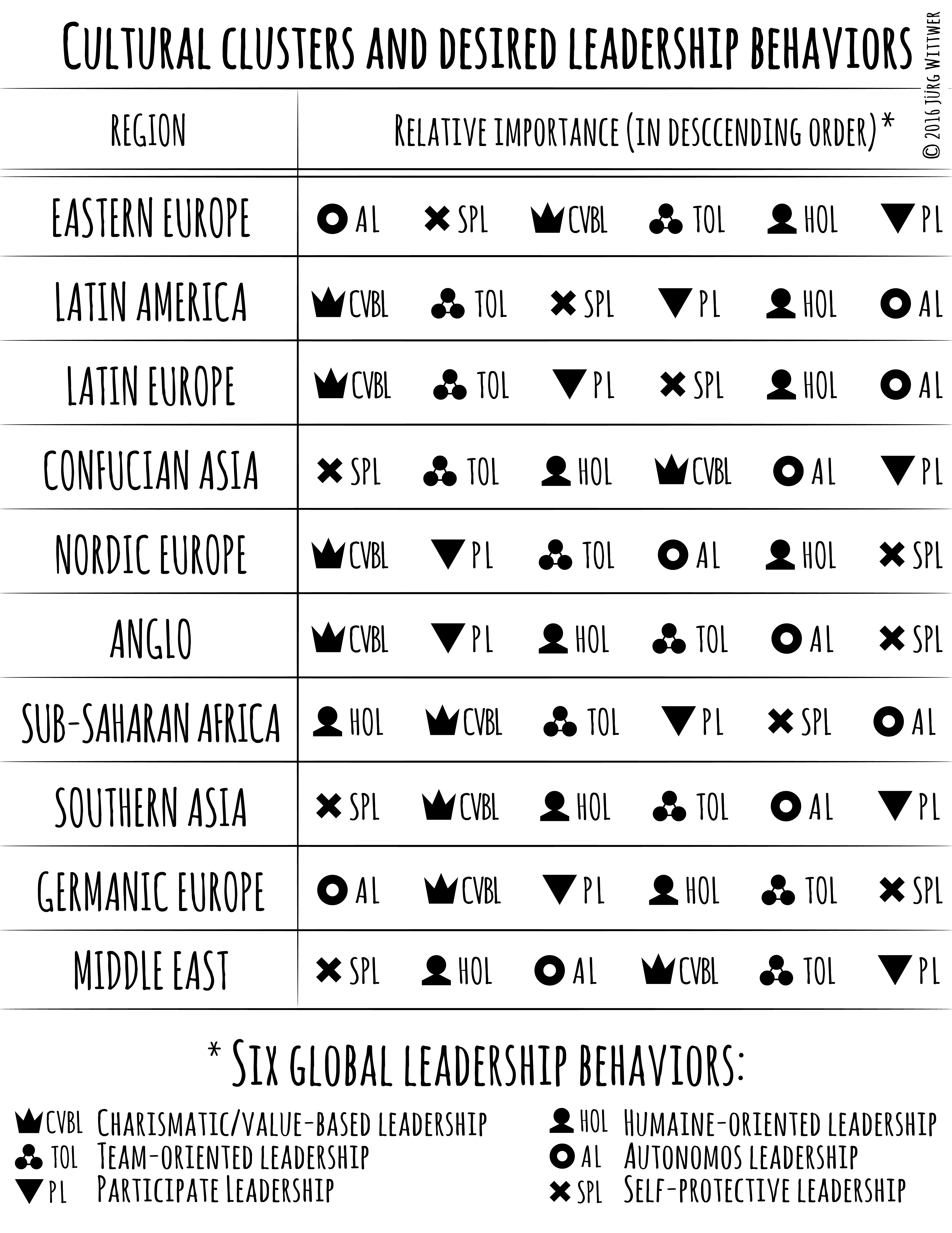
additional_charts_CMYK-06

While the charismatic/value-based leader was tops in the US, the UK, and Australia (Anglo-Saxon countries), the same leadership style was least preferred in the Middle East and South Asia, both of which sought self-protective leadership.

Human-oriented leadership was not favored in Nordic Europe but was favored in South Asia, while Latin America preferred team-orientated leadership.

Eastern Europe liked an autonomous leader, which rings true when you look at their history of favoring strong leaders.

The Roads Diverge

The greatest divergence in leadership preferences was between the Middle East and Western cultures.

Charismatic/value-based or team-oriented leaderships were favored least in the Middle East, in comparison to other regions.

Instead, the Middle East views self-protective leadership as less problematic.

Localized research also showed that Middle Eastern cultures preferred leadership attributes to include: humility, faithfulness, and family-orientation. This suggests that Western management styles would not be easily embraced.

Conclusion

The strong insights into how global cultures view leadership and what various populations expect from a leader are what make the GLOBE project a super useful tool for cross-cultural management.

For instance, due to these differences in favored leadership styles, GLOBE researchers remarked that mergers and acquisitions between European and Middle Eastern countries may be difficult.

Knowing the favored leadership styles of another culture allows international managers a blueprint for what sort of patterns are expected of them.

Instead of applying the management style you’ve learned in your own country, when you work internationally, you might tweak how you lead, applying tactical patterns from the local blueprint.

The bottom line is: employees from another culture likely expect a different type of leadership from their boss than you do from your own. So, prepare accordingly.

10 Cultural Universals: Rites of Passage & Familial Roles

Last week in our ten-part series of the 10 Cultural Universals, we talked about family structures.

This week, we’ll continue our discussion of family by identifying the roles of family members and rites of passage across two cultures.

Let’s travel to Mexico and Algeria to experience them both.

Familial Roles

Roles of family members form the structure and the line of authority within a family.

Mexico

The Mexican family is patriarchal and follows traditional gender roles. The father is the authoritarian figure, while the wife is generally submissive.

This cultural trend is believed to have developed from the 16th century Spanish conquistadors’ treatment of native women. After they’d been impregnated, they were treated with violence and threats of abuse in order to be made subservient.

The resulting “mestizo” children grew up with this devaluation of women normalized, which evolved the roles that exist today, particularly the concept of “machismo.”

Algeria

In Berber culture, traditional gender roles also reign supreme, with men working outside the home and women tending the house and raising the children. The eldest son steps into the authoritarian role of financial caregiver in place of the father, when he retires or passes away.

Grandparents, as well, play an important story-telling role in Berber society.

In the recent past, the entire family – often three or four generations – would gather around the elkanoun (fireplace) and listen to stories of morality told by the grandmother and grandfather.

The stories served as educational guides for their family, especially the young children.

Rites of Passage

Mexico/Latin America

A quinceañera is a rite of passage in Mexico, Cuba, Puerto Rico, and Central and South American countries.

During this huge 15th birthday party, which is both a social and religious event, the family celebrates the young woman’s passage from girlhood to womanhood. The celebration is also meant to highlight how meaningful society and family are in the life of women.

A mass, attended by her family and godparents, commences the celebration, followed by a large party with music, dancing, and food.

During the party, the young woman might present her younger sister with a doll as a symbolic gesture of passing from childhood to adulthood.

Algeria

In Algeria, a boy’s first haircut is celebrated with a big party to which all of the family is invited.

The wisest, oldest male member of the family – usually the grandpa on the dad’s side – cuts the first strand, and a traditional bread called lamsemen is cooked and placed on the young boy’s head.

Often, the grandma says to the child, “You will be strong and fat, like the bread.”

During Carem (Ramadan) the first time a child fasts, they are placed on the roof of the house during the Call to Prayer. There, they eat their meal – a special dish of eggs and bercoukes.

These are just a few important rites of passage and familial roles across cultures. Next week, we’ll talk about FCTS (food, clothing, transport, and shelter), some of the very basic aspects of culture.