“It’s All Greek to Me”: The Origin Story of Language Confusion

You’re traveling with your friends in a foreign country.

You stop at a restaurant for lunch.

The menu is in the local language.

When one of your friends asks you to translate, at a loss, you flit through the menu and mutter, “It’s all Greek to me.”

No, you’re not in Greece, but the phrase still stands.

“It’s all Greek to me” found its way into the vernacular of many English speakers, often used to express bewilderment when encountering something incomprehensible. 

But where did this curious expression originate, and how has it permeated popular culture?

Greek Origin Story

No, it did not emerge from the skull of Zeus.

The earliest recorded usage of “It’s all Greek to me” can be traced back to Shakespeare’s play Julius Caesar, written in 1599. 

In Act 1, Scene 2, Casca says,

“Those that understood him smiled at one another and shook their heads; but, for mine own part, it was Greek to me.” 

Here, the phrase is employed to convey Casca’s inability to comprehend a speech delivered in Greek by a Roman senator.

The usage likely stems from the perception of Greek as a complex and unfamiliar language to English speakers of that time. 

This association between Greek and incomprehensibility persisted over the centuries, solidifying the phrase’s place in the English lexicon.

Pop Culture

The phrase has made numerous appearances in literature, film, and media, often serving as a humorous or ironic expression of confusion. 

In Douglas Adams’ The Hitchhiker’s Guide to the Galaxy, the character Ford Prefect remarks, “It’s all Greek to me,” when confronted with the Vogon poetry, known for its excruciating awfulness.

Similarly, in the film My Big Fat Greek Wedding, the character Gus Portokalos frequently uses the phrase to dismiss anything he finds perplexing or foreign, despite his own Greek heritage. 

This comedic use underscores the universality of the expression.

Beyond its literary and cinematic appearances, the phrase has also found a place in everyday conversation, often invoked with a hint of self-deprecation or resignation when faced with complex or obscure subject matter.

“It’s All Greek to Me”

Whether it’s Greek or not, this fun expression continues to capture the universal experience of grappling with the incomprehensible. 

Its longevity speaks to the enduring power of language to illustrate shared human experiences, even across cultures and centuries. 

So, the next time you find yourself confronted with something utterly perplexing, find your inner Casca and suggest, “It’s all Greek to me.”


3, 2, 1…New Year’s Traditions From Around the World, Part III

As the clock strikes midnight and the world bids farewell to one year, diverse cultures welcome the new with unique traditions, each created by symbolism and fun. 

In Part I, we learned about “First Footing” in Scotland.

In Part II, we discovered the polka-dotted Philippines.

And this year, we’ll explore Greece, Brazil, and Colombia, where we’ll find that the global celebration of New Year’s Eve traditions continues to weave its tapestry of hope, luck, and the shared human desire for a brighter tomorrow.

Smashing Pomegranates in Greece

The Greeks engage in Podariko, a New Year’s custom involving pomegranates, seen as symbols of luck, prosperity, and fertility.

Before midnight on New Year’s Eve, households hang pomegranates on their doors, and just before midnight, lights are turned off.

A chosen individual reenters the house with the right foot first, bringing good fortune. 

Subsequently, another person smashes the pomegranate against the door, and the more seeds, the better – more seeds symbolize increased luck for the coming year.

Seven Wishes/Seven Waves in Brazil

Keep in mind that New Year’s is during Brazil’s summertime.

So, Brazilians often celebrate a beachy New Year’s Eve.

And in order to guarantee a successful year, immediately after midnight, people jump seven waves while making seven wishes.

Rooted in homage to Yemanja, the goddess of water, the tradition involves wearing all white, symbolizing purity, before taking the plunge into the waves.

Empty Suitcases in Colombia

Calling all globetrotters!

A favorite tradition among travel enthusiasts in Colombia involves running around the neighborhood with an empty suitcase, symbolizing a desire for numerous trips in the coming year.

If you also want to divine love or prosperity in your new year, choose your underwear wisely.

Wearing red underwear is believed to attract love, and many embrace this practice to welcome romance into their lives.

Yellow underwear, considered to possess “magical powers,” is worn to invite economic wealth and prosperity.

Maybe you’re greedy and want both.

You might consider wearing two pairs of underwear.

Wherever you’re celebrating, ring in the new year with some of these interesting New Year’s traditions and declare yourself a global citizen!

How Does Maslow’s Hierarchy of Needs Stack Up Across Cultures

Management trainings often cut out the cross-cultural nature of leadership expectations, hierarchies, and values and norms.

So, when you’re put into a cross-cultural leadership position, you’re a fish out of water, and you don’t have much to guide you.

Maslow’s “Hierarchy of Needs”

In Maslow’s theory, human motivation is pretty straight forward.

His “hierarchy of needs” is taught across many business administration curriculums and has been since its inception in the early ’40s.

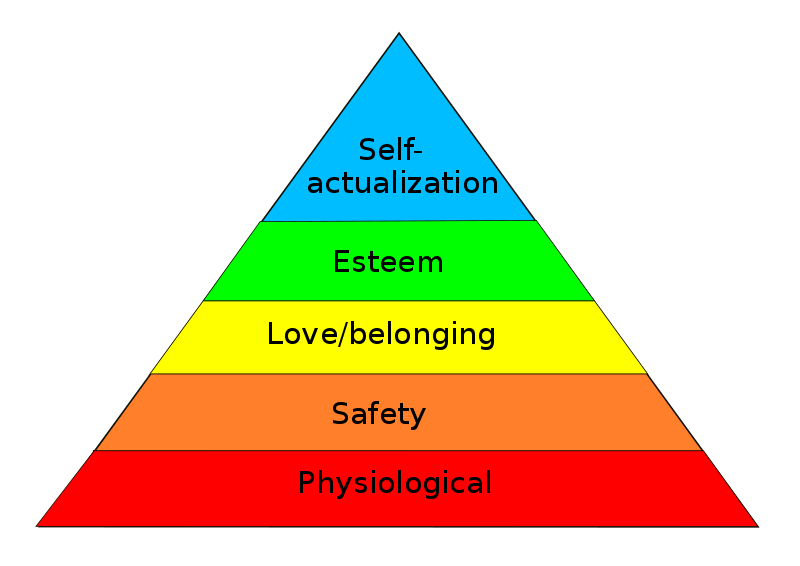
It was in 1943 that researcher Abraham Maslow identified basic human needs and categorized them in a pyramid.

hierarchy of needs
FireflySixtySeven [CC BY-SA 4.0 (https://creativecommons.org/licenses/by-sa/4.0)%5D

At the bottom are the most basic physiological needs:

When a person’s most basic human needs are satisfied, their more complex emotional and psychological needs rise to the top:

  • Love/belonging
  • Esteem
  • Self-fulfillment/actualization

Think about these needs. Do you feel them in this order and manner?

What A Man Can Be

Maslow once wrote:

“What a man can be, he must be.”

This explains the pyramid in a nutshell: if we can achieve something greater than simply meeting our physiological needs, we will seek it out.

The hierarchy of needs may seem instinctive to the Western mind, so much so that Western managers apply this basic model to motivate their teams and incentivize success.

Self-fulfillment would then be the highest motivation, manifesting itself in power and personal career development.

However, as it turns out, this hierarchy of needs hasn’t stood the cross-cultural test.

Security, Social Needs, & Quality of Life

Let’s take a look at Greece and Japan.

Self-actualization in these countries is undercut by security needs.

According to research done within IBM World Trade Corporation:

“At the country level, higher mean stress turned out to be associated with stronger rule orientation and greater employment stability…When [the mean level of anxiety] is higher, people feel more stressed, but at the same time they try to cope with their anxiety by searching for security.”

Both Japan and Greece had high Uncertainty Avoidance Indexes, which indicate higher stress and anxiety levels.

This is why life-long job security supersedes climbing the corporate ladder or seeking out challenging work in these countries and may be another reason Japanese companies keep on workers even though they may be subpar or their positions could be made redundant.

On the other hand, Norway, Sweden, and Denmark place a lot of emphasis on quality of life, thus building a career takes a back burner to social needs.

Hofstede Disagrees

As Geert Hofstede duly notes:

“My interpretation is that this tells us more about Maslow than about the other countries’ managers. Maslow categorized and ordered his human needs according to the U.S. middle-class culture pattern in which he was embedded himself – he could not have done otherwise.”

This can be said about many studies that unintentionally (or intentionally) discount cross-cultural differences.

Cross-cultural values and norms are not much considered when identifying “human needs.”

Instead, every human is painted with one brush; the brush of whichever culture is doing the research.

The Baobab Theory of Culture

Most folks who are interested in culture have heard about the Iceberg Theory.

The phrase was coined by Ernest Hemingway and applies to his style of writing – a.k.a. the theory of omission. But it also applies to culture.

The idea is that the deeper meaning of a story is below the surface. Or, in the theme of our blog, the deeper meaning of a culture…

Like an iceberg, that which we see of culture only makes up a small portion of the whole. What lies below is even more astounding and impactful.

But I’d like to expand on the Iceberg Theory and compare culture to a baobab.

The Baobab

We talked last week about the mythical baobab tree.

For the purpose of this theory, the baobab’s huge trunk and canopy will represent the visible part of culture.

Traditional clothing, food, art, architecture, language, gestures, appearance, behavior – this is all represented in the visible part of the baobab.

Behavior is often regulated by norms. Folkways, mores, taboos and laws are all represented above the surface.

The small branches at the edges of the canopy represent folkways, the most flexible of the norms. As the branches extend toward the trunk, they become thicker and more rigid. These are a society’s mores. They’re stricter and often based in deeper values.

And the trunk, itself? This represents a culture’s taboos and laws. Punishment for those who do not adhere to these two sets of norms is the most severe. Society members must comply, or they’ll be ostracized or imprisoned.

Know Before Traveling

While knowing the baobab – or the visible part of a culture – is only the beginning of full-on cross-cultural integration, this basic intro would probably be enough for brief travel to a foreign country or a short business trip.

For instance, if you’re traveling to Greece, it would be nice to know that their official working day ends during the early afternoon. Moreover, when formal events are held at work, they are often attended by only employees of the same rank.

Or if you’re on business in the UK, you’ll find that business culture there is quite direct. You’ll also find that the Brits are often on first-name basis with fellow colleagues and superiors. This may seem in stark contrast to the stereotypical image of their formality.

On the other hand, if business takes you to Portugal, you might be addressed very formally as “doutor” (doctor), whether you have a doctorate or not. Everyone with a university degree is honored with this title. You’ll also find that nepotism isn’t an issue in Portugal, as business and personal relationships are often intertwined.

Below the Surface

While all of these aspects are visible parts of the cultural baobab, this begs the question: what lies below the earth?

In the baobab’s case, an enormous network of roots spread into the soil as a culture’s underlying invisible values. We’ll talk about these roots next week.