
Locus of Control: How Region & Gender Influence Your Sense of Control

The degree to which a person believes in destiny is largely formed by their culture.

It can also be influenced by location, gender, ethnicity, and many other factors that impact a person’s primary socialization and conditioning.

Last week, we discussed the role culture plays in the locus of control.

This week, we’ll continue that discussion, fleshing out the roles location and gender have in a person’s sense of control over his/her own life.

Location, Location, Location

In John H. Sims and Duane D. Baumann’s study, “The Tornado Threat: Coping Styles of the North and South,” a survey was taken across two U.S. states: the state of Illinois and the state of Alabama.

The objective of the survey was to identify why these two states reacted differently in preparing for natural disasters, specifically tornadoes.

Alabama often has an alarmingly higher number of fatalities (23 in 2019, for example) than Illinois (0 in 2019).

One factor that may be contributing to that difference in coping with tornadoes is the locus of control.

After surveying four counties, a majority of Alabama residents demonstrated an external locus, while a majority of Illinois residents demonstrated an internal locus.

Considering the locus of control dictates to what degree a person/group feels they have control over their own fate, the line of logic suggests that preparation for natural disasters would differ across these two states according to the group’s collective locus.

More precautions would be taken by Illinois residents whose internal locus of control would make them proactive in reacting to tornado warnings, as they believe they have control over the outcome, while residents of Alabama, with their external locus of control, are more prone to leaving fate up to the whims of nature.

The conclusion, then, is that a region’s collective locus of control can influence the number of fatalities caused by natural disasters – and likely influence many other things related to our sense of control or lack thereof.

Gender

Gender also comes into play in regards to one’s locus of control.

One example of this can be found in M. A. Hamedoglu’s “The Effect of Locus of Control and Culture on Leader Preferences.”

In testing undergraduate students from Western and Eastern cultures, this study found that men are more often of an external locus of control, giving preference to autocratic leadership styles, while women are geared more toward an internal locus of control, preferring democratic leadership styles.

This collective locus regarding gender can impact everything from leadership preference to conflict resolution to one’s sense of accountability.

Next week, we’ll talk about how individuals across cultures try to control their fate, whether their locus of control is external or internal.

How Culture Impacts a Person’s Sense of Control (aka Locus of Control)

Do you believe in fate?

Last week, we talked about how the degree to which someone feels life is directed by destiny dictates their locus of control – that is their feeling of control over their own lives.

Let’s look at how the locus of control unfolds in the workplace.

The Blame Game

When a goal is set and not reached in a workplace environment, the reactions of your colleagues can be very telling.

Sheila blames Jeremy for not delivering the documents in time for her to complete her task.

Jeremy blames Tom for not communicating promptly.

Tom blames his home life for distracting him.

Team Leader Lisa admits she missed the mark and should have taken the campaign in another direction. She apologizes for the part she played in not meeting the goal.

People with an internal locus of control take personal responsibility for their role in a group’s failure, while those with an external locus point at everyone else but themselves, whether they see fault in the “weakest links” of the group or in external factors.

Cross-Cultural Factors

How do cross-cultural factors come into play in the locus?

The locus of control is directly related to personality orientation; however, social psychologists have begun to study the majority locus of control in various cultures and the factors that influence it.

They’ve discovered that quite often the people of any given culture look at fate or self-control in a generally collective manner.

As you may have guessed, individualist cultures generally demonstrate an internal locus of control. They believe they’re the masters of their own fate.

Collectivist cultures – like those of China or Japan – demonstrate an external locus. They accept that things are out of their hands and don’t put weight on the individual’s role in the whole.

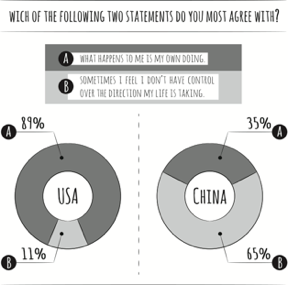
To illustrate this, when Americans and Chinese were surveyed about their view of fate, these were the results.

locusofcontrol

89% of questioned Americans agreed with the statement, “What happens to me is my own doing,” while 65% of Chinese admitted, “Sometimes I feel I don’t have control over the direction my life is taking.”

This aligns with each culture’s dominant traits, with Americans espousing ambition, individualism, and the “American dream,” while China espouses harmony and collectivism.

Next week, we’ll talk a little bit about how the group locus of control can be divided up further amongst ethnic groups and even simply locations in the same country. We’ll also talk about primary and secondary control. Stay tuned.

The Locus of Control: Do You Believe in Fate?

Late to work?

Missed a deadline?

Passed over for a promotion?

Believe it or not, how you view the circumstances surrounding these outcomes has everything to do with culture.

Are your choices, actions, and performance responsible for the results? Or do fate or environmental factors come into play?

Your locus of control will tell us everything we need to know.

Locus of Control

Developed by psychologist Julian B. Rotter in 1954, the locus of control is the degree to which a person believes they’re in control of their life. Rotter developed four dimensions of fundamental self-evaluation in his personality study, the other three dimensions of which include neuroticism, self-efficacy, and self-esteem.

Setting those three aside for now, the locus (Latin for “place”) is either internal or external.

One with an internal locus of control tends toward feeling in control of the events in his life; one with an external locus tends toward ascribing his life’s path to destiny, fate, or chance.

A person with an external locus believes environmental factors determine the outcome, and nothing he does can change that.

Internal vs. External

“You can walk around softly everywhere by putting on a pair of shoes, or you can demand that the whole Earth become covered by soft leather.”

This Indian proverb illustrates perfectly the locus of control.

Those with an internal locus put on a pair of shoes to make their walk comfortable; those with an external locus believe the environment must change in order to make them more comfortable.

Internal Locus

“I am the master of my fate: I am the captain of my soul.” – William Ernest Henley

It may come as no surprise that optimism and ambition are characteristic of those with an internal locus of control.

Being that individuals with an internal locus believe they affect change in their own lives, they have a sense of purpose, because they determine the outcome.

This gives those with an internal locus a sense of responsibility for their successes/failures, happiness/unhappiness, etc.

“Where there’s a will, there’s a way,” is their battle cry. The internal locus believes it can alter its course. In that sense, those with an internal locus hold themselves and others accountable for their actions and the outcomes these actions produce.

External Locus

On the other hand, the battle cry for those with an external locus might be, “Life is what happens to you.”

The external locus drives realistic and fatalistic views of life events.

Life is predestined, written in the stars, for individuals with an external locus, resulting in a sense of limitation when it comes to personal control over one’s future.

This acceptance of limitation suggests that any outcome is at least partly based on one’s own good fortune or luck.

We’ll talk about how all of this comes to a head cross-culturally, both socially and in the workplace, next week.

How Time Orientation & Chronemics Impact Queuing & Workplace Culture

Chronemics, which we described in a past post as the study of time’s role in communication, directly correlates with time orientation, discussed last week.

Knowing that some polychronic cultures view time as cyclical and sometimes don’t even have future tenses in their language, you may have guessed that polychronic cultures are often past-oriented.

Monochronic cultures, on the other hand, are largely future-oriented.

Here are a few ways in which chronemics direct cultural behaviors.

Queuing Culture

queue

Have you ever queued up in a foreign country and been cut in front of?

If you have and immediately thought to yourself, “how rude!” then you’re probably from a monochronic culture. Monochronic cultures are often cultures of law and order.

As this article by Leon Mann, “Queue Culture: The Waiting Line as a Social System,” published in American Journal of Sociology writes:

“Cultural values of egalitarianism and orderliness are related to respect for the principle of service according to order of arrival which is embodied in the idea of a queue. The importance of time in Western culture is reflected in rules relating to ‘serving time’ to earn one’s position in line, and to the regulation of ‘time-outs.’”

Remember, monochronic cultures – like the U.S. – are also cultures where “time is money.” So, essentially, if someone cuts the line, individuals in such cultures might consider this behavior as theft of time and/or money. The offender is essentially saying their time is more valuable than that of those they’ve cut.

Polychronic cultures do not queue orderly, if at all. They crowd and scrap their way to the front of the line. In fact, cutting in line is almost a sport in such cultures.

Although even some of those who are of polychronic cultures might get upset when cut, the queueing culture (or lack thereof) is, more or less, accepted.

Actions & Their Consequences

Another way in which chronemics and time orientation impact cultural behavior is the consequences of certain actions at work.

The chart below highlights some examples:

workplace.jpg

Monochronic cultures are deadline-driven and task-oriented regarding both negotiations or projects. And, more often than not, the hierarchy within the organization is enforced.

For polychronic cultures, a deadline is just a suggestion, and negotiations don’t end until an agreement is made. Even then, the contract is amendable.

Moreover, organizations are interaction-oriented, rather than task-oriented, and the hierarchy within the organization is not as rigidly enforced if one even exists.

We’ll look at these ideas in action next week.

4 Types of Cultural Time Orientation & Time Perception

The ways in which individuals in a culture work and how they view time frames are dictated by whether a culture runs according to a polychronic time system or a monochronic time system.

We talked last week about cultures with informal concepts of time, including cultures that view time as exclusively present (not past or future) and those who view time as cyclical.

How is this time-orientation learned? Let’s take a look.

Values & Norms

Just as values and norms are a culture’s learned behaviors, so is time perception.

Time perception is based on a society’s values. As we mentioned in an earlier post, those from monochronic cultures value relationships above all else. So, if they miss a deadline in lieu of putting time into a family matter, it’s a nonissue.

So, just as children learn values – such as the importance of family – during their primary socialization, so they are oriented toward a specific time cognitivism based on those values.

Time Orientation

There are four different types of time orientation.

These are:

  • Past – the past and the present are interchangeable in past-oriented cultures. They often do not fully grasp elapsed time.
  • Time-line – this type of time cognitivity is a detail-oriented linear concept of time. However, time-line cognitivity does not lend itself to multitasking.
  • Present – you might think of a thrill-seeker when you think of present-oriented cognitivity. These are low-risk aversion cultures.
  • Future – the goal-setting, forward-thinking cultures are future-oriented. Those with future-oriented cognitivity look at the bigger picture and follow their plans through to achieve that picture.

What is affected by time orientation?

Communication, particularly the content of what’s being communicated, as well as the urgency and frequency of communication.

Who Belongs Where

Older countries with centuries of history, such as India and China, are generally past-oriented. The broad scope of time in these cultures enables a view of time that judges minutes and hours as inconsequential.

Forget the stampede and the rush to meet goals. The clock doesn’t rule such cultures – or, in fact, industry or infrastructure in such cultures. A train in India will be late, and few will bother. Late trains and missed deadlines are to be expected.

Cultures who live for today, like France, are considered present-oriented. Their values are more often thrill-seeking and pleasure-based, rather than with a view on the future or the past.

Newer countries with an eye on innovation and the future, like the US, are future-oriented. The “American Dream,” for instance, is a quintessential thread in the country’s cultural fabric.

A dream is an ideal to work toward; hence, it’s always in the future. Milestones are often set to achieve this ideal. And the clock is ticking. This leads to a culture working against the clock.

Time orientation combined with a culture’s values dictate much about the way individuals in said societies live their lives.

We’ll talk about how monochronism and polychronism falls into time orientation next week.

Time is Present: Why Some Cultures Take an Informal View of Time

When a culture appears to have no concept of time whatsoever, their behavioral patterns might irk those from cultures that do.

To better understand this informal view of time, let’s take a quick look at some of these polychronic cultures.

Pirahã Tribe

When you live in the Amazon, a strict monochronic concept of time is unnecessary.

Enter, the Pirahã tribe.

Frozen in time in the middle of the rainforest, the Pirahã’s concept of time is also seemingly frozen.

Their language and behavioral patterns illustrate their concept of time.

There is no past tense in the Pirahã language. Time is a present concept. The future and the past don’t exist.

The tribe’s concept of time may also contribute to their lack of creation myth or religion.

Cyclical Time

Hinduism, Buddhism, and certain Native American tribes – especially the Hopi tribe of Arizona – view time not as linear but as cyclical.

The Hopi language is absent of verb tenses and, similar to other ancient philosophies, such as those mentioned above, their religious/spiritual concepts highlight a cyclical perception of time.

Buddhism even illustrates cyclical time in the famous “wheel of life,” seen below.

blog105-2

The West’s Perception of Polychronic Time

When Western countries – or those of monochronic cultures – collaborate with polychronic cultures, they might perceive the polychronic perception of time as rude or inconsiderate. Missing deadlines, running late – these things are unacceptable in monochronic cultures, whereas in polychronic cultures, they’re not uncommon, and they aren’t considered rude or inconsiderate.

Why?

Because relationships are ultimately the most important thing.

Many who live in polychronic cultures try to please everyone, making appointments with numerous people at once, scheduling the impossible.

They know they are not superhuman, and they don’t expect to attend to each appointment at their scheduled time; they simply accept that they’ll arrive in their own time.

In other words, people of polychronic cultures are not ruled by a timetable.

Western cultures might find this concept of time baffling. Western time is precise and strictly divided between tasks, especially in the business world.

Since the Industrial Revolution, monochronic time systems have made workers mechanisms in a machine. If workers don’t arrive on time, then the tasks aren’t completed. If the tasks aren’t completed, then money is lost.

“Time is money.”

With such a view, time has value. So, if you’re wasting someone’s time, you’re essentially wasting their money too.

Next week, we’ll discuss how these perceptions of time impact cultural time orientation.

The Difference Between Polychronic & Monochronic Time Systems

Sara starts dinner at 6, finishes at 6:30, and washes the dishes at 8. She walks the dog at 8:30 and arranges to run some errands the next morning at 9, while organizing her schedule that evening. She answers emails immediately in the morning and responds to phone calls at a set point in the day, when each of her pre-scheduled tasks has been completed in an orderly fashion.

Sara runs on a monochronic time system.

Shannon washes the dishes while cooking, walks the dog while running errands, loosely arranges her schedule while answering emails, takes phone calls while finishing up her daily tasks. She doesn’t have a set schedule defined by time. She simply has a to-do list, and things will get done as they do.

Shannon runs on a polychronic time system.

Polychronicity

The multi-task culture of a polychromic time system involves undertaking multiple tasks or activities simultaneously.

Instead of working on one individual task at a time, those who prefer a polychronic time system often have several things going at once, and they work towards accomplishing each task fluidly and in their own time.

Polychronicity is preferred in cultures that are not overly concerned about deadlines and precision. Latin American, Arab, African, and South Asian cultures tend toward polychronicity. These cultures also tend to value relationships, traditions, seasonal cycles, and community over the completion of tasks in an orderly fashion.

Monochronicity

As you may have guessed, monochronic cultures are quite the opposite of polychronic cultures.

In monochronic cultures – like those of the United States, the United Kingdom, Japan, Germany, Switzerland, Scandinavia, Canada, Taiwan, South Korea, and Turkey, to name a few – time is divided strictly into specific tasks.

Business schedules are essential, as “time is money.” A manager’s agenda is pre-arranged and precise.

Many other idioms involving time have been coined in such cultures, such as the phrase “killing time,” which means you have time to waste. Or “take your time,” which means there is no deadline. “To work against the clock” suggests you have deadlines to meet and are competing with time to meet them.

These are just a few examples in which the monochronic valuation of time has eked into language.

There are also characteristic differences between the two cultural types.

Characteristic Differences

Shared in the conference paper, “Everything is about time: does it have the same meaning all over the world?” a number of qualities and values between the people of polychromic and monochromic cultures differ. Here are a few:

Polychronic Monochronic
Do multiple things at once Complete one task at a time
Are subject to interruptions and distractions Concentrate on the task at hand
Time commitments are flexible Deadlines and schedules are strict
Are relationship-focused Are job-focused
Often alter plans Are plan-oriented
Consider the relationship when prioritizing time Time priority is emphasized
Build life-long relationships Build short-term relationships

We’ll talk more about why these differences in time perception sprang up between polychronic and monochronic cultures next week.

Time as a Measurable Substance: What are Chronemics?

Daily life is dictated by time. And time is dictated by daily life.

Both vary across cultures.

You can set your watch by a Swiss train, but to do so in India may very well put you in a different timezone.

Cross-cultural expectations in the workplace are impacted by how cultures conceptualize time.

A breach of expectations in meeting deadlines or appointments can be detrimental to cross-cultural relations, particularly regarding countries that are time-sensitive.

So, how do you even begin to understand another culture’s time expectations?

You start out with the basics.

Concept of Time

Time is a measurable substance. If you think of time in linear terms, it is portioned in intervals, based on activities.

That’s why “time lines” exist.

At any point along the line, one activity has ended, and another has begun.

But not all cultures measure time with the same yardstick.

And the measurements that they use can influence everything from their lifestyles to the speed of their speech.

This is why a firm understanding of a cross-cultural business partner’s measurement of time will allow managers to account for these differences in expectation.

Knowledge of the culture’s time etiquette enables managers to plan accordingly.

For instance, when you make an appointment, understanding the other culture’s expectations about punctuality or tardiness will direct you to behave according to their concept of time – or at least prepare you to allow for their cultural norms without feeling disrespected.

And these norms are largely dictated by whether the culture is polychronic or monochronic.

Chronemics

Chronemics is the study of time’s role in communication – particularly non-verbal communication.

What does chronemics cover?

It evaluates a culture’s:

  • Perception of time
  • Structure of time
  • Time values (i.e. punctuality)
  • Response to time frames (i.e. patience in waiting)

The perception of time, itself, is like a cultural time capsule. Cultural norms in relation to time encapsulate so many aspects of a culture, you can almost sketch out a general idea of their cultural baobab, simply from their concept of time.

Chronemics is divided into two different time systems: monochronic and polychronic. We’ll discuss both at length next week.

When Being On-Time Means Everything: How Important is Punctuality to Culture?

How does your culture value time?

Are they more often punctual or late?

Do people care?

Time is valued differently across cultures. In some places, like Switzerland or Germany, punctuality is important. Tardiness is unacceptable and often viewed as disrespectful.

In such cultures, daily schedules, goals, and decision-making processes are dictated by time.

Some cultures, on the other hand, don’t stress punctuality. They might be an hour late, a day late, a week late.  And that’s a-okay. Time is not ruled by a schedule, and neither is business.

This can lead to huge headaches in cross-cultural business. When one culture’s concept of time is not the same as your own, how do you deal?

We’ll discuss that over the next few weeks. For now, let’s take a look at why time is viewed differently across cultures.

Finding Cultural Equilibrium

Is our valuation of time deeply engrained in our values? Or is it simply a reaction to others’ tardiness?

A 2002 study on punctuality in culture, entitled, “A Cultural Trait as Equilibrium,” concludes that punctuality is largely reactionary:

“…punctuality may be simply an equilibrium response of individuals to what they expect others to do. The same society can get caught in a punctual equilibrium or a non-punctual equilibrium.”

In other words, individuals of a society may collectively habit-form according to punctuality or tardiness, based on what they expect from their peers. Then this habit becomes a cultural norm.

This study suggests that such habits “could be subject to evolutionary erosion or bolstering.” The researchers consider a society’s punctuality/tardiness norm is both a shared social trait and an individual reaction to our expectations of others, adjusting our behaviors to arrive at equilibrium.

This makes sense. After all, have you ever had a group of friends that were perpetually late and, in knowing that, you found yourself arriving for planned meetups later and later than the set time.

“Fashionably late” is a term for a reason. Who wants to be the first one to arrive, the longest to wait? How unfashionable.

The question is, what came first, the chicken or the egg? Did society’s general values about time inform the initial tardiness/punctuality that evolved and became a norm? Or did the values evolve as the norm became more, well, normal?

The Clocks Run On-Time…Literally

While cultural studies tend to delve into the intangible nature of cultural attitudes and values to explain behavior, some behaviors may result from very practical matters.

One interesting theory that developed from a 1980 study on punctuality pattern differences between the United States and Brazil is that Brazilian watches were simply not as reliable, which may have led to less stress on punctuality in Brazilian culture.

When researchers studied various watches in the United States and Brazil, they found evidence to support the theory that “public clocks and personal watches [are] less accurate in Brazil than in the United States.”

An interesting hypothesis, and not a conclusion you’d immediately jump to.

Are Swiss more punctual, because their clocks are notoriously accurate? Or are their clocks notoriously accurate, because they value punctuality?

Do German trains run on time, because their tickers do?

Over the next few weeks, we’ll discuss culture and its relation to time. How it impacts everyday life, communication, orientation, and business relations. Stay tuned.

Corporate Social Responsibility Model: Changing the Way Corporate Giants Do Business

Enhancing education, partnering with the World Wildlife Fund, committing to Conservation International’s sustainability efforts.

These are just some ways in which big corporations are leaning hard on a corporate social responsibility business model.

Last week, we talked about social responsibility and how it can be passive or active.

Corporate social responsibility (CSR) is an active approach in which businesses consciously change the way they do business in order to positively impact society.

CSR Objectives

There are two main motives to CSR:

  1. To improve quantitative social aspects – including the company’s societal impact
  2. To improve qualitative social aspects – including efficient employee management and processes

This relatively new concept of CSR has evolved as shareholders have. Today’s shareholders are often concerned in a company’s ripple-effect – its impact on the environment and society – rather than simply on the bottom line.

Industrial repercussions are at the forefront of the social conscience, thus shareholders are more apt to hold a corporation responsible for environmental and social impact.

This is not an individualist approach to business; it’s a collectivist approach.

personal values societal resp.jpg

As you can see in the chart above, rule-based/individualist cultures lean towards personal responsibility, while relationship-based cultures lean towards societal responsibility.

In this way, you can see how economic management business models can benefit from cultural values other than our own.

CSR injects rule-based cultures with relationship-based cultural values.

And it’s a beautiful thing.

Mandated CSR

In some cases, governments mandate corporate social responsibility.

India, for example, required that companies donate 2% of net profits to charitable organizations in 2014, becoming the first country to enact such legislation.

The law required that a CSR board committee be established within the company, designating that 2% over the previous three years’ net profit to CSR. The board director would, at fiscal year’s end, review the company’s efforts to ensure compliance.

But, oftentimes, CSR is voluntary, as in the following cases.

Voluntary CSR

Microsoft’s Bill Gates is well known for his charitable efforts.

The Bill and Melinda Gates Foundation has done a huge part in eradicating hunger and poverty.

The Microsoft company, itself, has focused its efforts on social responsibility, with the Reputation Institute’s Chief Research Officer, Stephen Hahn-Griffiths, stating:

“Microsoft is committed to enhancing education as a highly relevant global human issue – and, unlike Apple, operates as an open-source platform that fosters perceptions of good citizenship and good governance.”

Another example of CSR done right is the Danish company, Lego.

Lego promotes sustainability, partnering with the World Wildlife Fund to fulfill its “Build the Change” and “Sustainable Materials Center” initiatives.

In 2017, Lego extended this partnership, with goals to push global action on climate change and reduce manufacturing- and supply chain-CO2 emissions.

These are just two examples of CSR in action.

What do you think of corporations taking an active approach in positive social change? As a conscious consumer, does a corporation’s social responsibility influence your purchases?