Values & Communication: How Cultural Perspective Colors Our Speech

You’re flying to London, and you’re sitting by someone from another culture on the plane.

You decide to try and strike up a conversation.

You start chitchatting, sharing about your visit to London, asking about their final destination, wondering what their plans are…but they seem reluctant to speak.

They avoid eye contact and offer only short answers. After a while, you catch a clue and give them the solace of silence.

You walk away from the attempt at small talk with the impression that they’re shy.

While you may be right that they’re more introverted, their communication style may also simply be part of their culture.

In this study in the International Education Journal, titled “Why do they not talk?”, unique habits of communication were found in individualist and collectivist cultures.

The study evaluated the communication tactics of Australian and Chinese students to discover the distinct cultural differences that set each apart.

The Australians

The Australian students demonstrated a more independent self, emphasizing individuality in their communication. 

They expressed themselves openly and asserted their unique inner qualities in interactions with friends, parents, and in class. 

Their behavior was guided by their individual personalities rather than predefined roles. 

They appeared nonchalant about others’ opinions, focusing on being their own person while still desiring their parents’ pride.

The Chinese

In contrast, the Chinese students displayed a high degree of self-monitoring. 

They exhibited an interdependent self, prioritizing group harmony and considering others’ perceptions.

They were sensitive to others’ feelings and often hesitated to voice their opinions, particularly in class or group settings, for fear of imposing on others. 

Some researchers suggested that their attentiveness to others’ expectations might compromise their verbal fluency and creative expression. 

Additionally, the Chinese students tended to downplay their abilities and engage in self-effacement, adhering to societal expectations and valuing humility.

The Chinese students also demonstrated a strong inclination toward affiliating with groups that shared their language and cultural background. 

This sense of security and belonging contributed to their intense focus on working collectively and cooperatively as a group. 

It’s important to note that interdependence does not negate individual judgment, opinions, or abilities.

Instead, it highlights the adaptive nature of Chinese students who navigate interpersonal situations by balancing their self-awareness and agency.

As one student put it,

“As long as I know I am good, enough already. We were not brought up to brag about ourselves.”

Individualism vs. Collectivism

To sum up, the Australian students emphasized their individuality and personal expression in communication, while the Chinese students prioritized group harmony and were attuned to others’ perceptions. 

This is common in individualist versus collectivist cultures.

These cultural differences shape communication styles and strategies, highlighting the diverse ways in which individuals navigate social interactions.

Does Individualism Corrode Social Capital? Find Out Here

Would you require more social capital and cultural capital to succeed in an individualist country? Or less?

Do you think the individualist system or the collectivist system is more conducive to social cohesion?

There is a debate among theorists about whether individualism poses a threat to a society’s cohesion and communal association or whether it aids the development of social solidarity and cooperation

Some argue that the growth of individuality, autonomy, and self-sufficiency is essential for a healthy society, while others argue that excessive individualism undermines social ties and leads to a breakdown of community.

This study by Anu Realo and Jüri Allik suggests the opposite is true. 

Let’s take a look.

Individualism-Collectivism & Social Capital

Social capital and individualism-collectivism (IC) are two important constructs that have been studied extensively in the social sciences. 

As we outlined in a previous post, social capital refers to the networks, norms, and trust that facilitate coordination and cooperation among individuals and groups.

We’ve also extensively discussed IC – the degree to which people prioritize their own goals and interests versus those of the group.

Despite the seemingly contradictory nature of individualism and social ties, research on the relationship between social capital and IC suggests that there is a positive association between the two constructs. 

Individualism & Trust

Countries with higher levels of social capital are more individualistic, which suggests that independence and freedom to pursue one’s personal goals are of value to social capital. 

This is because social capital is based on trust, and trust is more likely to form in societies that value individual autonomy and self-determination.

Those societies in which trust is limited to only nuclear family or kinship have lower levels of social capital. 

Social capital is not evenly distributed within societies and can vary depending on the size of social networks and the degree of trust within them.

Social Capital Not at Odds with Individualism

To put it simply, social capital and individualism are not necessarily at odds. 

Instead, promoting social capital through policies that strengthen relationships and trust – such as investments in education, infrastructure, and community development – can help to build stronger communities, even in societies that value individual autonomy.

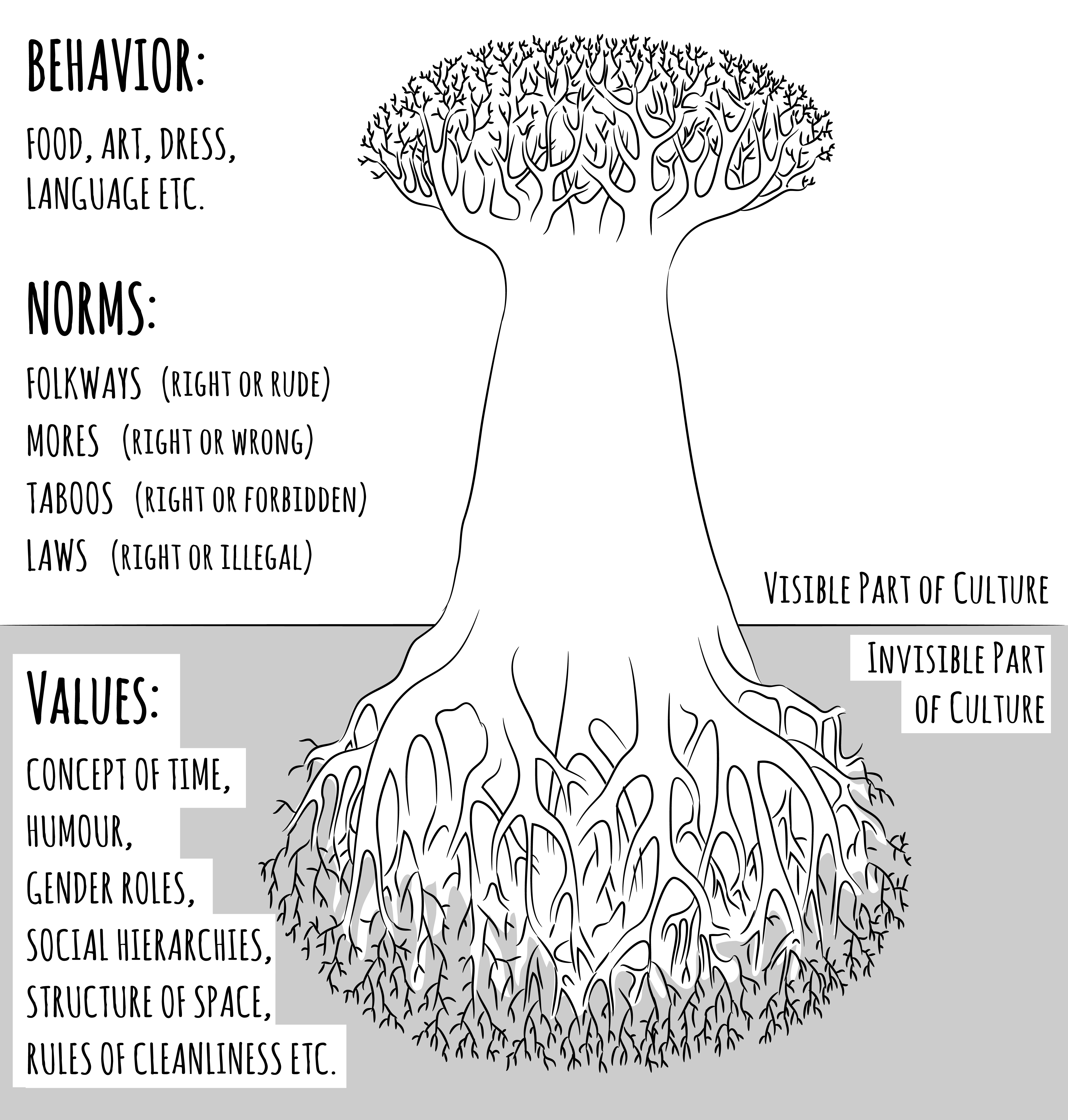
The Roots of the Baobab: The Invisible Part of Culture

The upper baobab – the above-ground part of culture – is what cultural books and guides often cover.

Pick up any book on the business culture of any single European nation, and you’ll find greatly detailed lists of behaviors, dress, etc. – you know, the visible parts of culture we talked about last week.

But the baobab’s canopy is only part of the magnificent tree of life. Buried below the African soil, the roots branch out into an enormous structure that you cannot see; one that is even more important to cross-cultural integration.

Invisible to the Naked Eye

Just as the roots of the baobab are hidden extensions of the tree of life, the roots of a culture are often hidden too.

But it’s worth digging up the soil to examine these roots in order to understand why certain cultural behaviors exist and how they developed.

If you’re working in a cross-cultural environment and/or immigrating to a foreign land, it’s pretty clear why this understanding is important. It’s only when you understand a culture’s underlying values that you will be able to accept and adapt enough to integrate into the culture.

baobab

The Swiss

For instance, the Swiss are punctual. This is demonstrated in their behavior. This “always on time” mentality is the above-ground baobab – the visible part of culture.

What are the roots – the invisible part?

The Swiss’ values are. The culture’s concept of time is the invisible part. Time is valued in Switzerland, and that valuation is made manifest in the general behaviors of society.

The American

Another example: Americans are self-promoting. They are not often modest about their success, and some often display it or announce it, so that others know just how successful they are.

“Part of the beauty of me is that I am very rich.” – Donald Trump, March 2011, in an interview with Good Morning America

Self-promotion is one branch of their above-ground baobab, the visible part of their culture.

And the invisible part?

Individuality is deeply ingrained in American values. It extends in the roots beneath the earth which grow into the branch of self-promotion. Being able to “stand out” in some way – be it with wealth, accomplishment, or success of any kind – is an integral part of American culture.

The Roots Grow

In any cultural baobab, the wispy branches (folkways), the sturdier branches (mores), and the trunk (taboos, laws) all grow from these well-watered roots of a culture’s values.

Values create a culture’s behaviors, norms, and traditions in a way that is not always obvious. But if you look closely enough at a culture, you can better understand how its norms and values are tied. Arriving at this understanding will greatly aid you in cross-cultural integration.