Navigating Negotiation: Understanding Cultural Differences in Negotiation Styles

Negotiation is a fundamental aspect of human interaction, influencing everything from business deals to interpersonal relationships. 

However, the approach to negotiation can vary significantly across cultures, shaped by unique communication norms, conflict resolution approaches, and decision-making processes

Understanding these cultural differences is essential for navigating successful negotiations in diverse contexts.

Communication Norms

One of the key determinants of negotiation style is communication norms. 

In some cultures, such as those with high-context communication styles like Japan or China, much of the meaning is conveyed through nonverbal cues, implicit messages, and contextual factors. 

As a result, negotiations in these cultures may involve reading between the lines and paying close attention to subtle signals.

Conversely, in cultures with low-context communication styles like the United States or Germany, communication tends to be more direct and explicit. 

Negotiators in these cultures may prioritize clarity and transparency, favoring straightforward language and clear terms.

Conflict Resolution Approaches

Cultural differences also influence approaches to conflict resolution within negotiations. 

In some cultures, such as those with a preference for harmony and avoidance of confrontation, negotiators may prioritize preserving relationships and avoiding direct conflict. 

This can manifest in a tendency to downplay disagreements or seek compromise solutions that maintain goodwill.

In contrast, cultures that value assertiveness and directness may approach conflict resolution more confrontationally. 

Negotiators in these cultures may be more inclined to express their needs and preferences openly, engaging in vigorous debate and advocacy to achieve their objectives.

Decision-Making Processes

Another dimension of cultural difference in negotiation styles lies in decision-making processes

In some cultures, decisions are made collectively, with input sought from various stakeholders and consensus sought before proceeding. 

This collaborative approach may require more time and patience but can lead to greater buy-in and commitment from all parties involved.

In other cultures, decision-making may be more hierarchical, with authority and decision-making power concentrated in the hands of a select few. 

Negotiations in these cultures may involve deference to authority figures and a focus on top-down directives rather than consensus-building.

Culture Shapes Style

Cultural differences play a significant role in shaping negotiation styles and approaches. 

By recognizing and understanding these differences, negotiators can adapt their strategies and behaviors to effectively engage with counterparts from diverse cultural backgrounds.

Successful negotiation in a globalized world requires more than just mastery of negotiation tactics; it requires cultural competence and sensitivity to navigate the nuances of communication, conflict resolution, and decision-making across cultures. 

By embracing cultural diversity and fostering cross-cultural understanding, negotiators can build stronger relationships, achieve better outcomes, and bridge divides in an increasingly interconnected world.


Assertive vs. Avoidance Tactics: How Does Culture Determine Approach to Conflict Resolution?

How do you approach conflict resolution?

Are you tactically assertive or avoidant?

And is your approach determined by personality or culture?

Over the coming weeks, I’ll discuss scientific studies dealing with the six cultural constructs, the first of which is individualism versus collectivism.

This paper by cognitive and cross-cultural psychologist, C. Dominik Guess, takes a look at conflict resolution in individualist and collectivist cultures.

Japan Collectivism vs. US Individualism

One of the studies in Guess’ paper explores how cultural background shapes the way conflict is handled – specifically, American individualism versus Japanese collectivism.

A group of researchers, led by Ohbuchi, Fukushima, and Tedeschi, gathered American and Japanese students and unleashed the power of conflict recall. 

They asked participants to dig deep into their memories and recall a conflict they had experienced.

These participants were then asked to share their conflict experience – what they did, what they wanted to achieve, etc. 

Using rating scales, they were asked to measure various aspects of the conflict, like goals and tactics. 

In the battlefield of conflict, four major tactics emerged, each with its own arsenal of sub-tactics: conciliation, assertion, third-party intervention, and avoidance.

The Four Tactics

Let’s better understand the four tactics identified.

Conciliation this tactic involves finding common ground. It’s a way to indirectly communicate expectations and build bridges. 

Assertion this tactic is a bold and assertive move, where you fiercely demand what you want.

Third-party intervention this tactic involves calling in reinforcements in the form of seeking help or advice from an outsider. 

Avoidance this tactic is the ultimate passivity, dodging confrontation like a pro.

Considering these differing approaches to conflict resolution, you can imagine the cultural clash that may result.

The Results: Assertive vs. Avoidant

As you may have guessed, the American students, with their individualistic spirit, generally used assertive tactics in their conflicts. 

On the flip side, the Japanese students, being the collectivist champions they are, took a more subtle approach overall. 

They opted for avoidance tactics, sidestepping confrontation and prioritizing harmony in their relationships.

This may be because each group’s main goal in these conflicts also differed.

The Japanese participants prioritized their relationships, while the American participants’ goal was more often geared toward achieving a sense of justice.

While the results confirm what most would have hypothesized, considering what we already know about individualist and collectivist cultures, the research could be adapted so that the type of conflict being discussed is more uniform. 

An individual’s approach (the tactics and goals) may vary based on the conflict.

As the students were allowed to choose whichever conflict they wanted to assess, their responses may have differed based upon the type they chose.

Regardless, this study may tell us something key about how individualists and collectivists approach conflict: individualists with justice in mind, and collectivists with harmony.

Using Stereotypes Wisely: German Planning vs. Russian Improvisation

Meet Ralf.

Ralf is a German manager and the head of business development. His company is expanding into Russia.

Vlad, the Russian project manager, calls him one morning from St. Petersburg, where he’s aiding the opening of the new office.

“Planning is underway,” Vlad confirms. “Everything will be completed by the deadline.”

Ralf asks some follow-up questions, pressing for further details to ensure things are, indeed, on track, but he finds that despite Vlad’s initial assurances, his responses are vague.

“At this point, only the rough planning is done,” Vlad admits, adding, “but everything is under control.”

Needless to say, after this phone call, Ralf does not feel confident that his ducks are in a row, while Vlad feels he was being interrogated.

Stereotype: Russians Don’t Like to Plan

When Ralf shares his concerns with his boss, he says: “Don’t worry, the office will be finished according to schedule. Russians aren’t good at planning. They say that if you plan too much, you can’t demonstrate your improvisational skills.”

Although Ralf’s boss employed a stereotype to placate his worries, there is truth in this stereotype.

According to scientific studies, Russians generally do not prioritize detailed planning as much as Germans or Austrians. They’d prefer to resolve issues as they occur instead of predicting and investing time in future issues.

Ralf’s boss responded with a stereotype, but his response alleviated Ralf’s stress and may have diffused misunderstanding and potential conflict in the company’s cross-cultural business relations.

One reason this stereotype could be considered wise is that it was explanatory; it allowed Ralf to better understand the rationale behind his Russian counterpart’s behaviors.

Stereotype: Germans Like Detailed Planning

Back in St. Petersburg, Vlad sensed Ralf’s lack of confidence in his management of the project. Being a bit annoyed, he, too, mentioned the exchange to his boss.

Vlad’s boss tells him: “Germans like to plan. Their plans are concrete and detailed, down to the letter. They anticipate potential issues and their variable responses to these issues in order to use time efficiently and reduce risk.”

This is another stereotype. It’s generally true that Germans view time as a resource that shouldn’t be wasted, hence they invest in detailed planning.

This, too, is backed by data making it, more or less, the norm.

This is one way in which stereotypes can aid mutual understanding, allay worries and unnecessary stress, and prevent cross-cultural conflict.

Stereotypes Exaggerate the Norm

Despite the sometimes-usefulness of stereotypes, it’s important to note that stereotypes aren’t all-encompassing and tend to exaggerate norms.

Not every German is a planner and not every Russian likes to improvise.

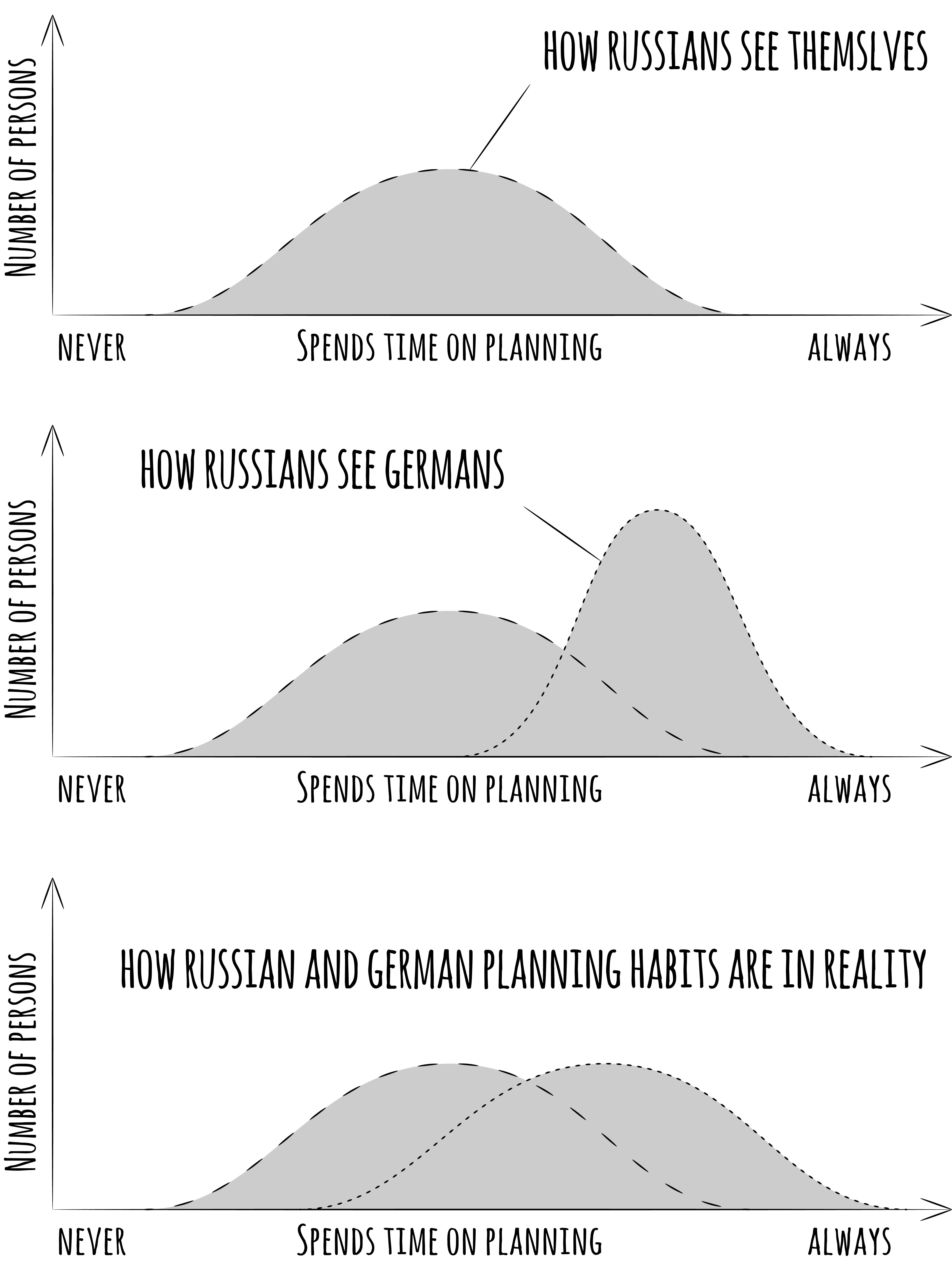
To illustrate this exaggeration, consider these graphs.

monkey_charts_CMYK-16

The top graph shows how Russians view their own penchant for planning. They acknowledge that improvisation is valued as much as planning, leaving the curve centered.

The next graph shows the Russian perspective on the German penchant for planning. Russians view Germans as planning fanatics, leading to most Germans falling under this stereotypical umbrella right of center.

In the end, the reality is more like the last chart. Germans are, on average, slightly more adept at planning than Russians, and the German company culture often produces and favors managers who work accordingly. However, this stereotype doesn’t apply so severely to all Germans, though the Russian perspective exaggerates that view.

Point being, take stereotypes with a grain of salt.

Their primary use in business management should be to provide generic odds and a general understanding of the values a culture prioritizes.

But don’t let stereotypes color your opinion about another individual in an ugly way, especially if their actions show you the opposite.

As Maya Angelou wisely wrote,

“When someone shows you who they are, believe them.”

Locus of Control: How Region & Gender Influence Your Sense of Control

The degree to which a person believes in destiny is largely formed by their culture.

It can also be influenced by location, gender, ethnicity, and many other factors that impact a person’s primary socialization and conditioning.

Last week, we discussed the role culture plays in the locus of control.

This week, we’ll continue that discussion, fleshing out the roles location and gender have in a person’s sense of control over his/her own life.

Location, Location, Location

In John H. Sims and Duane D. Baumann’s study, “The Tornado Threat: Coping Styles of the North and South,” a survey was taken across two U.S. states: the state of Illinois and the state of Alabama.

The objective of the survey was to identify why these two states reacted differently in preparing for natural disasters, specifically tornadoes.

Alabama often has an alarmingly higher number of fatalities (23 in 2019, for example) than Illinois (0 in 2019).

One factor that may be contributing to that difference in coping with tornadoes is the locus of control.

After surveying four counties, a majority of Alabama residents demonstrated an external locus, while a majority of Illinois residents demonstrated an internal locus.

Considering the locus of control dictates to what degree a person/group feels they have control over their own fate, the line of logic suggests that preparation for natural disasters would differ across these two states according to the group’s collective locus.

More precautions would be taken by Illinois residents whose internal locus of control would make them proactive in reacting to tornado warnings, as they believe they have control over the outcome, while residents of Alabama, with their external locus of control, are more prone to leaving fate up to the whims of nature.

The conclusion, then, is that a region’s collective locus of control can influence the number of fatalities caused by natural disasters – and likely influence many other things related to our sense of control or lack thereof.

Gender

Gender also comes into play in regards to one’s locus of control.

One example of this can be found in M. A. Hamedoglu’s “The Effect of Locus of Control and Culture on Leader Preferences.”

In testing undergraduate students from Western and Eastern cultures, this study found that men are more often of an external locus of control, giving preference to autocratic leadership styles, while women are geared more toward an internal locus of control, preferring democratic leadership styles.

This collective locus regarding gender can impact everything from leadership preference to conflict resolution to one’s sense of accountability.

Next week, we’ll talk about how individuals across cultures try to control their fate, whether their locus of control is external or internal.