East Meets West: Lessons from Geely’s Acquisition of Volvo

With so many cross-cultural minefields, international business negotiations often flounder.

But that wasn’t the case with the 2010 acquisition of Volvo by China’s Zhejiang Geely Holding Group Co.

This case study stands out as a masterclass in cross-cultural negotiation

The landmark deal not only marked a significant milestone in the automotive industry but also showcased the cultural intelligence (CQ) necessary for successful global business transactions.

Here’s where it all began…

Geely Meet Volvo

In 2010, Geely, a relatively unknown Chinese automaker, acquired Volvo Cars from Ford Motor Company for $1.8 billion

This acquisition was a bold move by Geely, aiming to elevate its status on the global stage. 

For Volvo, a prestigious Swedish brand known for safety, quality, and environmental sustainability, the acquisition posed both opportunities and challenges.

Cultural Dynamics

Chinese business culture often emphasizes hierarchical relationships, indirect communication, and long-term relationships. 

Geely, a young and ambitious company, sought to expand its global footprint and saw Volvo as a perfect partner.

Swedish business culture values flat organizational structures, direct communication, and consensus-driven decision-making. 

Volvo, with its strong heritage, was concerned about preserving its core values and operational independence.

Negotiation Approach

Geely’s Strategy 

Geely approached the negotiation with a deep understanding of cultural differences

They respected Volvo’s heritage, assuring that Volvo would retain its brand identity, operational independence, and continue production in Sweden. 

This strategy was crucial in gaining trust and reducing resistance from Volvo’s management and employees.

Volvo’s Concerns

Volvo’s team was apprehensive about potential changes in corporate culture, job security, and maintaining high-quality standards. 

Geely addressed these concerns by committing to uphold Volvo’s core values and investing in innovation and technology.

Challenges and Strategies

Trust Building 

Geely invested significantly in building trust with Volvo’s management and workforce. 

They engaged in extensive dialogues to understand Volvo’s concerns and communicate their intentions transparently. 

Geely’s chairman, Li Shufu, emphasized Volvo’s autonomy and promised to invest in enhancing its competitiveness.

Integration and Adaptation

Post-acquisition, integrating different management styles and corporate cultures was challenging. 

Geely allowed Volvo to maintain its Swedish management team and decision-making processes, ensuring a smooth integration. 

They established a collaborative framework for sharing technology and expertise while respecting cultural differences.

Outcomes

Positive Synergy

The acquisition resulted in positive synergy between Geely and Volvo. 

Volvo leveraged Geely’s financial strength to expand its product line and enter new markets, especially in China. 

Geely benefited from Volvo’s advanced technology and strong brand reputation.

Cultural Respect

The success of this cross-cultural negotiation was largely due to Geely’s respect for Volvo’s corporate culture and commitment to maintaining its brand values. 

This respect helped overcome cultural barriers and fostered a cooperative relationship.

The Geely-Volvo case study underscores the importance of cultural intelligence in cross-cultural negotiations.

It demonstrates that cultural diversity can be leveraged to create mutually beneficial outcomes and foster long-term success in international business.


Using Stereotypes Wisely: German Planning vs. Russian Improvisation

Meet Ralf.

Ralf is a German manager and the head of business development. His company is expanding into Russia.

Vlad, the Russian project manager, calls him one morning from St. Petersburg, where he’s aiding the opening of the new office.

“Planning is underway,” Vlad confirms. “Everything will be completed by the deadline.”

Ralf asks some follow-up questions, pressing for further details to ensure things are, indeed, on track, but he finds that despite Vlad’s initial assurances, his responses are vague.

“At this point, only the rough planning is done,” Vlad admits, adding, “but everything is under control.”

Needless to say, after this phone call, Ralf does not feel confident that his ducks are in a row, while Vlad feels he was being interrogated.

Stereotype: Russians Don’t Like to Plan

When Ralf shares his concerns with his boss, he says: “Don’t worry, the office will be finished according to schedule. Russians aren’t good at planning. They say that if you plan too much, you can’t demonstrate your improvisational skills.”

Although Ralf’s boss employed a stereotype to placate his worries, there is truth in this stereotype.

According to scientific studies, Russians generally do not prioritize detailed planning as much as Germans or Austrians. They’d prefer to resolve issues as they occur instead of predicting and investing time in future issues.

Ralf’s boss responded with a stereotype, but his response alleviated Ralf’s stress and may have diffused misunderstanding and potential conflict in the company’s cross-cultural business relations.

One reason this stereotype could be considered wise is that it was explanatory; it allowed Ralf to better understand the rationale behind his Russian counterpart’s behaviors.

Stereotype: Germans Like Detailed Planning

Back in St. Petersburg, Vlad sensed Ralf’s lack of confidence in his management of the project. Being a bit annoyed, he, too, mentioned the exchange to his boss.

Vlad’s boss tells him: “Germans like to plan. Their plans are concrete and detailed, down to the letter. They anticipate potential issues and their variable responses to these issues in order to use time efficiently and reduce risk.”

This is another stereotype. It’s generally true that Germans view time as a resource that shouldn’t be wasted, hence they invest in detailed planning.

This, too, is backed by data making it, more or less, the norm.

This is one way in which stereotypes can aid mutual understanding, allay worries and unnecessary stress, and prevent cross-cultural conflict.

Stereotypes Exaggerate the Norm

Despite the sometimes-usefulness of stereotypes, it’s important to note that stereotypes aren’t all-encompassing and tend to exaggerate norms.

Not every German is a planner and not every Russian likes to improvise.

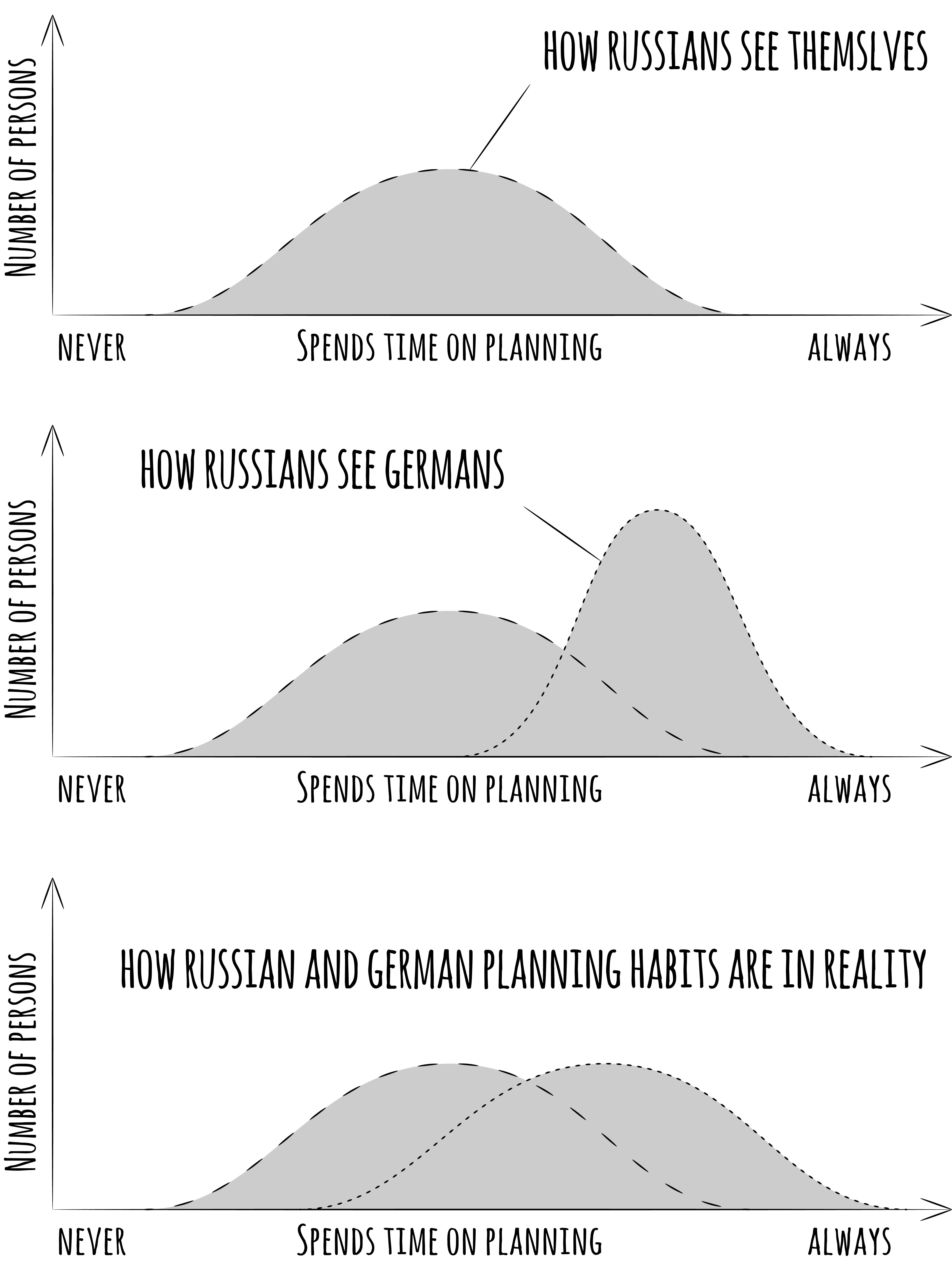
To illustrate this exaggeration, consider these graphs.

monkey_charts_CMYK-16

The top graph shows how Russians view their own penchant for planning. They acknowledge that improvisation is valued as much as planning, leaving the curve centered.

The next graph shows the Russian perspective on the German penchant for planning. Russians view Germans as planning fanatics, leading to most Germans falling under this stereotypical umbrella right of center.

In the end, the reality is more like the last chart. Germans are, on average, slightly more adept at planning than Russians, and the German company culture often produces and favors managers who work accordingly. However, this stereotype doesn’t apply so severely to all Germans, though the Russian perspective exaggerates that view.

Point being, take stereotypes with a grain of salt.

Their primary use in business management should be to provide generic odds and a general understanding of the values a culture prioritizes.

But don’t let stereotypes color your opinion about another individual in an ugly way, especially if their actions show you the opposite.

As Maya Angelou wisely wrote,

“When someone shows you who they are, believe them.”

Ethnocentrism and the Workplace: How Our Biases Enter Into Business Relations

We’ve talked about ethnocentrism the past couple weeks and the ways in which it might crop up in cross-cultural research.

But ethnocentrism isn’t just a vague concept that infiltrates research; it often shows up in your average everyday workplace.

Let’s take a look at how and why.

Ethnocentrism in Business Communication

International business ventures require that individuals communicate cross-culturally.

This can either turn into a promising business partnership and even a delightful way to share cultures or into a complete devolution of business relations.

Let’s take a look at one example:

Ted (from the U.S.) sets up a video conference with Saanvi (from India).

“Let’s talk tomorrow at 8 AM, sharp,” he writes.

The next day, Ted logs into the video conference room at 7:45. 8 AM rolls around, and there’s no sign of Saanvi. Ted shoots Saanvi a quick message to let him know he’s there. By 8:10, Saanvi still hasn’t shown up. Ted is growing impatient. At 8:30, Ted sends Saanvi a curt message about rescheduling and then signs off.

Saanvi later responds to Ted, indicating that he did eventually show up to the online conference room. He video calls Ted, and when Ted asks if Saanvi can talk the next day at the same time, Saanvi nods.

The following day, the same thing happens. Ted is livid. Saanvi had confirmed with his nod, after all.

There are a few things going on cross-culturally here, and both Ted and Saanvi would do better to understanding these cross-cultural issues.

Punctuality & Visual Cues

Ted and Saanvi come from two different backgrounds, two different traditions. They possess different values and likely have different approaches to business and methods of communication.

They likely process things from their own cultural conditioning.

This, in and of itself, is not a bad thing. With basic cross-cultural understanding, one might be able to acknowledge and accept this gap. And with an even more specific mastery of the cross-cultural differences between your culture and the other, one might be able to bridge that gap effectively.

With nothing but ethnocentrism, the gap widens and business relations potentially implode.

Why?

Because when the individuals involved do not have a basic understanding of cross-cultural issues, they don’t know that the differences in communication aren’t intentional rudeness or unprofessionalism; they may simply be cultural differences.

For instance, whereas in America, time is money, punctuality is generally taken lightly in India. Even VIPs may show up late to business meetings.

Moreover, when Indians nod their heads, the movement doesn’t necessarily mean ‘yes.’ Rather, the nod can be employed simply to show they’re being attentive to what you’re saying.

Instead of understanding the other culture, both Ted and Saanvi refused to acknowledge and adapt at all to their counterparts and instead forced their own ethnocentric business standards upon the other.

In this case, they both look like monkeys in each other’s eyes.

Without understanding and compromising to some degree, ethnocentrism can become a toxic trait, creating chasms in business relations and in cross-cultural workplaces where there should be bridges.