
Cultural Norms: What are They? And How Do They Relate to Values?

Conformity.

Last week, we talked about conforming to cultural norms. But what types of norms are we conforming to? And why and how are we conforming?

Well, to understand norms, first we must talk about values.

Values are what define a culture’s goals and ideals, and cultural norms are, in a way, these values, personified.

Values & Norms

Study.com defines norms relative to culture, thusly: “The term ‘culture’ refers to attitudes and patterns of behavior in a given group. ‘Norm’ refers to attitudes and behaviors that are considered normal, typical or average within that group.”

So, norms are more closely related to our behaviors, while values are more closely related to our attitudes, ideals, and beliefs. Both our values and norms are ingrained in us and in our society through its existing systems, such as family, the education system, and government.

The government and other higher institutions define a nation’s values, while the norms and values are implemented and taught by families and schools. Some degree of conformity in these two areas is expected in every culture. The degree of conformity is often based on survival vs. self-expression values, but conformity always defines cultural norms.

And we are often completely oblivious to the influences of both values and norms in the way we live our lives.

Different Norm Types

There are four different types of norms, which we will detail over the coming weeks.

These are:
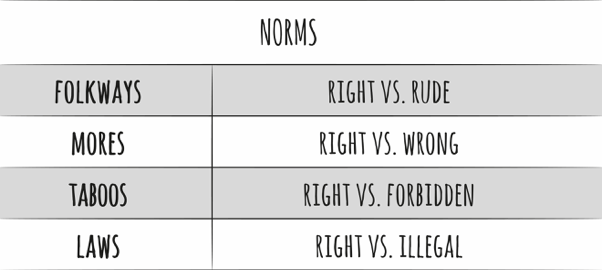
norms

The majority culture in any nation invokes these expectations and rules, which are primarily based on their values. Behavior – such as habits, customs, traditions, and rule of law – is guided by the most prominent culture; they create the yardstick of what is considered “right” and “wrong” on the whole.

Swimming With/Against the Current

Do you follow your own culture’s norms? Do you swim with the school of fish? Or do you make a point of standing out from the crowd?

Whether you swim with or against the current, you’re making choices in defiance of your society’s values and norms, or you’re making choices in favor of them. Either way, your individuality is defined by the cultural norms of your society.

Remember, if you want to “fit in” to a foreign culture, you can look at norms as a sort of etiquette guidebook for the culture in which you choose to integrate.


Cultural Norms: Do You Conform?

Do you shake hands upon greeting? If so, do you use the right or the left? Is there a reason for this?

Do you smile a lot? Is it normal to smile at strangers in your culture? Is politeness valued?

Whether you answered ‘yes’ or ‘no’ to any of these questions, the answers are relative to the norms that exist in your culture.

Are we all susceptible to cultural norms, and are you conforming to them right now?

Conformity

Conformity is expected in most cultures, but the degree of conformity is often based on the strength of a culture’s survival values vs. its self-expression values.

However, even in cultures where self-expression values are strong, individuals feel pressure to conform to some degree.

Does everyone, then, conform to norms?

It’s almost impossible not to. In the end, the degree to which one does depends on if an individual wants to ‘fit in’ or not.

Solomon Asch Study

In 1951, Solomon Asch experimented with societal pressure and its relation to conformity. Asch gave 50 male students from Swarthmore College a ‘vision test,’ in which one oblivious tester was placed amongst seven trained testers who had prepared their responses beforehand.

The students were given three lines (A, B, and C) to compare, and they had to choose which was the ‘target line.’ The answer was always obvious. Each of the trained participants would state their answer aloud, with the real participant answering last.

Of the 18 trials, the prepared group gave 12 wrong answers. What Asch found was that nearly a third of real participants conformed to the majority view, despite the fact that the majority was quite obviously wrong, with around three-fourths conforming at least once.

Only a quarter of the real participants didn’t conform at all to the wrong answers. In the control group (a group with all real participants), less than 1% answered incorrectly.

Why Conform?

In their post-experiment interviews, real participants admitted that they didn’t agree with the answers of the crowd.

But they conformed to them anyway.

So, why are we so inclined to conform with something we think is wrong?

The participants expressed a fear of being thought peculiar or of being teased by their peers. Some also said that, due to the majority view, they considered that perhaps they were mistaken in their answer. The probability that an entire group answered incorrectly seemed less likely than that they were wrong.

These results show that people conform because:

  • They want to fit in
  • They believe a group must be better informed than an individual

These are called normative and informational influences, respectively. And, in essence, they are what enforce a society’s values and norms.

Next week, we’ll talk about different types of cultural norms and what this conformity looks like. Stay tuned.

How Cultural Values Inform Communication

You are an individualist. Your goal in life is to succeed on your own. To seek out your fortune, using your own talents, your own mind. Individual achievement is paramount to your self-actualization and identity. You believe you have your own voice. You use it. You speak out, directly and without hesitation.

You are a collectivist. Your goal in life is to succeed as a group. To seek out the fair share for all, utilizing everyone’s talents, with a group mindset. Collective achievement is paramount to the group’s well-being. You believe in group think. You speak when expected to, indirectly and with caution.

There are outliers in any culture but, in general, these are the differences between Eastern and Western communication. And it all comes back to the values that inform our behaviors.

What Drives Western Cultures?

“If freedom of speech is taken away, then dumb and silent we may be led, like sheep to the slaughter.” – George Washington

Capitalism and freedom are often the driving factors behind Western cultures. Democracy, free speech, individualism – these values inform the West’s cultural behaviors.

Western communication is direct, clear, and concrete. There’s nothing ambiguous about it; no beating around the bush or mincing of words. The meaning of speech isn’t often lost in a sea of vague undertones or unspoken “understandings.” Nothing is implied or inferred when it comes to business communication. Both parties are taken at their word.

To put it simply, the cards are on the table.

What Drives Eastern Cultures?

“If what one has to say is not better than silence, then one should keep silent.” – Confucius

Collectivism (and in some cases, communism) and harmony are often the driving factors behind Eastern cultures. These values inform the East’s cultural behaviors.

There’s a don’t-rock-the-boat mentality in some Eastern cultures. So, when it comes to communication, they find the straight-shooting of Western cultures ill-mannered.

Nonverbal and indirect communication is favored by many Eastern societies. This is because the group’s entire harmony, as opposed to individualism, is valued.

But this harmony may only play out in words, not necessarily in actions.

For instance, in Chinese culture, a colleague may tell you he’ll have his work in by a certain deadline, but then fail to do so. He may not even have intended to meet this deadline when he claimed he would.

While this might seem to Westerners a form of deceit, it’s more often done to maintain a surface level of harmony than to lie. Others in the culture would understand that their colleagues’ actions wouldn’t necessarily align with their words. This is accepted.

The fact is, the culture knows itself. A direct “no, I can’t get you that by deadline” upsets the balance – an unharmonious response that would make one “lose face.” And so, whether the colleague will keep his word isn’t the issue; the surface harmony is. Therefore, inconsistency is anticipated and accepted by all, so that the relationship may be preserved.

East vs. West Communication

If communication was a body of water, then the Eastern sea would be a glassy surface with plenty of disturbances below, whereas thousands, millions of raindrops would make their mark on the surface of the Western sea, with some waves, and even maybe a hurricane or two.

Either way, when the two seas meet, both sides can be frustrated with the differences in communication styles. Some may even “lose face,” which we’ll talk about next week.

Values: What Are They & How Do They Shape Culture?

You often hear various groups and cultures talk about their “values.”

But what are values, really?

Are they only ideals? How are they put into practice?

Values are practiced ideals; they’re principles or standards to live by. In a culture, they distinguish between what is important or unimportant. What is worth fighting for and what is not. What is good and what is evil and, correspondingly, who is good and who is evil.

Values are a culture’s unwritten rule of law. In fact, sometimes, a culture’s values influence the nation’s written laws.

Swiss Values

Let’s take a look at Swiss values, for example.

According to ediplomat, “The Swiss value cleanliness, honesty, (and) hard work…They value sobriety, thrift, tolerance, punctuality and a sense of responsibility.”

Swiss values also include environmentalism, freedom, orderliness, neutrality, and world peace. We’re also savers and are proud of the material wealth that accompanies economic responsibility.

You can see these values come to life in our culture. In the way we dress, the way we behave, the way we live.

Walk down any street in Geneva, and you’ll notice several things: gorgeous greenery, an absence of litter, Swiss people dressed clean and neat and, yes, plenty of wealth.

You can also see these values in our policies and politics.

The Swiss unadjusted unemployment rate rarely exceeds 4% and dropped to 3% in June of 2017, which is less than the average 4-12% unemployment in other developed countries. This may be partially attributed to our values of hard work and our sense of responsibility.

Being a neutral nation, we’re also not a member state of NATO. We are, however, members of the Partnership for Peace, which cooperates with NATO on crisis-management training and operations, as well as humanitarian missions.

This is how cultural values are made manifest: putting into practice the ideals that are most important to you and your broader culture.

Swiss Values-turned-Laws

You can see Swiss values represented in written law, as well.

Take jaywalking, for example.

In many countries around the world, a slap on the wrist is the most you’ll get for jaywalking. In fact, in most places, you won’t even get that – it’s acceptable to cross the street wherever and whenever you choose.

But, in Switzerland, our values of orderliness, sobriety and our sense of responsibility come into play yet again. Jaywalkers are disturbing the order of things and aren’t taking the risk of potential pedestrian fatality seriously. Therefore, jaywalkers are fined on the spot by police if caught in the act.

This is just one of many written laws and unwritten norms that exemplify our values in Switzerland. Next week, we’ll talk about the difference between individualist and collectivist cultures and where their values diverge.