
Big Issues with Small Talk Across Cultures: Germany vs. Japan Watercooler Rules

Image credit: John Brooks

Sarah, a marketing executive from Berlin, is attending a business conference in Tokyo. 

As she enters the crowded conference hall, she spots Hiroshi, a senior executive from a leading Japanese corporation, standing alone by the refreshment table. 

Eager to make a good impression, Sarah approaches Hiroshi with a warm smile and a casual greeting.

“Guten Tag, Hiroshi! Wie geht es Ihnen?” Sarah asks (“Hello, Hiroshi! How are you doing?”), extending her hand for a shake.

Hiroshi, taken aback by Sarah’s directness and informal demeanor, hesitates before responding with a polite nod. 

“Es geht mir gut, danke,” he replies (“I’m fine, thanks”), his tone reserved and formal.

Sarah is completely bewildered by his demeanor. But unbeknownst to her, her attempt at small talk has inadvertently breached cultural norms

In Japanese business culture, casual inquiries about personal well-being are uncommon, especially when first meeting someone in a professional setting. 

Instead, initial interactions typically focus on exchanging business cards and discussing neutral topics related to the conference agenda.

As Sarah and Hiroshi navigate this cultural disconnect, they highlight the topic of a German study centered around chatbots. 

Chatbot Study

Researchers sought to explore how cultural differences influence small talk by using chatbots programmed to engage in culture-specific casual dialogue. 

They focused on comparing the small talk practices of Japanese and German participants, two cultures known for their distinct communication styles.

To conduct the study, researchers set up simulated conversations between pairs of German and Japanese individuals using these chatbots. 

They carefully observed and analyzed the interactions between the participants to identify cultural differences in small talk behavior

Based on their observations, they programmed the chatbots to reflect these cultural nuances in their dialogue.

After programming the virtual agents, the researchers asked German participants to observe pairs of German and Japanese virtual agents engaging in small talk and rate which conversations they found more appropriate or interesting. 

This allowed the researchers to gauge the participants’ perceptions of small talk behaviors across cultures.

The Results

The results of the study revealed several interesting findings. 

German observers tended to interpret the Japanese participants’ small talk style, which focused on commenting on the immediate environment and avoiding personal discussions, as “distant” and “superficial.” 

In contrast, they perceived the more familiar German tendency to discuss personal topics as indicative of greater interest in their conversation partner.

Additionally, the study highlighted cultural variations in the perceived value of small talk. 

While some cultures, like the Germans, may place importance on engaging in personal discussions as a way to express interest and build rapport, others, such as the Japanese, may prioritize maintaining a polite and respectful distance, particularly in initial interactions.

Overall, the study demonstrated how cultural misunderstandings and assumptions can arise in seemingly innocuous social situations like small talk. 

By using chatbots to simulate cross-cultural interactions, the researchers were able to shed light on the stark differences in communication styles and the importance of cultural sensitivity in social interactions.

Using Stereotypes Wisely: German Planning vs. Russian Improvisation

Meet Ralf.

Ralf is a German manager and the head of business development. His company is expanding into Russia.

Vlad, the Russian project manager, calls him one morning from St. Petersburg, where he’s aiding the opening of the new office.

“Planning is underway,” Vlad confirms. “Everything will be completed by the deadline.”

Ralf asks some follow-up questions, pressing for further details to ensure things are, indeed, on track, but he finds that despite Vlad’s initial assurances, his responses are vague.

“At this point, only the rough planning is done,” Vlad admits, adding, “but everything is under control.”

Needless to say, after this phone call, Ralf does not feel confident that his ducks are in a row, while Vlad feels he was being interrogated.

Stereotype: Russians Don’t Like to Plan

When Ralf shares his concerns with his boss, he says: “Don’t worry, the office will be finished according to schedule. Russians aren’t good at planning. They say that if you plan too much, you can’t demonstrate your improvisational skills.”

Although Ralf’s boss employed a stereotype to placate his worries, there is truth in this stereotype.

According to scientific studies, Russians generally do not prioritize detailed planning as much as Germans or Austrians. They’d prefer to resolve issues as they occur instead of predicting and investing time in future issues.

Ralf’s boss responded with a stereotype, but his response alleviated Ralf’s stress and may have diffused misunderstanding and potential conflict in the company’s cross-cultural business relations.

One reason this stereotype could be considered wise is that it was explanatory; it allowed Ralf to better understand the rationale behind his Russian counterpart’s behaviors.

Stereotype: Germans Like Detailed Planning

Back in St. Petersburg, Vlad sensed Ralf’s lack of confidence in his management of the project. Being a bit annoyed, he, too, mentioned the exchange to his boss.

Vlad’s boss tells him: “Germans like to plan. Their plans are concrete and detailed, down to the letter. They anticipate potential issues and their variable responses to these issues in order to use time efficiently and reduce risk.”

This is another stereotype. It’s generally true that Germans view time as a resource that shouldn’t be wasted, hence they invest in detailed planning.

This, too, is backed by data making it, more or less, the norm.

This is one way in which stereotypes can aid mutual understanding, allay worries and unnecessary stress, and prevent cross-cultural conflict.

Stereotypes Exaggerate the Norm

Despite the sometimes-usefulness of stereotypes, it’s important to note that stereotypes aren’t all-encompassing and tend to exaggerate norms.

Not every German is a planner and not every Russian likes to improvise.

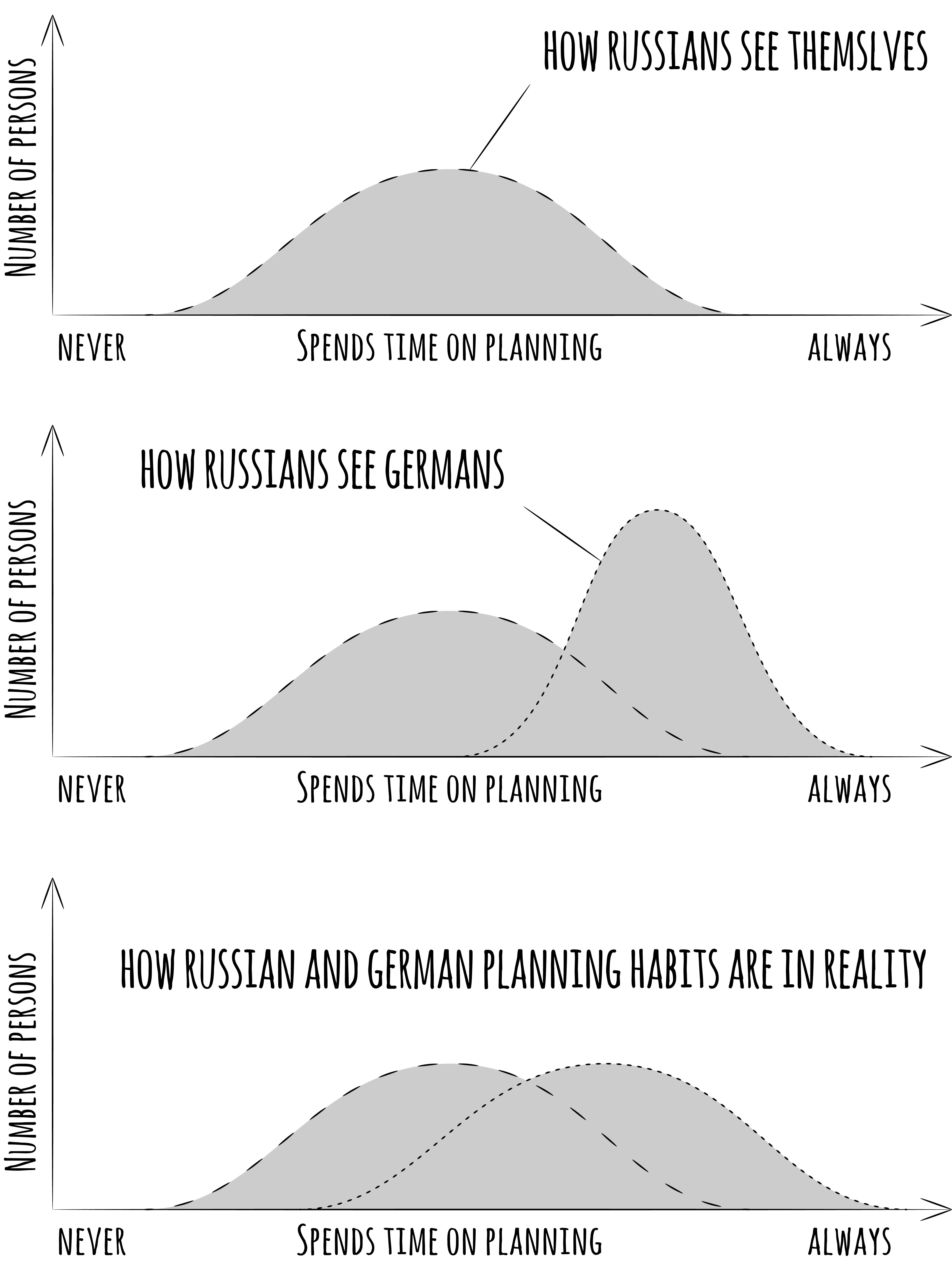
To illustrate this exaggeration, consider these graphs.

monkey_charts_CMYK-16

The top graph shows how Russians view their own penchant for planning. They acknowledge that improvisation is valued as much as planning, leaving the curve centered.

The next graph shows the Russian perspective on the German penchant for planning. Russians view Germans as planning fanatics, leading to most Germans falling under this stereotypical umbrella right of center.

In the end, the reality is more like the last chart. Germans are, on average, slightly more adept at planning than Russians, and the German company culture often produces and favors managers who work accordingly. However, this stereotype doesn’t apply so severely to all Germans, though the Russian perspective exaggerates that view.

Point being, take stereotypes with a grain of salt.

Their primary use in business management should be to provide generic odds and a general understanding of the values a culture prioritizes.

But don’t let stereotypes color your opinion about another individual in an ugly way, especially if their actions show you the opposite.

As Maya Angelou wisely wrote,

“When someone shows you who they are, believe them.”