Sister Cities: Global Diplomacy in the Best of Times and the Worst of Times

Ever driven by a sign that says your city is “sisters” with some far-flung place like Timbuktu and thought to yourself, “Really? How did that happen?” 

Well, in the US, it’s a tale as old as…1956. 

While we covered how Sister Cities were born out of World War II, the US program was launched by President Dwight D. Eisenhower’s “People-to-People” conference in 1956. 

Ike, clearly ahead of his time, envisioned world peace not through big speeches or flashy treaties, but through ordinary people connecting across borders. 

Thus, Sister Cities International (SCI) was created, a nonprofit that has since grown to link over 500 US cities with more than 2,100 global counterparts. 

It’s like an international club but with trade delegations, cultural festivals, and sometimes awkward exchanges of ceremonial plaques.

Sister Cities in the Best of Times

You might be wondering, “What do Sister Cities actually do?

Great question. 

These partnerships aren’t just symbolic – they’re active, and they make a real impact. 

Each Sister City relationship is unique, but here are the four main flavors of collaboration:

1. Arts and Culture

Exchanging cultural expression – such as music, art, or festivals – is a cornerstone of Sister Cities. 

Communities share in each other’s traditions, encouraging appreciation of other cultures.

2. Business and Trade

Economic collaboration between Sister Cities facilitates everything from business exchanges to trade missions. 

The aim is to grow both regions by tapping into each other’s economic strengths and resources.

3. Community Development

Sister cities are all about problem-solving.

They look toward innovative solutions to issues like healthcare and sustainability. 

Providing the other with expertise, resources, or support, Sister Cities find solutions to each other’s problems – just like any sister would.

4. Youth and Education

Youth programs and educational exchanges contribute to the energy of Sister City relationships.

These initiatives give young people the chance to learn about other cultures, develop leadership skills, and build international friendships on the other side of the world.

Sister Cities in the Worst of Times

If 2020 taught us anything, it’s that in the worst of times, people find ways to step up – even across international borders. 

Sister Cities provided aid in crisis. And they played a quiet but impactful role during a year that tested everyone. 

When wildfires ravaged Oregon, firefighters from Guanajuato, Mexico, flew to their Sister City, Ashland, to lend a hand. 

Firefighters from Querétaro did the same for Bakersfield, California. 

And during the height of the coronavirus pandemic, the concept of “mask diplomacy” came to life. 

Hanam City, South Korea, sent masks to Little Rock, Arkansas; Naka, Japan, supported Oak Ridge, Tennessee; and cities in China, like Harbin and Changsha, provided aid to Anchorage, Alaska, and Annapolis, Maryland.

This wasn’t a one-way street. 

Pittsburgh, Pennsylvania, donated masks to Wuhan, China, at the pandemic’s onset, and Phoenix, Arizona, funded a new kindergarten for Chengdu, China, after the devastating 2008 earthquake. 

These actions underscore the unique ability of Sister Cities to foster goodwill and humanitarian support, even when national-level relationships are strained.

The Eisenhower Effect

When Eisenhower pitched this idea, he probably didn’t imagine mayors swapping hats or communities hosting dumpling-making contests…or the pandemic. 

But that’s the beauty of Sister Cities – they’re living proof that diplomacy can be done with a smile.

In a world that sometimes feels more divided than ever, these partnerships remind us that peace doesn’t have to come in the form of grand gestures. 

Sometimes, it’s just about showing up. One city, one connection, one laughably oversized welcome sign at a time.


Culture in Crisis, Part I: How Cultural Values Impact Communal Response to Trigger Events

Fight, flight, or freeze: these are three common human responses when one is under threat.

Each individual will respond to crises in a different way.

But does our culture influence how we, as a community, respond?

Think NYC’s response to 9/11 or Japan’s response to the Fukushima nuclear disaster.

From terrorism to natural disasters to global pandemics, communities and nations often respond in different ways to trigger events, based on their own cultural values.

Let’s take a look at one example.

The Amish

A school shooting occurred in an Amish community on October 2, 2006. Five young girls were killed.

Amish values include forgiveness, living righteously, and hating the sin and not the sinner, and this was reflected in their response to the trigger event. 

As Melinda Rene Miller’s paper, titled “The Human Element: A Study of the Effects of Culture on Crisis Reactions,” notes, revenge is not a part of Amish culture.

In mourning the victims of the tragedy, the community also mourned the shooter and embraced his family

They donated money to the killer’s widow and children and attended his funeral.

Sociologist Donald Kraybill who co-authored a book on the tragedy spoke on the power of Amish forgiveness, saying, 

“Several families, Amish families who had buried their own daughters just the day before were in attendance [at the killer’s burial service], and they hugged the widow and hugged other members of the killer’s family.”

Other cultures might respond to this type of crisis with a need for action, through new laws or regulations; a need for revenge or justice, through an investigation and public trial; and/or a plea for monetary donations for the community to recover.

None of these approaches would have lent themselves to the values of Amish culture.

The response of unity and emphasis on religion and humanity’s purpose on earth correlated with their values.

Behavioral and Attitudinal Reactions

As mentioned in the intro, everyone reacts to crises differently. 

Miller’s 2007 study set out to determine if, and to what degree, cultural values impact group response to trigger events.

The paper’s abstract proposes:

“While each individual person within a given community will react to a potential crisis situation in their individual ways, as a whole, their reactions will never vary too greatly, as their behaviors and attitudes are largely based upon their learned cultural values.”

Next week, we’ll delve into the results of this study, surrounding varied outcomes in communities devastated by Hurricane Katrina.

Adapting to a Culture: The U-Curve Adjustment Theory

Week 1.

You land in your host country. You’re in love.

The energy, the climate, the newness.

It’s all so fresh and bright.

You are thrilled to be here, and you can’t imagine ever NOT being thrilled.

This is the honeymoon period.

Week 2.

You’ve been trying to get your WiFi set up for over a week now.

The service guy hasn’t dropped in yet, even though you’ve called several times.

How are you supposed to work? How are you supposed to talk with your family back home?

You’ve never been more frustrated.

You’re missing home, where things are straightforward and service is immediate.

No waiting around, no wondering what to do. No communicating in broken Spanish.

No confusion.

You’re also feeling lonely, missing your friends and family, and wishing you were back in their comfortable presence.

This is the crisis period.

Week 9.

You’ve been living in your host country for three months.

Your WiFi has long been set up, and you’ve managed to put that crisis in your rearview.

You’ve faced several more in the past few months but, bit by bit, you’re figuring things out.

You’re making friends, eating the local foods, finding great places to go. Some that even remind you of home.

You still fell twinges of homesickness, but you haven’t researched one-way tickets back in weeks.

This is the recovery period.

Week 27.5.

You’ve been in your host country for two years. 

You’re well adjusted, and it almost feels like your second home.

You’ve established yourself, have your group of friends, new routines. You’re learning the language, you know your way around.

You’re adapting.

And you’re beginning to admire this new culture.

Things that used to irritate you about it are becoming easier to manage and even endearing.

This is the adjustment period.

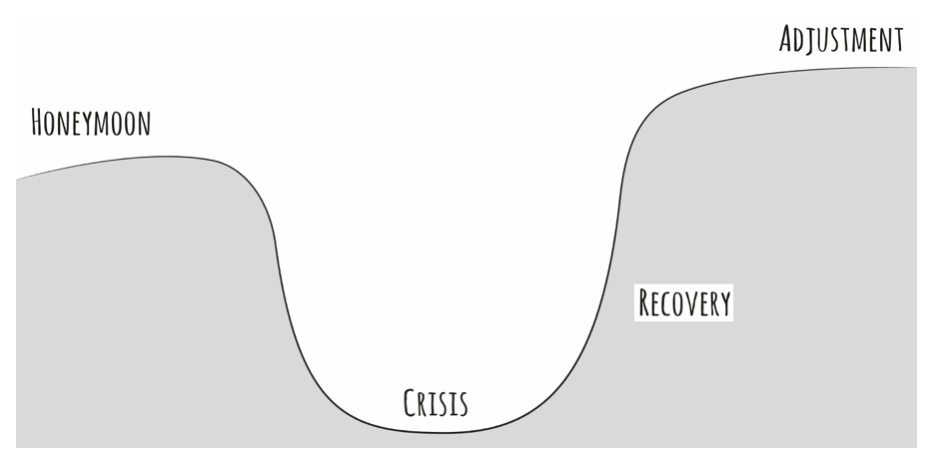
Lysgaard’s U-Curve

Norwegian sociologist Sverre Lysgaard’s U-curve is a widely used model for cultural adapting and adjustment. 

Lvsgaard hypothesized in 1955 that the inverted bell-curve is a common expat experience. 

He writes:

“Adjustment as a process over time seems to follow a U-shaped curve: adjustment is felt to be easy and successful to begin with; then follows a ‘crisis’ in which one feels less well adjusted, somewhat lonely and unhappy; finally one begins to feel better adjusted again, becoming more integrated into the foreign community.”

These highs and lows might sound familiar to expats and international managers alike.

When adjusting to a culture, you’re bound to face days where you’ve had enough and feel that you’re at the end of your rope.

You may even hide inside and refuse to venture out of your safe space to interact with the locals.

Why? Because going outside will provoke you; it will remind you of all the things that are different about your host country: everything takes longer, people drive insane, you’re sick of the food, the language barriers…

You’ll contrast your host country with your “more civilized” home country, where everything seems right and makes sense.

You’ll resent the illogical nature of this new culture and feel angry about it.

Does this sound familiar?

The Consecutive Cycle

Although many do experience the highs and lows of an adjustment period, subsequent studies found that only 10 percent of those surveyed actually cycle consecutively across these four stages.

For the other 90 percent of expats, things are more confusing.

The feelings may ebb and flow. They might not follow in this order – or you may skip out on some stages altogether.

Or perhaps you won’t experience any of this at all.

Some expats have no honeymoon period whatsoever. They are disappointed and unhappy from the very first day they set foot off the plane.

And for some, that feeling may never change.

But keep in mind, research has shown that the first few months of expatriation are the most stressful.

If you can get over the hump, your honeymoon period just might come later.

Next week, we’ll talk about what to do if your U-curve is actually a knot.